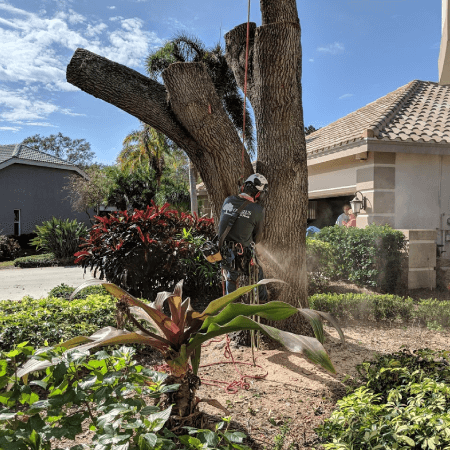
What Happens to the Wood and Debris After Tree Work?
We haul it. On our proposals, debris hauling is its own line, priced by how much of a grapple truck load your job fills. Most of it goes to places that turn it into mulch or firewood. You can keep the firewood. We generally do not leave debris at the curb for the city or county.
Where the Wood Goes
Most of what we haul goes to places that repurpose it for mulch or firewood. Sometimes, if it is a nice piece of wood, we have some woodworkers who want it.
Yard trash from all over the county gets a second use too. Pinellas County grinds tree and shrub trimmings, palm fronds, stumps and clean wood into mulch and gives it to county residents free at 15 locations. Pinellas County Mulch Pickup Program.
Nice Logs Go to Woodworkers
When a log has good wood in it, we would rather see it become something than get ground up. The log in this photo went to a woodworker who plans to make tables and desks from it.
What a Nice Log Can Become
Slabs cut from a good log can turn into pieces like these tables. Not every tree has wood like that, but when one does, it is worth asking.
We Load Whole Brush and Logs, So There Is No Chip Pile
We do not run chippers. We use grapple trucks, which have a hydraulic claw, the grapple, that picks up whole brush and logs and sets them in the truck bed.
That means we do not leave a pile of wood chips behind for mulch. If you want mulch for your beds, the county program above is one free option.
If you spread wood mulch yourself, UF/IFAS, the University of Florida’s extension service, gives a few simple rules in Mulching Herbs, Vegetables and Fruit Trees in the Florida-Friendly Edible Landscape:
- Spread it 2 to 3 inches deep around established plants.
- Do not pile it against the trunk. UF/IFAS calls that volcano mulching and says it can cause rot and insect problems.
- Do not put wood mulch against your house. UF/IFAS says termites usually prefer other wood, but its research found they may be more common in mulched areas.
How Hauling Is Priced
Debris hauling is its own line on our proposals, so you can see what it costs apart from the cutting. We price it by how much of a grapple truck load the job fills, and we estimate it in tenths of a load. A small single tree removal is usually a small part of a load. A full load from a big tree runs $800 or more, and on a removal around $2,800, debris often runs $450 to $1,000 depending on the size of the tree.
Two things tend to move that line. A backyard job usually means every piece has to be carried or routed out through a gate. And keeping some or all of the wood on site lowers it, because less goes on the truck.
Our tree removal cost guide shows how the cutting itself is priced and lists debris as a separate line item. When you compare bids, check whether each one includes hauling. A low number with no debris line may mean the wood is staying with you.
In tight spots like the one in this photo, a small articulated loader carries debris out to where the grapple can reach it.
Why We Do Not Leave It at the Curb
Curbside yard waste pickup is built for what a homeowner trims and bags, not for a tree crew’s load. The rules depend on where you live, so this is what we found for a few of the communities we work in.
- Clearwater. The city says it picks up materials cut and gathered by the property owner only. All debris generated in Clearwater by a contractor, including a tree surgeon, landscaper or arborist, must be removed and disposed of by the contractor, under City Ordinance 6391-99, Sec. 32.282 (1). Clearwater residential collection.
- Dunedin. The city collects bundled piles of up to 4 cubic yards in total, with limbs no longer than 4 feet and logs no more than 4 inches across. Dunedin yard and bulk waste.
- Palm Harbor, East Lake and other unincorporated areas. The county does not collect trash there outside Lealman. Each property owner sets up service with a private hauler, so yard waste rules depend on your hauler. Pinellas County trash and recycling.
A whole tree is far more than any of those limits, and in Clearwater it is not allowed at the curb at all when a contractor cut it. That is why we haul by default.
If you cut a tree down yourself in Clearwater without a city permit, the city says a letter from an arborist is required under Florida Statute 163.045, and Solid Waste may ask to see the permit or the letter before picking up the debris. Our page on tree removal permits explains how that works.
Keeping the Wood for Firewood
If you want to keep some or all of the wood, tell us at the estimate. Whatever stays with you is wood we do not haul, and the debris line comes down to match.
Larry Figart, the urban forestry agent for UF/IFAS Extension in Duval County, lists oak, all species, among the best local wood to burn, and says it can take 6 to 9 months to properly season firewood. UF/IFAS Selecting Firewood.
- Stack it well away from the house. The same article says to store firewood well away from any structure.
- Do not take it far. UF/IFAS says not to move firewood more than 50 miles from where it was cut. The Don’t Move Firewood campaign says long moves inside Florida are not illegal but are highly discouraged, because firewood can spread pests like laurel wilt disease. Don’t Move Firewood, Florida.
- Ask for what you can use. If you want rounds cut to fit a fire pit, or one nice log set aside, tell your arborist at the estimate so it is written on the proposal.
What Happens to the Stump Grindings
Grinding a stump leaves a mix of wood fiber and soil where the stump was. On our stump grinding jobs you have three choices: we rake the grindings back into the hole and haul the extra, we leave all of it for you to use as mulch, or we haul everything and backfill with fresh soil. Most clients choose the first one.
Grindings can be used as mulch. A Maryland extension answer suggests letting them age first and spreading them about 2 inches thick, away from the base of plants. Ask Extension, tree stumps. If you plan to replant a tree in the same spot, the same answer says to refill the hole with topsoil.
Expect the spot to settle a little as the roots left below break down. In most lawns that is barely noticeable, and a little topsoil evens it out.
After a Hurricane, the Rules Change
After a declared storm, the county and each city may run their own storm debris pickup. Pinellas County says each city manages its own program. Pinellas County debris cleanup.
This is what Pinellas asked for after Hurricane Helene. Pinellas Helene debris pickup:
- Separate the debris by type. Large tree limbs go in their own pile, cut to 4 foot lengths. Bagged or mixed debris was not collected.
- Set it next to the road, not in the road or the gutter, and not near storm drains.
- Keep it away from downed power lines, utility boxes, trees, poles, fire hydrants and meters, as FEMA’s debris sorting fact sheet asks.
After a storm, we still plan to haul what we cut.
The exception is when a city or the county is running a storm pickup and its rules allow storm-damaged wood from your property at the curb. Those rules change from storm to storm, so we check them for your address before we plan on it. Our storm page explains how we handle storm calls.

Tree Debris FAQ
We do, by default. On our proposals, hauling is a separate line priced by how much of a grapple truck load the job fills, so you can see what it costs.
With us it is its own line on the proposal, not hidden in the removal price. When you compare bids, check that each one lists hauling, because a bid without it may leave the wood with you.
Yes. Tell us at the estimate what you want to keep, and the debris line comes down to match. Stack it well away from the house and let it season before you burn it.
Usually not. Clearwater says debris cut by a contractor must be removed by the contractor, and Dunedin collects bundled piles of up to 4 cubic yards in total. In unincorporated areas like Palm Harbor, the rules depend on your private hauler.
No. We do not run chippers; our grapple trucks load whole brush and logs, so there is no chip pile. Pinellas County gives residents free mulch made from yard trash at 15 locations.
After a declared storm, your city or the county may run a storm debris pickup with its own rules. Our default is still to haul what we cut, and we check the current rules for your address before planning on the curb.