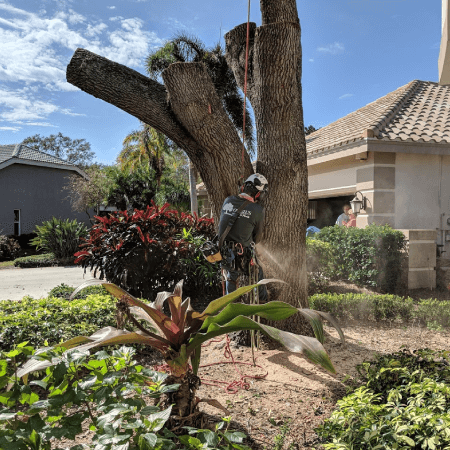
Tree Service in Palm Harbor, FL
O'Neil's Tree Service provides structural pruning, tree removal, plant health care, risk assessment, cabling, and stump grinding throughout Palm Harbor, East Lake, and northern Pinellas County, covering the 34683, 34684, and 34685 zip codes. We are based in Ozona, minutes from Palm Harbor. Apollo O'Neil is a Board Certified Master Arborist. All work follows ISA and ANSI A300 standards.
Trees and Conditions in Palm Harbor
Palm Harbor’s canopy reflects its history as one of the older, more established communities in northern Pinellas County. Southern live oaks dominate residential lots throughout neighborhoods like Innisbrook, Lansbrook, and Crystal Beach, and many of them have been growing in place since before the homes around them were built. Laurel oaks are common as well, especially on lots where faster-growing trees were planted during development decades ago.
The relationship between mature trees and homes in Palm Harbor is often complicated. Rooflines notched around oaks, root systems that have grown under driveways and foundations, and branches trained by decades of neighboring structures are all common situations here. Trees that have shared space with homes for twenty or thirty years carry a history that affects how they should be managed, and sometimes whether they should stay at all.
Sandy soils throughout Palm Harbor create the same root health challenges found across Pinellas County. Urban compaction, irrigation systems that encourage shallow rooting, and fill soil from original construction all limit what the root zone can do. Trees that look structurally sound from the street are sometimes operating under significant soil stress, and that stress shows up eventually in the canopy.
Palm Harbor also falls within Pinellas County’s tree protection ordinance. Certain species and sizes require review before removal or significant work. Knowing permit requirements before a job begins is part of the process.
Tree Services We Provide in Palm Harbor
We provide the full range of arboricultural services for residential and commercial properties throughout Palm Harbor:
- Structural pruning and crown cleaning to ANSI A300 standards.
- Tree removal, including crane-assisted removal on tight or constrained sites .
- Plant Health Care programs for trees and ornamentals under stress.
- Tree risk assessment and consulting for property owners, HOAs, and real estate transactions .
- Cabling and bracing for trees with structural defects worth preserving.
- Stump grinding and site cleanup.
- Mosquito control, outdoor pest control, and lawn fertilization through O’Neil’s Land Care.
If you are not sure what your trees need, request an assessment. We will walk the property, explain what we see, and give you a clear recommendation.
Why Palm Harbor Property Owners Work With Us
We are local. O’Neil’s operates out of Ozona, which puts us inside Palm Harbor’s backyard. When you call, you are not waiting for a crew dispatched from across the county. We know this canopy, these species, and these soils.
Apollo O’Neil holds the Board Certified Master Arborist credential from the ISA, the highest credential in arboriculture. That credential requires documented experience, a rigorous written examination, and continuing education. It is what we build the consulting and prescription work on.
We do not use fear to move jobs. If a tree is healthy and structurally sound, we will tell you. If there is a concern worth addressing, we will explain it clearly and walk you through the options. Some trees need pruning. Some need support systems. Some need removal. Some need monitoring, not a crew.
Recent Work in Palm Harbor
Virginia Avenue: Crane Removal of a Live Oak That Predated the Home
A property on Virginia Avenue had a sand live oak with a 22-inch trunk diameter growing at the northeast corner of the home. The tree had been growing there since before the home was built. The builder had notched the roofline to give it room, but the tree had continued growing and was now getting close to the structure. The homeowner wanted a clear assessment and a path forward.
The site had limited access and the tree’s position relative to the home required careful removal. We brought in a 75-ton crane to lift sections of the tree away from the structure as the climber worked down, reducing the risk of contact with the roofline and avoiding ground disturbance that traditional rigging would have caused on that lot. A separate 30-inch live oak growing from the neighboring property over the client’s roof was reduction-pruned to slow and suppress growth over the home. A weeping fig (Ficus benjamina) on the property line with prior heading cuts and cold damage was pruned back to the line using proper reduction cuts to slow re-encroachment. Debris was hauled and recycled.
Orange Pointe Avenue: Laurel Oak Reduction Pruning Over the Home
A property on Orange Pointe Avenue had multiple laurel oaks with canopy extending over the home. The concern was weight over the roof and the risk of failure from stems with no reduction history. The prescription was 10 to 15 percent weight reduction from the ends of the stems extending over the home, removal of all dead, diseased, broken, or detached branches two inches in diameter or larger, and deadwood cleaning throughout the canopy. All work was done to ANSI A300 and ANSI Z133 standards. Debris was hauled and recycled.
Woodcutter Court: Crape Myrtle Fungicide Program
A property on Woodcutter Court had a crape myrtle showing signs of fungal activity. We recommended a targeted fungicide treatment program applied via drench, scheduled every four to six weeks until the issue was resolved. The treatment plan included a minimum site visit structure and clear instructions on what to watch for between applications.
Request An Assessment

Palm Harbor Tree Service FAQ
Palm Harbor is an unincorporated area of Pinellas County, which means it falls under the county’s tree protection ordinance rather than a separate municipal code. Certain species and sizes require a permit before removal. Live oaks and other protected canopy trees above a specified diameter typically need review. We advise you on what applies to your specific trees before any work begins. Acting without the right permit can result in fines and required replanting.
Not necessarily. The answer depends on the species, the tree’s structural condition, the angle and rate of encroachment, and what options exist for managing it. Some trees in that situation can be pruned back on a regular cycle to maintain clearance without removal. Some can be managed with reduction pruning that slows growth toward the structure. Others, particularly those with root or structural issues on top of the encroachment, are better removed. We assess the full picture and give you a clear recommendation.
Crane removal uses a crane to lift sections of a tree away from the area as the climber works, rather than relying entirely on ropes and rigging to lower pieces to the ground. It is most useful when a tree is very close to a structure, when there is no clear path to get debris to the ground safely, or when the risk of contact with a roofline or fence is high. It typically results in less property disturbance than traditional removal on constrained sites. We assess each removal individually and recommend crane use when the site conditions warrant it.
The warning signs that matter most are structural, not cosmetic. Codominant stems with included bark at the union, large deadwood in the canopy, cracks or splits in the trunk or major limbs, visible root damage or decay at the base, and significant lean that was not always there are all worth having looked at. A tree can look full and green from the street and still have structural issues that increase failure risk under wind load. If something looks off, request an assessment. We will tell you what we see.
Yes, with some important limits. Property owners generally have the right to prune branches that cross their property line back to the line, but cuts must be made correctly to avoid damaging the tree and creating liability. We can assess the situation, advise on what is arboriculturally appropriate, and perform the work in compliance with ANSI A300 standards. We can also advise on how to document the situation if the neighbor’s tree poses ongoing concerns.
Yes. We work with HOAs and property management companies throughout Palm Harbor and Pinellas County. HOA projects often involve consistent standards across multiple properties, board approval processes, and documentation requirements. We provide the written assessments and proposals that HOA boards typically need, and we are familiar with working within those timelines and approval structures.