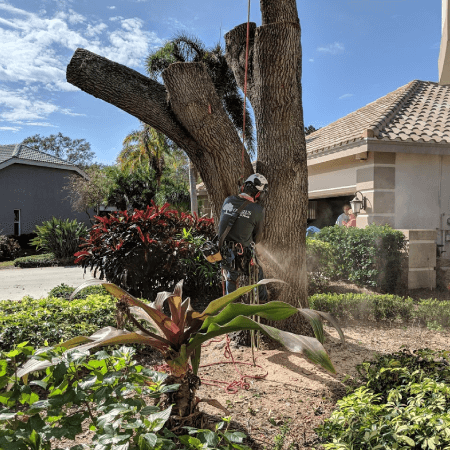
What Is a Fair Price to Cut Down a Tree, and Who Is the Cheapest?
A fair price for tree removal covers trained people, insurance, the right equipment, and cleanup, and it shows each of those on paper. Across six years of our own removals the average has been about $993. The cheapest bid is usually missing things, and the paperwork tells you what.
What Makes a Price Fair
We think of every job as a fair exchange. You know exactly what you are paying for, and we get paid for doing it right. A fair price is one where both of those are true.
On paper, that looks like separate lines you can read: the removal itself, debris hauling, a crane if the tree needs one, stump grinding if you want it, and a permit if the city requires one. Behind the lines, a fair price pays for general liability insurance, workers’ compensation, trained climbers, and equipment that is maintained.
For a single residential tree in north Pinellas, the removal line often lands somewhere between $400 and $2,850, depending on trunk size and whether it is in the front or back yard. Our tree removal cost guide has the full chart, and the cost by height page translates it for a 30, 40, or 60 foot tree. Our tree removal service page shows how we plan and scope that work.
So Who Is the Cheapest?
Usually the company carrying the least cost. That can mean no workers’ compensation, no certified arborist, a borrowed chipper, or one climber doing the work of three. Sometimes it is a good small outfit having a slow week. You cannot tell which from the number alone.
A cheap price often comes from a company whose crew has had little or no training. It can also come from someone who is not planning to be around in a few years, and often they are not. In my experience, about as many tree services close up shop every year or two as start up. If something goes wrong a year later, there may be no one left to call.
You can tell from the paperwork. Ask for a certificate of insurance and call the insurer yourself to confirm it is active, and ask how many employees are on the workers’ compensation policy.
Check ISA certification at treesaregood.org. Our page on how to choose a tree service walks through each check.
Tree work is dangerous work, and workers’ compensation is the coverage that answers who pays if someone gets hurt on your property. That is why it is worth confirming, and why a company that carries it costs a little more. It is part of what a fair price buys.
What a $99 Special Usually Means
Search “tree service” around Clearwater and Google suggests “$99 tree trimming near me today” and “$99 tree removal special.” When you see a price like that, it is worth asking which of these it is:
- A starting price for a small palm or shrub, not the tree you are looking at.
- A price that does not say whether hauling is included, so the brush stays in your yard or the debris line shows up later.
- A lead ad from a referral site that sells your phone number to several companies.
- A crew without insurance, which can account for much of the savings.
In my opinion, $99 tree service is a scam. No legitimate business can drive a crew and equipment to your house, do the hazard assessment at the job site that OSHA requires, set up the safety equipment the job needs, do the work, haul and dispose of the debris, and still stay in business.
Ways to Lower the Price Without Cutting Corners
- Do several trees in one visit. Setup and drive are about the same for one tree or four, so the price per tree usually drops.
- Keep the wood. If you want firewood or chips, the debris line can come down.
- Leave the stump low. If you do not need the ground flat for a lawn or a bed, skip the grinding.
- Schedule in the slower months. Late fall and winter are often easier to schedule. See the cheapest time of year for tree removal.
- Ask whether pruning would do the job. Sometimes the tree can stay. See whether trimming or removal costs less.
- Plan before storm season. A tree that breaks onto a roof is a harder job than the same tree taken down on a calm day.
What Is the Best Price for Tree Trimming?
For trimming, our tree trimming cost guide puts most trees in the Tampa Bay area at $150 to $400 under 25 feet, $400 to $800 from 25 to 50 feet, and $800 to $1,500 or more above that.
The best price is the one you only pay once in a while. A tree pruned correctly every three to five years usually costs less over time than one cut cheaply every year. Stripping the inside of a tree and leaving long, heavy limbs looks like trimming and can make the tree more likely to break, which is often the most expensive outcome. Our tree trimming and tree pruning pages explain the cuts we make and why.
Once a branch is cut, you can’t glue it back on. Cheap tree service usually means poor pruning and bad cuts, and those can’t be fixed. The tree carries them for the rest of its life.

Fair Price and Cheapest Tree Removal FAQ
A fair price covers trained, insured people, the right equipment, and cleanup, and it lists each piece separately. For one residential tree in north Pinellas, the removal often runs $400 to $2,850 depending on trunk size and access, with debris and stump work on their own lines.
Usually whoever is carrying the least cost, which often means less insurance or less training. Compare what each bid includes and confirm insurance with the insurer directly before you compare prices.
For a small palm or shrub, maybe. For a shade tree, no. A price that low cannot cover a trained crew, equipment, a hazard assessment, safety setup, the work, and hauling the debris away. Ask what is included before you book.
Most trees in the Tampa Bay area fall between $150 (when doing more than one tree) and $1,500 or more, depending on size and access. The best value is correct pruning done every three to five years, not a cheap cut every year.
Compare what each bid says it will do first. If one is far lower, ask what is missing, whether that is debris, insurance, a crane, or the number of trees. The lowest number for less work is not a savings.
Group several trees into one visit, reduce scope to just clearance, keep the wood or chips, leave the stump low if you do not need it ground, and schedule non-urgent work in late fall or winter when schedules are lighter.