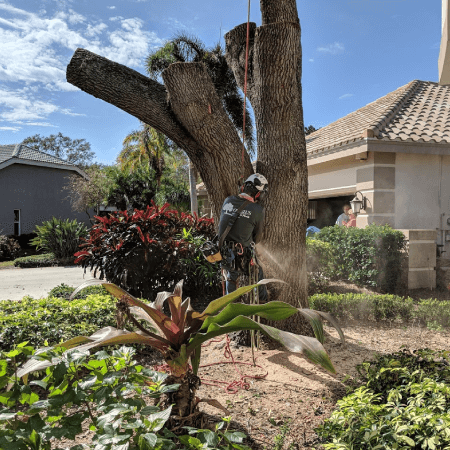
How Much Does Tree Trimming Cost in Clearwater and Palm Harbor, FL?
Tree trimming costs vary widely, and anyone giving you a flat price without seeing your trees should be viewed with skepticism. In the Tampa Bay area, most homeowners pay between $150 and $1,500 or more depending on tree size, species, condition, access, and risk. The only accurate number comes from an on-site evaluation by a qualified arborist.
Why Tree Trimming Costs Vary So Much
Tree trimming prices vary because no two trees and no two properties are the same. Tree trimming is not a commodity service. Two trees of the same size can have very different costs depending on how they have been maintained, where they are located, and what the objectives of the work are.
Some of the most common factors that influence cost include:
-
Tree height and canopy size
-
Species and growth characteristics
-
Structural defects or decay
-
Proximity to homes, power lines, or other targets
-
Access for equipment
-
Level of risk to people and property
A small tree growing in an open yard may take an hour to trim. A similarly sized tree growing over a home may require specialized rigging, additional crew members, and significantly more time. Understanding what goes into pricing will help you make better decisions and avoid paying for poor-quality or unsafe work.
Average Tree Trimming Cost in the Tampa Bay Area
While exact pricing requires an on-site evaluation, typical cost ranges for tree trimming in the Clearwater and Palm Harbor area are:
-
Small trees (under 25 feet): $150 to $400
-
Medium trees (25 to 50 feet): $400 to $800
-
Large trees (over 50 feet): $800 to $1,500 or more
These are broad ranges and should only be used as general reference points. Pricing that falls far outside these ranges, especially on the low end, should raise questions about what is actually being included and who is doing the work.
For context, the average cost of a full tree removal across all sizes we have performed over the last six years was $993.22. Trimming costs less than removal, but the same factors that drive removal pricing, access, risk, equipment, and labor, apply here as well.
What You Are Actually Paying For
When you hire a professional tree trimming company, you are paying for more than someone cutting branches. Costs reflect:
- Trained, experienced labor
- Insurance and risk management
- Specialized equipment and maintenance
- Time spent planning and executing proper pruning
- Cleanup and debris handling
Most tree trimming companies base their pricing on how long the job will take. The cost per hour is determined by many factors: drive time, the hourly cost for each employee on site, office and admin staff, management, consulting arborists, fuel, equipment repair and maintenance, amortization of equipment to replace it when it wears out, required insurance coverage, continuing education, training, employee benefits, and more.
Larger trees take more time to trim, often require specialized equipment, and demand more skill to care for safely. A company carrying $400,000 or more in insurance, employing ISA Certified Arborists, and running proper equipment will cost more than a company doing none of those things. That difference in cost is real and it matters when something goes wrong on your property.
Companies that cut corners often do so by reducing training, skipping insurance, or rushing the work. None of that benefits your trees or your property.
Does Insurance Affect Tree Trimming Cost?
Yes. Proper insurance protects you from liability. Tree work is dangerous, and costly mistakes are made every year. Hiring an insured company will increase costs compared to one that is not insured, but it is worth it. Ask for a certificate of insurance and verify it directly with the provider. A policy document can be obtained with a down payment and then not renewed, so asking to see it is not enough.
Why Cheap Tree Trimming Often Costs More Later
Extremely low prices often indicate:
-
Improper pruning techniques
-
Excessive removal of live tissue
-
Increased likelihood of decay and structural failure
-
Higher long-term maintenance costs
Damage caused by poor pruning may not be obvious right away. Trees often decline slowly, and homeowners may not associate problems that show up years later with the work that caused them. A tree that was lion-tailed, meaning the interior was stripped and weight was left concentrated at the branch ends, may look fine for a season or two before the structural consequences become clear.
The most common form of cheap tree trimming in this area is also the most damaging: crews that remove interior branches while leaving long, heavy branch ends. This increases wind-load, reduces taper, concentrates density where you do not want it, and makes branches more likely to fail in storms. It looks like trimming. It is actually the opposite of what your trees need.
How to Compare Tree Trimming Estimates
Comparing estimates is not about finding the lowest number. It is about understanding what you are being offered.
A professional estimate should clearly outline:
-
Tree species and size (DBH, or diameter at breast height)
-
Location on the property
-
Conditions of concern
-
Objectives of the pruning
-
Prescriptive pruning instructions, meaning what cuts will be made and why
Vague estimates usually indicate vague planning. If an estimate just says “trim oak tree” with a price, you have no way of knowing what will actually be done to your tree or why. Ask what the objectives of the pruning are. Ask what techniques will be used. If the person estimating the job cannot answer those questions clearly, that is important information.
If you are unsure what a proper estimate should look like or how to evaluate one, our arborists are glad to walk you through it.
Is Tree Trimming Worth the Cost?
Yes, when it is done correctly and for the right reasons. Professional tree trimming is worth the cost when:
- Branches threaten structures or people
- Structural defects need to be managed before they become failures
- Clearance is required for safety or access
- Long-term tree health and wind resistance are the goal
Good pruning is an investment. Poor pruning is an expense.
If cost is your only concern, tree trimming may not be the service you are actually looking for. Many homeowners who call asking for tree trimming really need a site evaluation first to understand what their trees actually need. An arborist who looks at the tree and says nothing needs to be done right now is giving you valuable information, not wasting your time.
Request An Assessment

How Much Does Tree Trimming Cost FAQ
Larger trees take more time, require more skilled arborists, and often need specialized equipment such as lifts, bucket trucks, or cranes. The cost per hour for a tree trimming crew reflects many things beyond just the people on site: drive time, office and admin staff, management, fuel, equipment maintenance and replacement, insurance, training, and employee benefits. When a tree is large, all of those factors scale with it.
Most urban trees in the Tampa Bay area benefit from pruning every three years when done correctly. Many Florida homeowners trim their trees every year out of concern about hurricanes, but annual trimming is rarely beneficial to the tree and often does more harm than good over time. The exception is young trees, which benefit from structural pruning earlier and more frequently to establish good form before problems develop.
It can. Drive time, permit requirements, and local access conditions all factor into pricing. A tree in a tight urban lot in Clearwater Beach requires different logistics than a tree on a larger property in East Lake or Palm Harbor. Permit requirements also vary by city, and in most Pinellas County municipalities a permit or arborist letter is required before certain species or sizes can be pruned significantly or removed.
The tools are the same. The difference is the knowledge behind the cuts. Pruning is done with a clear purpose: safety, structure, and the long-term health of the tree. Trimming is most often done on a schedule or to a shape, with no plan tied to what the tree actually needs. Proper pruning by a trained arborist typically costs more than basic trimming because it requires more time, judgment, and education. It also produces better results for the tree.
Yes, but compare them carefully. The lowest estimate is not automatically the best value, and the highest is not automatically the best quality. Ask each company to explain what they will do and why. A company that can clearly explain the objectives of the pruning and how they plan to achieve them is giving you more useful information than a number alone.
Sometimes, over a long enough time horizon. A tree that requires significant pruning every two to three years due to structural problems, proximity to structures, or aggressive growth may cost more to maintain over ten years than it would to remove and replace with a better-suited species. A qualified arborist can help you think through that calculation honestly. We would rather tell you the truth about that tradeoff than keep selling you work a tree does not warrant.