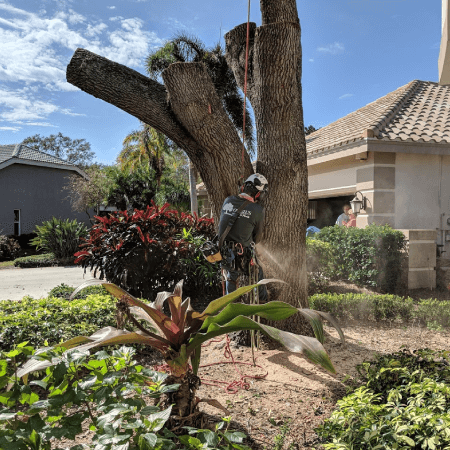
Tree Cabling and Bracing in Clearwater and Palm Harbor, FL
Cabling and bracing are supplemental support systems installed in trees with structural defects to reduce the risk of branch or stem failure. They do not fix defects; they manage them. Installed to ANSI A300 Part 3 standards by ISA Certified Arborists. O’Neil’s Tree Service serves Clearwater, Palm Harbor, and Pinellas County.
What Cabling and Bracing Actually Does
When a tree has a structural defect, such as co-dominant stems with included bark, an overextended limb growing over a structure, or a major union showing signs of separation, the question is not always whether to remove it. Often the question is whether the defect can be managed safely, and for how long. Cabling and bracing are the tools we use to answer yes to that question.
The analogy that works best: think about how we manage structural problems in the human body. A younger person with an anatomical problem, such as a short leg, scoliosis, or a structural joint issue, can often have it corrected surgically. An older person with the same condition may be past the point where surgery is the right answer. The severity of the intervention at that stage could cause more harm than benefit. So instead, you manage it. A cane, a brace, a walker. Supplemental support that allows the person to function safely despite the underlying condition.
That is exactly what cabling and bracing does for trees. The defect does not go away. What changes is the tree’s ability to carry its load safely, because the supplemental system is now sharing that load. The important word is supplemental. These systems add to what the tree can do on its own. They do not replace it.
Cabling
A cable system connects two or more stems or major branches with a either a flexible synthetic rope material (dynamic cable) or a rigid steel cable (static cable) installed in the upper third of the canopy. There are pros and cons to dynamic cables and rigid cables. Typically dynamic cables allow for more movement which still allows the tree to move more naturally and even develop reaction wood (sort of like how we experience atrophy if we don’t move) normally make the tree still develop a bit more naturally. However, we often see dynamic cables that haven’t been inspected frequently, which is required of both, wind up girdling (squeezing and shutting off nutrient flow) the stems they are trying to support. Rigid cables often require drilling wounds into the tree’s tissue creating wounds (can create decay pockets and cavities) The cable limits how far the stems can move apart under load. It does not prevent all movement even in a rigid cable although a rigid cable would allow much less movement especially below where it is installed whereas the dynamic cable will allow more movement below itself and above. The tree still sways, still responds to wind, still builds reaction wood through that movement. What the cable prevents is the kind of separation that leads to failure at a compromised union.
We install EHS (Extra High Strength) steel cable to ANSI A300 Part 3 standards. Hardware is installed through the stems using eye bolts sized to the diameter of the wood. The system is designed to engage under load, not to hold the tree rigid under normal conditions. That distinction matters: a cable that prevents all movement creates dependency without allowing the tree to continue developing its own structural response.
Cable systems require periodic inspection (once per year from the ground and every other year an aerial inspection is recommended). Hardware can pull through wood as stems grow, anchors can loosen, stems grow and are choked by dynamic cables and the geometry of the canopy changes as the tree develops. An installed cable is not a permanent fix; it is a managed intervention that needs to be evaluated on a regular basis.
Bracing
A brace rod is a threaded steel rod installed through a defective or concerning union or stem to provide rigid support. Where a cable limits movement between two points in the canopy, a brace rod reinforces the union itself, which is the point where failure is most likely to occur.
Brace rods are used when a union is showing active signs of separation, when included bark is severe, or when the geometry of the stems means a cable alone may not prevent the specific failure mode the tree is at risk for. A one-inch 304/316 stainless steel brace rod has an ultimate tensile strength typically between 70,000 and 85,000 PSI, translating to roughly 55,000 to 66,000 pounds of holding power before failure. Five rods through a union that would otherwise be held together only by compromised bark tissue represents a substantial increase in the load that union can carry.
I have one tree we installed a system in 12 years ago that was splitting apart. Now, you look at the tree, you can’t see the rods and you can’t see the split. The tree has grown new tissue and the rods are completely embedded in the wood doing their job. Point is, threaded steel rods (braces) are very strong and add a lot of supplemental strength.
Bracing creates more rigidity than cabling. Because the brace rod prevents movement at the union, the tree experiences some atrophy in that area over time, similar to how a limb in a cast loses muscle. The union becomes more dependent on the rod. That is an acceptable tradeoff in situations where the alternative is failure. The rod is doing the job the wood can no longer do reliably on its own. This is similar to a bone that is bolted together.
Propping
Propping is a less common but sometimes appropriate method for supporting a very large overextended branch that cannot be effectively managed with cable or brace alone. A prop system typically involves a footing installed in the ground and a vertical or A-frame support structure that bears some of the branch’s weight from below.
One variation uses an A-frame that reaches up and over the limb connecting as a sort of squared off A, above the subject branch. A cable runs from the A through the branch and is held underneath typically with a wedge grip, which allows side-to-side movement while preventing the branch from dropping. This preserves some of the branch’s natural dynamic motion, which helps maintain reaction wood development in the wood above the prop. A direct vertical prop from below is more rigid and eliminates most movement. The tradeoff is increased dependency: if the prop is ever removed or fails, the branch has not been developing the structural response it would have without the prop in place.
Propping is typically used on specimens with significant historical, aesthetic, or ecological value where the branch represents something worth preserving at the cost of ongoing maintenance. It is not a standard first-line response.
Reduction Pruning as Part of the System
Supplemental support systems work better when the load they are managing has been reduced. Reduction pruning, selectively removing weight from the ends of branches, decreases the moment arm and reduces the gravitational and wind-driven forces acting on the defective union. Less load on the union means the cable or brace is working with a more manageable system.
In many situations we recommend reduction pruning as part of the same scope of work as cabling, bracing or propping. These interventions address the same problem from different directions: pruning reduces the force, the cable, brace or prop supplements the structure’s ability to resist that force.
Tree Health and Timing
One factor that gets underestimated in conversations about cabling and bracing is tree health at the time of installation. Drilling through a stem to install a brace rod or boring a hole for an eye bolt creates a wound. The tree’s ability to respond to that wound, to compartmentalize it and limit decay spread, depends on its overall vigor.
A tree under significant stress from root restriction, soil compaction, drought, or nutrient deficiency has a reduced capacity to respond to wounding. Before recommending cabling or bracing on a tree that is already stressed, we evaluate whether improving the tree’s health first would produce a better outcome. This is the same logic as a physician recommending that a patient improve their health before elective surgery. If the intervention is not urgent, a healthier tree going into it will recover better and compartmentalize the installation points more effectively.
When the situation is urgent; when a defective union is showing active signs of separation and the target exposure is high, we install the support and address health separately. The analogy holds: you do not delay emergency surgery because the patient is not in ideal health. You do the surgery and manage the recovery. But given the choice, a healthier tree handles the intervention better.
When Cabling and Bracing Is the Right Answer
Cabling and bracing is appropriate when a tree has documented structural defects, retains enough sound wood and overall health to benefit from the intervention, and has enough value, aesthetic, historical, ecological, or financial to justify the cost of installation and ongoing maintenance. It is not appropriate as a substitute for removal when a tree’s structural integrity is too compromised for supplemental support to make a meaningful difference.
The trees that benefit most are species with strong wood and good compartmentalization. Live oak and bald cypress are the most common candidates in Pinellas County. Both species respond well to managed interventions and have long lifespans that make the investment worthwhile. Laurel oak and other species with weaker compartmentalization carry more risk from the installation wounds themselves, however dynamic cables can be an alternative when worried about wounding. Each tree and situation should be evaluated on a case-by-case basis.
Every cabling and bracing recommendation at O’Neil’s starts with a structural assessment of the defect, an evaluation of the tree’s overall health and vigor, and a clear explanation of what the system will and will not do. You decide whether the tradeoff makes sense for your property.
Request An Assessment

Tree Cabling and Bracing FAQ
No. Cabling and bracing manage defects, they do not correct them. The structural condition that created the need for the cable remains. What changes is the tree’s ability to carry its load safely, because the cable, brace or prop is sharing that load. Think of it the way you would a brace or cane for a joint problem: the underlying condition is still there, but the supplemental support allows the person to function safely. The same logic applies here.
We install stainless steel bracing hardware and when using rigid cables we specify galvanized steel. Both are durable in outdoor conditions but since we can’t see many of the brace rods we don’t take any chances and go a step further. The system itself (visible systems) should be inspected every one to three years. As the tree grows, hardware can pull through wood, anchors can loosen, and the geometry of the canopy changes. We note re-inspection intervals on every installation. A cable system is a managed intervention, not a one-time fix. Even though it is not possible to see some of the brace rods or maybe even any of them, the tree should still be inspected frequently to see if any changes are occurring.
That depends on how healthy the tree is, what the defect is, how structurally sound the tree is otherwise, what species it is, and what value the tree has to your property. We do not recommend cabling when removal is clearly the right answer (it is frequently not the wrong answer though). When cabling is appropriate, it can extend the life of a tree for years or decades at a fraction of the cost of removal and replacement plus you can’t often replace mature trees in a life time. We explain the tradeoffs plainly and let you make the call with complete information.
A cable is a either a synthetic rope material or flexible steel cable connecting two points in the upper canopy, limiting how far they can separate under load while allowing normal movement. A brace rod is a rigid threaded steel rod installed through a union to reinforce it directly. Cables address movement between canopy components. Brace rods address structural integrity at the union itself. In many cases both are used together.
There are non-invasive cable systems that use slings or straps rather than hardware drilled into the wood (these are often called dynamic cable systems). These are appropriate in some situations, particularly for younger trees or where installation wounds are a significant concern. We evaluate which hardware type is appropriate based on the tree’s size, species, and the specific defect being addressed. We install both systems depending on what the situation calls for.
To a degree, yes, particularly with brace rods, which prevent movement at the union and can reduce the wood’s natural structural development in that area over time. A cable system that allows normal dynamic movement has less of this effect. We explain the dependency tradeoff on every installation. In most cases where cabling or bracing is warranted, the alternative, an unmanaged defect, carries more risk than the dependency.