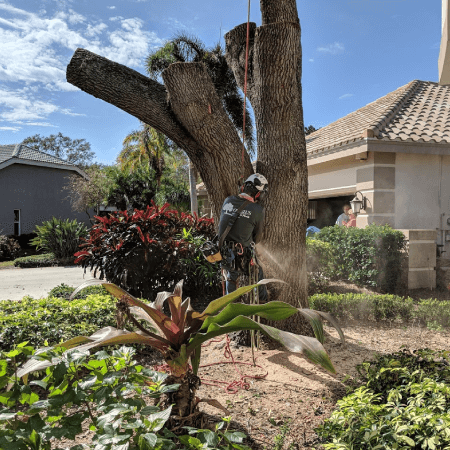
How Much Does Crane-Assisted Tree Removal Cost in Clearwater and Palm Harbor, FL?
Crane-assisted tree removal in Clearwater and Palm Harbor, FL typically runs $1,000 to $14,000, depending on tree size, access, and which crane the job actually needs. A 40-ton crane assist usually starts around $600 to $1,500 on top of the removal itself; a 75-ton crane runs $1,800 to $5,400. Site complexity does the rest.
Why a crane gets used in the first place
Most tree removals do not need a crane. A qualified arborist climbs the tree, cuts it in small pieces and lowers it down by rope, and the ground crew handles the brush. That works when there is room to drop pieces safely, when the tree is sound enough to climb, and when large portions of the canopy are not over the home.
A crane gets used when on of the following things exists. The tree leans toward a roof. The trunk has decay that makes climbing unsafe. The yard is closed in by a screened pool cage, a fence, and a narrow gate. The branches grow over a neighbor’s house. In those situations, lowering pieces by hand is slower, harder on the property, more risky, and sometimes flat out impossible. A crane lets us lift the wood up and away instead of lowering it down past the obstacles.
In Pinellas we run into this constantly. Backyards are tight, properties are narrow, and the older neighborhoods grew their canopies in faster than planned for.
Our crane-assisted tree removal service page covers how we plan each lift, and our tree removal page covers removals that do not need a crane.
What drives the price
Crane-assisted tree removal pricing is built from two parts: the removal itself, priced by trunk diameter, yard placement and other factors, plus the crane assistance. The crane size is priced by determining the distance to the tree and an approximated weight of the tree sections to be lifted as this determines the size of the crane needed.
Five factors move the number up or down.
- Trunk diameter (DBH). A 22-inch oak costs different money than a 48-inch one, no matter how the rest of the job looks.
- Front yard versus back yard. Backyard removals typically cost 40 to 50 percent more than the same tree out front, because rigging time, debris handling, and access issues all stack up.
- Crane capacity needed. The 40-ton, 75-ton, or 120-ton crane is chosen by tree size and the reach distance from where we can park the crane to where the tree stands. Bigger tree or farther away means a bigger crane.
- Obstacles and access. Power lines nearby, wet turf, a 32-inch gate, branches over a target that cannot be moved, all of it adds time and changes the safety plan.
- Debris and stump. The base price is removal to ground level. Hauling the wood, chipping the brush, and grinding the stump are separate line items.
Typical ranges for crane-assisted removals in Pinellas County
These are honest starting numbers from our published price chart. The actual quote depends on the site walk, because a 30-inch tree with a clean shot to the truck is not the same job as a 30-inch tree with a screened lanai underneath it.
| Tree size (DBH) | Front yard removal | Back yard removal | 40-ton crane assist | 75-ton crane assist |
| 10 to 15 inches | $400 to $800 | $592 to $1,184 | $600 | $1,800 |
| 16 to 24 inches | $1,150 to $1,920 | $1,702 to $2,841 | $800 | $1,800 |
| 25 to 36 inches | $2,200 to $3,300 | $3,256 to $4,884 | $800 to $1,000 | $1,800 to $2,400 |
| 37 to 49 inches | $3,600 to $4,800 | $5,328 to $7,104 | $1,000 to $1,200 | $2,400 to $2,800 |
| 50 to 63 inches | $5,200 to $5,900 | $7,696 to $8,732 | $1,200 to $1,500 | $2,800 |
| 64 to 84 inches | $6,100 to $7,900 | $9,028 to $11,692 | $1,500 to $2,400 | $3,200 to $5,400 |
A few real-world combinations:
- A 17-inch oak in a front yard with a 40-ton crane assist runs roughly $1,950 total.
- A 22-inch oak in a back yard with no crane runs roughly $1,920 plus debris.
- A 30-inch live oak in a back yard with a 40-ton crane assist runs roughly $4,800 plus debris.
- A 50-inch tree close to a house with a 75-ton crane assist typically lands between $9,500 and $11,000, plus debris and stump.
The published price chart is a guide, not a quote. Trees vary, sites vary, and bulk pricing applies when we remove several trees in the same visit.
40-ton, 75-ton, and 120-ton: what the numbers actually mean
Crane size refers to capacity. For tree work, the practical question is reach. The crane has to lift the picks at a usable distance from its center pin. A good rule of thumb is to plan for 5,000 pounds of working capacity at the working distance, especially with larger trees.
- 40-ton crane. Useful reach 50 to 80 feet depending on pick weight. Handles most residential jobs in Clearwater and Palm Harbor.
- 75-ton crane. Useful reach up to 120 feet. Used when the crane has to set up across the street or on the opposite side of a property.
- 120-ton crane. Useful reach up to 150 feet. Used for very large trees, deep backyards, or jobs where the crane cannot get close to the tree at all.
A bigger crane is not automatically a safer or better choice. It costs more to mobilize and takes more space to set up. The right crane is the one with the capacity and reach the job actually needs.
Here is why crane cost moves in steps instead of smoothly. We own a 55 ton knuckle boom that handles most trees out to about 60 feet of reach, and it covers roughly half to 60 percent of our crane jobs. Once a tree passes about 30 inches in diameter, the average pick gets heavy enough that we step up to a rented stick crane, 60, 75, 90, or 120 ton, depending on the size of the tree and the distance to it. Each step up is a real cost jump, because the machine, the transport, and the setup all get bigger. We keep stepping up until the lift is safe with room to spare; once a section is cut from the tree, the crane has to carry it, so the safety factor is not optional.
When the lowest bid is the wrong call
Crane work is governed by ANSI Z133, the safety standard for arboricultural operations. Setup, rigging, communication, and load planning all follow that standard when the job is done correctly. We have walked onto job sites to clean up after companies that skipped those steps. The cost of cleaning up an overload or a missed cut is always higher than the cost of doing it right the first time.
A good crane removal quote shows you the line items: removal, crane assist, debris, stump. The crew shows up with the right PPE on, walks the site, and explains the plan before the first cut. If a bid is dramatically lower than the others, ask what is missing from it.
What about insurance, permits, and the stump?
- Homeowner’s insurance often covers crane-assisted removal when the tree has fallen on an insured structure and the tree parts must be removed to make repairs or prevent further damage. Routine removals are typically not covered by insurance. Our insurance and tree removal guide covers what to document before you file.
- Clearwater, Largo, Safety Harbor, Belleair, and Pinellas County each have their own tree ordinances. Permits depend on tree size, species, and lot type. We pull permits for our clients when they are required.
- Stump grinding is a separate line item, priced by stump diameter and grinding depth. We can include it in the same visit when access allows.
One more number worth knowing: insurance claims involving crane removals routinely exceed $20,000, because storm work is triage. Think of it like the emergency room; your primary doctor has much of the same equipment, but the unscheduled visit costs several times more. A tree that has to be lifted off a house pulls crews from booked work, reshuffles the schedule, and often runs into overtime. It costs more than the same tree standing in the yard, and carriers understand why.
Request An Assessment

Crane Assisted Tree Removal FAQ
Most crane-assisted removals in Pinellas County fall between $2,500 and $7,500 once removal, crane, and debris are added together. Very large trees, 75-ton or 120-ton work, and difficult sites push it higher. Small trees rarely need a crane at all.
Backyard tree removals typically run 40 to 50 percent more because rigging takes longer, debris has to be carried out by hand or routed through gates, and access is usually tighter. The crane fee itself is the same in either case; it is the removal cost that shifts.
Sometimes the answer is no. A skilled climbing crew can take down trees that look intimidating, as long as the rigging path is clear and the tree is sound enough to climb. A site walk by an ISA Certified Arborist may be the best way to find out.
By the heaviest pick the job requires and the reach distance from where the crane can set up. We plan for at least 5,000 pounds of working capacity at full reach. A small crane on a long reach is not a savings, it is a risk.
No. Stump grinding is priced separately by stump diameter. We can grind it in the same visit when access is available.
You are paying for the crane mobilization, the operator, and the planning time the crane adds. What you get back is a faster, safer, lower-impact job, especially in tight spaces. On the right job, a crane saves the yard from rutting, saves a roof from potential rigging mishap damage, and finishes work in a day that would otherwise take three.
Often yes. Clearwater has its own canopy ordinance. Pinellas County’s rule covers unincorporated properties at 4-inch DBH and up for protected species. If the client selects for us to apply for the permit on their behalf, we can ensure this is done.
Not necessarily. Plenty of trees that look concerning are structurally fine, and a few that look fine are not. A risk assessment from an ISA Certified arborist with a TRAQ-qualification or a BCMA tells you what is structural and what is cosmetic. Our page on when tree removal is necessary walks through the decision.