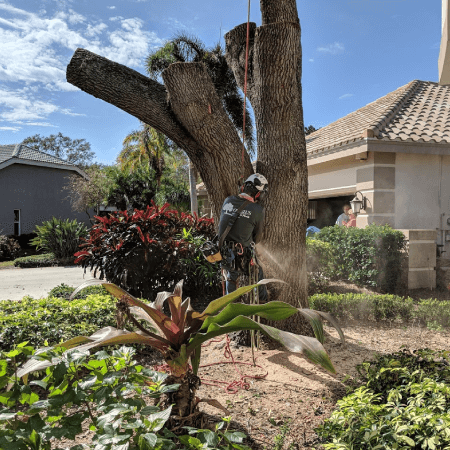
Tree Trimming in Clearwater and Palm Harbor, FL
Most homeowners search for tree trimming when what they actually need is reduction pruning or structural pruning. Both involve cutting branches, but the goal and the result are different. O'Neil's Tree Service performs ISA-standard pruning that improves tree health, structure, and safety. We serve Clearwater, Palm Harbor, and surrounding Pinellas County.
What Problem This Solves
Most homeowners call because something caught their attention: branches hanging too low, deadwood they can see from the driveway, limbs rubbing the roof, or a canopy that has gotten dense enough to concern them. Those are the right things to notice. They are also the starting point for an honest conversation about what the tree actually needs.
Trees in the urban environment accumulate defects over time, from previous cuts made without a clear purpose, from storm damage, from co-dominant stems that were never corrected early. What looks like a trimming job sometimes reveals structural issues worth addressing while we are there.
We help homeowners understand what their trees actually need, not just what will make them look tidier this season.
When Tree Trimming Is Appropriate
Call us when:
- Branches are growing into the roof, gutters, or HVAC equipment
- The canopy has not been touched in three or more years
- You are seeing deadwood, crossing branches, or codominant stems forming
- You want to improve airflow and light through the canopy
- You are preparing the tree before storm season
- A neighbor, HOA, or utility has flagged a branch concern
- You just moved into a property and want a baseline assessment of the trees
When Tree Trimming Is Not the Right Answer
Not every tree needs to be cut. We will tell you that on-site if it applies.
-
If a tree is structurally sound and growing well, pruning it unnecessarily causes stress without benefit
-
If a tree is in decline from disease, root damage, or soil compaction, pruning is a secondary concern
-
If the goal is to reduce height significantly, that is called reduction pruning and has specific limitations under ANSI A300 standards. We will explain what is achievable before any work begins.
-
If a tree is dead or dying, removal is likely the better conversation
We do not upsell cuts. If your tree does not need work, we will tell you.
Our tree trimming cost guide covers price, and when to trim trees in Florida covers timing.
What to Expect: Our Process
-
Site visit and assessment. We walk the property, identify the trees, and talk through what you have noticed. We are looking at structure, species, soil, and surrounding conditions.
-
Recommendation. We explain what we see, what we recommend, and why. If we recommend against work, we tell you that too.
-
Scope and agreement. We define exactly what will be pruned, to what standard, and what the cleanup will include.
-
Pruning work. Our crew works to ANSI A300 spec. Cuts are made at the branch collar, leaving the tree’s natural wound-sealing chemistry intact.
-
Cleanup and review. All debris is cleared from the property. Whenever possible we walk the site with you before leaving.
Common Mistakes We See
These are the most frequent problems we encounter when assessing trees that were previously worked on by someone else.
- Topping. Removing the central leader or cutting branches back to stubs. This causes rapid regrowth of weakly attached shoots, decay entry points, and long-term structural failure. ANSI A300 prohibits it.
- Lion’s tailing. Stripping interior branches and leaving foliage only at the branch tips. This shifts weight to the end of the branch and increases wind-sail effect.
- Flush cuts. Cutting branches flush with the trunk removes the branch collar, which is where the tree seals the wound. This opens the tree to decay.
- Over-pruning. Removing too much live canopy in one season stresses the tree and reduces its ability to photosynthesize and recover.
- Pruning at the wrong time of year for species-specific disease risks. For example, red bay trees in Central Florida have specific timing considerations due to laurel wilt, although most red bays in the area have already been lost to this disease.
Request An Assessment

Tree Trimming FAQ
Most established shade trees benefit from a structural assessment every three to five years. Young trees benefit from more frequent developmental pruning in their first ten to twenty years. Some species and site conditions require different schedules. We will give you a specific recommendation for each tree on your property after the site visit.
Sometimes, within limits. Crown reduction is a recognized pruning technique under ANSI A300, but it has constraints. We reduce to a lateral branch that is at least one-third the diameter of the limb being cut. We do not top trees. We will show you on-site what is achievable and what the long-term result will look like.
No. There is no requirement to get a permit to trim trees. However, municipal ordinances do govern how much can be pruned from a tree and how it can be pruned. We handle permitting when required and will flag any relevant restrictions before work begins.
No, a majority of the time. Some deadwood is normal in healthy trees, especially in the lower canopy where light is reduced. Deadwood becomes a concern when it is large, over a high-traffic area, or when die-back is progressing into live tissue. An arborist can tell the difference quickly on-site.
Both have value. Pre-storm pruning reduces wind-sail and can address structural defects that could become failure points. Post-storm pruning addresses damage and restores structure. In Pinellas County, we typically recommend a structural assessment in late spring before the Atlantic hurricane season begins.
A very large factor is the cost of payroll taxes and appropriate insurance, which runs $700,000 to $800,000 per year for a company like ours before we make a dollar. Beyond that, lower-priced companies are often cutting more and caring less. Faster production means more cuts with less attention to how each one affects the tree. Our work is priced to reflect time on-site, proper technique, and crew training. Apollo O’Neil is a Board Certified Master Arborist. That is not a marketing claim; it is a credential that requires documented knowledge and continuing education.
All debris generated by our work is removed from the property. We haul everything unless you request otherwise. Stump grinding is a separate service and is quoted separately if needed.
Why O'Neil's Tree Service
-
Apollo O'Neil holds the ISA Board Certified Master Arborist credential from ISA, the highest professional certification in arboriculture
-
All pruning work follows ANSI A300 standards
-
Fully insured, with general liability and workers’ compensation coverage
-
Serving Clearwater and Palm Harbor with a focus on long-term property stewardship, not one-time transactions
-
No fear language, no manufactured urgency. We tell you what we see and what we recommend.