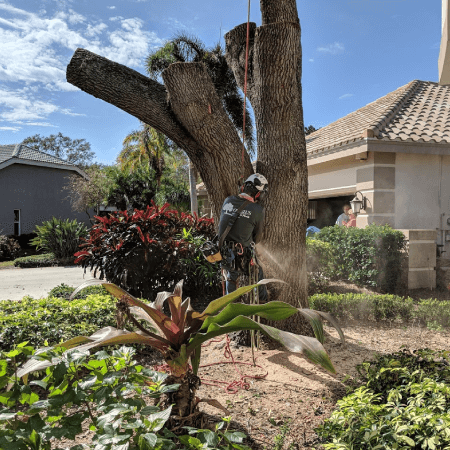
When Is Tree Removal Actually Necessary?
Most of the trees we get called on to remove can be saved with pruning and care. Just because they are declining, does not mean they are a dead tree. Many trees that look sick or damaged can recover with the right management, and removal should be a last resort after a qualified arborist has assessed the full picture. Here is how to tell the difference between a tree that needs help and one that needs to go.
Most Trees Do Not Need to Be Removed
This is the part most tree companies skip. A homeowner sees a dead branch, a crack in the trunk, or a mushroom at the base and assumes the tree is done. In many cases, what they are looking at is a symptom, not a death sentence.
Trees are built to compartmentalize damage. An old live oak with a hollow trunk often has decades of sound wood surrounding the cavity, with very little actual strength loss. Research by Frank Rinn on shell-wall thickness and tree biomechanics has shown that large-diameter mature trees can tolerate significantly more internal decay than smaller trees because the absolute thickness of sound outer wood matters more than the percentage of the cross-section affected. A laurel oak dropping leaves in March may just be going through its normal spring leaf exchange. The question is never just “does this tree have a problem?” It is “can this tree still function safely on this property?”
That distinction matters because removal is permanent. Once a mature canopy is gone, the shade, property value, stormwater management, and wind protection it provided are gone with it. Replacing a 30-year-old live oak with a new planting means waiting another 15 to 20 years for meaningful canopy coverage. The benefits a mature tree provides took a lifetime to develop, and they do not come back quickly.
When Removal Is the Right Call
There are situations where removal is clearly the best option. An ISA Certified Arborist or an ISA Board Certified Master Arborist can confirm these through a formal tree risk assessment, but here are the conditions that most often lead to a removal recommendation:
- The tree is dead. No live cambium, no leaf production, bark sloughing in sheets. A dead tree near a structure or high-use area is a liability, not a landscape feature. Even then, if the tree is far enough from structures and foot traffic, it may be worth reducing in height and leaving as a wildlife snag rather than removing entirely.
- Structural failure is imminent. A major crack through the main stem, a root plate lifting out of the ground, or a lean that developed suddenly after a storm are signs the tree’s load-bearing structure has been compromised. That said, not every root plate lift is fatal. Some trees, including historic oaks, have had partial root plate lifts and recovered fully once the root system re-established, particularly in low-target areas away from structures. The key is whether the movement is ongoing or has stabilized, and whether targets are present.
- Decay has consumed a structurally significant portion of the trunk cross-section. The old rule of thumb that 30 to 40 percent decay means removal is an oversimplification. In larger mature trees, roughly 36 inches DBH and above, the surface area of the remaining sound shell wall is so large that even a sizable decay column may not create meaningful strength loss. Resistograph testing and sonic tomography can measure internal decay precisely. The question is not how much wood is gone, but how much functional wood remains relative to the load the tree carries.
- The tree has Ganoderma or another root and butt rot pathogen with advanced fruiting bodies. Ganoderma attacks the structural roots and base of the trunk. Once conks appear, internal decay is usually significant. However, Ganoderma is not always a death sentence. Many live oaks in particular can live with Ganoderma infections for years, even decades, without structural failure. UF/IFAS Extension notes that infected trees can appear healthy for extended periods after conks first appear. The presence of conks means monitoring and assessment are required, not automatic removal.
- Before making a removal decision based on conks, make sure the person assessing the tree can correctly identify the fungal species and confirm that the fruiting body is actually attached to the tree in question. Not every conk growing near a trunk is growing from that tree. Conks frequently develop on old roots from trees that were removed years ago, on decaying root tissue no longer connected to the living tree, or on buried debris nearby. Excavating around the base of the conk to trace its attachment point is a basic step that gets skipped more often than it should. An arborist should evaluate the remaining structural root system, the extent of decay, and the proximity to targets before making a recommendation.
- The tree has been topped or severely damaged by past work. Topping creates multiple weak attachment points that are prone to failure. Many topped trees, however, can be managed through corrective pruning over several years, reduction cuts to bring the canopy back into proportion, and supplemental support where needed. Topping is bad arboriculture, but it does not always mean the tree has to come down.
- The root zone has been destroyed. Construction damage, grade changes, soil compaction, or root severance within the critical root zone can kill a tree slowly over 3 to 7 years. If a large portion of the root system has been lost, recovery odds drop. But trees can surprise you. Air excavation to assess and improve the root zone, soil amendments to rebuild biology, and growth regulators to redirect energy toward root production can turn some of these situations around. The key is catching it early and investing in the recovery.
When the Tree Can Probably Be Saved
This is the conversation most homeowners never get to have, because many tree companies only offer removal. If your tree shows any of these conditions, preservation is often the better path:
- Declining canopy with no structural issues. Thinning leaves, pale color, or undersized growth often point to a soil or root health problem, not a removal situation. Plant health care programs that address soil biology, nutrition, and root zone conditions can reverse these symptoms in many species. And even when there are structural concerns, reduction pruning and supplemental support like cabling can manage the risk without removing the tree.
- Dead branches in an otherwise healthy canopy. Deadwood removal is routine pruning, not a reason to take the whole tree. Crown cleaning removes the dead and damaged material while leaving the healthy structure intact.
- A cavity or hollow section that has been stable for years. Cavities in trunks are common in mature trees, especially live oaks. If the cavity has been there for years without expanding and the tree’s lean, root plate, and canopy are stable, the tree may be perfectly safe. What matters more than the cavity itself, assuming it isn’t massive, is the tree’s response to past wounds. A tree that has produced strong response wood within two to three years of a pruning cut or injury is showing that it has the energy reserves and fibrous root system to sustain itself. A tree showing very little response wood may need help, and that help often looks like air excavation, soil amendments, organic inputs, and other plant health care measures to rebuild root vitality.
- Storm damage limited to secondary branches. Losing a major limb in a storm looks dramatic, but if the main stem and root plate are intact, the tree can usually be restored through corrective pruning.
- Insect or disease pressure that has a treatment pathway. Scale, borers, leaf spot, and many fungal infections respond to targeted treatments when caught early. An arborist can identify the pest or pathogen and recommend the right approach before it becomes a removal issue.
The Assessment That Should Happen First
Before any tree comes down, someone qualified should look at it. That does not mean a crew leader giving a thumbs-up from the truck. It means an arborist walking the property, examining the tree’s structure, root zone, and canopy, and explaining what they find.
Here is the honest reality most people do not hear: most ISA Certified Arborists own or work for tree companies. Their business runs on selling work. That does not mean they are dishonest, but it does mean their recommendation is shaped by the services they offer. If the person quoting the job does not offer plant health care, risk assessment, or structural pruning as alternatives to removal, they may not be considering those options.
If you want truly unbiased information, consider calling a consulting arborist, someone who does not own a tree removal company and has no financial stake in the outcome. A consulting arborist who specializes in mature trees and has experience managing and inspecting large specimens can give you a recommendation based entirely on what is best for the tree and for your property.
Whether you call a tree service arborist or a consultant, the right person should have TRAQ (Tree Risk Assessment Qualification) credentials or be a Board Certified Master Arborist. A proper tree risk assessment evaluates the tree’s likelihood of failure, the size of the part most likely to fail, and what it would hit if it did. This is the framework arborists use to make removal recommendations based on evidence, not gut feeling.
If the arborist recommends removal, they should be able to explain exactly why. If they recommend preservation, they should outline what care the tree needs going forward, whether that is structural pruning to reduce weight on overextended stems, a plant health care program to address root zone decline, or cabling to support a weak attachment point.
Be skeptical of anyone, credentialed or not, who suggests removal as the only option, unless the tree has no leaves and it is summer. At other times of the year, what looks dead may be normal. The pink tabebuia goes completely bare before it flowers and looks dead, but it is not. Many deciduous species in Florida go through seasonal changes that alarm homeowners who are not expecting it. If someone offers no option besides removal, get another opinion.
At the very least, a tree that truly cannot be saved might still serve a purpose as a wildlife snag, reduced in height and left standing in a low-traffic area away from structures. Woodpeckers, owls, and dozens of other species depend on standing deadwood. Removal is not the only possible ending.
What Most People Get Wrong
The biggest mistake is making a permanent decision based on a temporary symptom. A tree that drops all its leaves in January might look dead. In Florida, many deciduous species like bald cypress, sweetgum, and some oaks go through normal seasonal leaf drop that looks alarming if you are not expecting it.
The second mistake is trusting a removal recommendation from someone who only does removals. If the person quoting the job does not offer plant health care, risk assessment, or structural pruning as alternatives, they have no financial incentive to tell you the tree can be saved. That is not a criticism of their character. It is just the reality of how most tree companies are structured.
The third mistake is waiting too long to get professional advice. Some conditions, like Ganoderma infections or worsening structural cracks, progress with time. A tree that could have been monitored safely last year may need more aggressive intervention this year because the decay advanced or a storm event worsened the situation. That does not always mean removal. I have cabled and braced live oaks and eastern red cedars back together after complete splits where you could see daylight through the crack. These are not always removals. But they do require professional assessment and action sooner rather than later.
The right approach is giving tree owners information and education so they can make an informed decision, not pressuring them into a removal they may not need. Annual inspections by a qualified arborist catch changes early and keep options open.
A Simple Decision Framework
Ask these questions in order. If you get to a “yes” on the first two, removal is likely necessary. If you get to the third or fourth question, you probably have options.
-
Is the tree dead? If yes, and it is near a structure, walkway, driveway, or play area, removal is the right call. If it is in a low-traffic area away from targets, consider reducing it to a safe height and leaving it as a wildlife snag.
-
Has an arborist confirmed a structural defect that cannot be corrected or managed? If yes, removal or significant risk-reduction pruning is the recommendation. Note that “cannot be managed” is a high bar. Many structural defects, including co-dominant stems, included bark, and even partial splits, can be addressed with cabling bracing, and reduction pruning.
-
Is the tree declining but structurally sound? If yes, a plant health care program, soil amendment, or targeted treatment may reverse the decline.
-
Is the damage cosmetic or limited to secondary (non-primary) branches? If yes, pruning and monitoring are usually sufficient.
If you are not sure which category your tree falls into, that is precisely what an arborist visit is for. The assessment itself is the first step, not the removal quote.
Request An Assessment
When Is Tree Removal Necessary FAQ
Scratch a small section of bark on a young branch with your fingernail. If the tissue underneath is green and moist, the branch is alive. If it is brown and dry, that branch is likely dead. Do this in several spots. A tree with no live cambium on any tested branch is most likely dead. In Florida, some species drop leaves seasonally but remain fully alive, so timing matters.
It depends on the species of fungus and how far the decay has progressed. Ganoderma and other butt rot fungi attack the structural roots and lower trunk. By the time fruiting bodies appear, internal decay is usually significant, but that does not automatically mean the tree must come down. Many live oaks live with Ganoderma for years without failure. An arborist can assess whether the remaining sound wood is sufficient to support the tree. In some cases, risk-reduction pruning and ongoing monitoring can extend the tree’s safe life considerably.
Yes, especially for mature trees with significant canopy value. If the first company only offers removal and does not discuss preservation options, it is worth having a consulting arborist evaluate the tree independently, ideally someone who does not have a tree removal business. Look for someone with TRAQ credentials or a Board Certified Master Arborist designation, which indicates advanced training in risk assessment and tree biology.
Homeowner’s insurance typically covers removal when a tree falls on an insured structure such as a house, garage, or fence. It usually does not cover removal of a standing tree that has not caused damage, even if the tree is leaning, dead, or hazardous. Policies vary, so check with your insurer. For a deeper breakdown, see our guide on insurance and tree removal.
Mature trees add measurable value to residential properties. Studies cited by the USDA Forest Service and ISA estimate that healthy, well-maintained trees can add 10 to 20 percent to a property’s appraised value. Removing a large tree reduces shade, curb appeal, and stormwater management capacity. If removal is necessary, replanting a well-chosen species in the right location starts rebuilding that value.
In Florida’s growing climate, a fast-growing species like a red maple can provide noticeable shade within 7 to 10 years. A live oak, which grows more slowly but lives much longer and develops a broader canopy, typically takes 12 to 20 years to reach meaningful coverage. Choosing the right species for the site matters more than choosing the fastest grower.