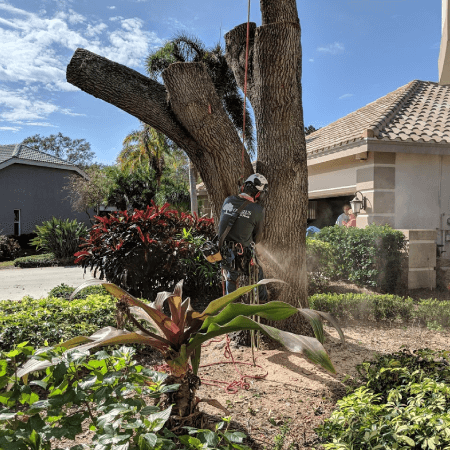
Resilient Roots Storm Readiness Program
Resilient Roots is our storm readiness program for your trees and the property around them. It is built around a tree and landscape risk reduction assessment and structural pruning, with plant health care where it fits, to help get your trees ready for hurricane season. The assessment is free for new and existing clients.
What the Program Includes
The program has three parts.
- A tree and landscape risk reduction assessment. We walk the property, record each tree in our tree inventory software, look at the trees and what sits under them, like the house, the driveway and the places people use, and give you recommendations sorted by priority.
- Structural pruning. Pruning to build or keep a strong branch structure, done to ANSI A300, the national pruning standard. Our tree pruning page explains the types of pruning we do.
- Plant health care. Care aimed at lowering the stress a tree is under, so it may have more in reserve when a storm comes.
You are not obligated to use O’Neil’s for any of the recommendations. If you want to take the list to another company, or handle some of it yourself, that is your call. We would rather you make an informed decision than a rushed one.
What the Assessment Looks For
The assessment is a walk of the property with one of our arborists. What I look for are the things most likely to break or come down in high wind:
- Dead or weak branches. Dead limbs, broken hangers, and branches with poor attachments.
- Overly dense canopies. The canopy, or crown, is the leafy top of the tree. A crown that has grown crowded may need careful reduction, not stripping out the inside.
- Defects. Structural weak points such as co-dominant stems, two trunks of about equal size growing from one point, and included bark, bark trapped in a tight V between them. Our page on tree defects goes through the common ones.
- Potentially hazardous trees or limbs. Trees or parts of trees that could fail and hit something or someone.
Hurricane research from the University of Florida Institute of Food and Agricultural Sciences, UF/IFAS, lists signs that suggest decay inside a tree, including cracks, seams, a swollen trunk base, dead branch stubs, and large old wounds, and notes that mushrooms at the base of the trunk might point to root problems, according to Wind and Trees: Lessons Learned from Hurricanes (FR173).
At the end you get our recommendations, sorted by priority, so you can see what matters most now and what can wait. You also get an approximate value of the trees we inventoried, figured with the appraisal method arborists use, because it helps to know what is at stake when you decide what to do. Some trees may need more than this walk-through. If a tree needs a formal, documented risk rating, that is a separate service, our tree risk assessment.
Why Structural Pruning Matters
Structural pruning has research behind it. After Hurricane Andrew hit south Florida in 1992, researchers compared trees that had been pruned properly with trees that had not. Among broad-leaved trees, 73 percent of the pruned trees survived compared to 47 percent of the unpruned ones, according to UF/IFAS FR173.
In that study, properly pruned meant not topped, with more open and well-distributed crowns. The same publication recommends a preventive structural pruning program for both young and mature trees.
It also warns that poor pruning, such as topping or removing large branches, makes trees more likely to fail in wind. Large pruning cuts can let in the fungi that start decay, which can weaken the tree years later.
What We Will Not Do
- No topping. Topping means cutting the top of the tree back to stubs. It can lead to decay and leaves the tree more likely to fail in wind.
- No lion-tailing. UF/IFAS Extension in Miami-Dade describes lion-tailing as removing small branches and leaving the foliage only on the end.
- No heavy cutting in one visit. The International Society of Arboriculture, ISA, says that generally no more than 25 percent of the crown should be removed at once, and less for mature trees, in its Pruning Mature Trees guide.
- No hurricane cuts on palms. UF/IFAS Extension advises against removing green or yellow palm fronds, and to keep the fronds above the 9 o’clock to 3 o’clock line, in Preparing Palms for Hurricane Season. Green fronds help the palm’s stability and health. Fronds that are completely brown can come off.
Plant Health Care: What It Can and Cannot Do
Fertilization does not make a tree wind resistant.
In my opinion, a healthy tree with less stress, or none, may be better able to survive a storm, especially if it is compromised at all. A tree with more energy reserves, and more capacity to refill them, may have more to recover with after it loses leaves and limbs. That is why plant health care is part of this program.
Pest control is a different matter. In my opinion it is not a hurricane measure. Boring insects and termites are generally not a big factor in a storm unless they have already compromised the strength of the wood.
Timing: Before the Season, Not Before the Storm
The Atlantic hurricane season runs from June 1 to November 30, according to the National Hurricane Center. Pruning is best done well ahead of a storm, not as one is on the way.
The City of Lake Wales asks residents not to cut back trees or do major yard work once a storm has been named, because debris left at the curb may not be collected before landfall and can become flying debris. Miami-Dade County says not to begin any pruning during a Hurricane Watch or Hurricane Warning.
If you want the work done before the season, it helps to contact us early. If a storm has already come through, our storm response page covers what to do and what we do.

Resilient Roots FAQ
Start with an assessment of the trees closest to your house and the places people use. Deal with dead and weak branches, defects, and trees that may be hazardous, and have structural pruning done before the season rather than when a storm is named.
Yes. The assessment is free for new and existing clients. You get recommendations sorted by priority and an approximate value of the trees we inventoried, with no obligation to use us for the work.
Proper pruning appears to help. A UF/IFAS study after Hurricane Andrew found 73 percent of properly pruned broad-leaved trees survived compared to 47 percent of unpruned trees. UF/IFAS also notes that topping and removing large branches make trees more likely to fail in wind.
No. UF/IFAS Extension advises leaving green and yellow fronds on the palm and removing only the ones that are completely brown. The green fronds help the palm’s stability and health.
Fertilization does not make a tree wind resistant. A tree under less stress may be better able to survive a storm and recover afterward, which is why plant health care is part of this program, but it is not a substitute for good structure.
In my opinion, no. Boring insects and termites are generally not a big factor in a storm unless they have already weakened the wood.
No. The recommendations are yours to use however you want, with us, with another company, or on your own.