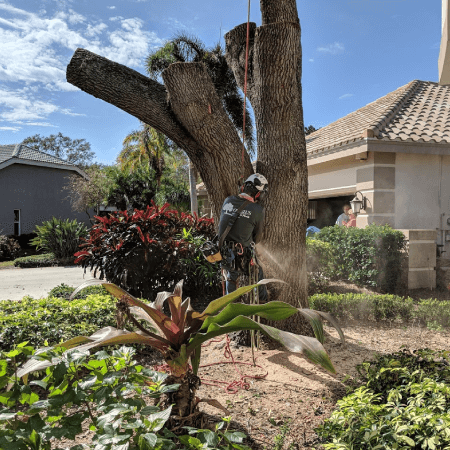
Emergency Storm Tree Removal in Clearwater and Palm Harbor, FL
O’Neil’s Tree Service responds to storm-damaged trees throughout Clearwater, Palm Harbor, and Pinellas County. Our ISA Certified Arborists assess what needs to come down now, what can wait, and what can stay. We answer the phone 24 hours a day and have been doing this work in Pinellas County since 2008.
The Same Standard, Extended to Your Whole Property
The hour after a storm is not the time to start cutting. Stay clear of any tree that has contacted a power line, is leaning against your structure, or has an obvious root plate lift. Call your utility provider first if lines are involved, then call us.
One of the most dangerous situations on a storm site is a loaded tree or limb that is partially supported by something else. The weight builds up enormous stored energy. When you cut the wrong place, that energy releases instantly. I had a piece come back on me on a job and the impact was so severe I thought my leg was gone. It hit the side of my knee. I saw it coming and managed to jump enough that my foot was not planted when it hit. The doctor told me if I had been planted it would have been a shattered knee, MCL and ACL tears, and over a year of recovery. I was not able to walk the following day. Do not cut into a loaded situation without training and the right equipment.
Spring poles are another hazard that gets less attention than widow makers but may be more common. A spring pole is a tree or limb that has been bent under load and is under tension. When you cut it, it releases violently in the direction of its stored energy. Widow makers, which are broken limbs still partially attached and elevated, are the other thing to watch for. Both look stable. Neither is.
If you can see a broken branch that is still partially attached and elevated, stay out from underneath it until we can get there.
When a tree is resting on a house, the safest removal is usually a crane. It lifts the tree off under control instead of cutting weight loose over the roof, and lifting nearly eliminates additional damage on the way out; cutting it off in place or dragging it with ropes tends to add roof punctures, ripped gutters, and torn soffits to the claim.
Steps to take right now:
Keep people and pets away from any visibly damaged trees until assessed
Photograph the damage from a safe distance for your insurance records
Do not attempt to remove hanging branches from a ladder; electrocution from downed or hidden lines is a serious risk in storm situations
Call O’Neil’s at (727) 599-7548; we answer 24 hours a day
If a tree has hit your home, notify your insurance carrier as soon as you can and ask what they need from you
If a tree has hit your home: our emergency response process
We can respond right away. We carry an emergency agreement that lists our rates for every type of storm work, so you see the price before we start. Florida no longer allows assignment of benefits on property insurance policies issued or renewed since January 1, 2023, so you sign our agreement and pay us directly. We give you a detailed, itemized scope of work, photos, and an invoice to submit to your insurance company, and we are glad to explain our bid to your adjuster. We do not negotiate your claim or interpret your policy; a licensed public adjuster or an attorney can help with that.
Before we roll a full crew, we ask a few questions and request photos so we show up with the right equipment. Whether your policy covers the removal is between you and your carrier. In general, a tree that damaged your home, a fence, a shed, or another structure is more likely to be covered than one that came down in the yard without hitting anything, so if coverage will affect your decision, it is probably best to call your carrier before the work starts.
Assessment First. Removal Second.
We have been on thousands of post-storm sites. The trees that actually need to come down and the trees that look alarming but are structurally sound are two very different groups. Telling them apart is what a BCMA or TRAQ-qualified arborist does.
A root plate that has partially lifted is often a removal. In some cases, if there is nothing the tree can hit and the root plate has not fully separated, crown reduction can remove enough weight to make the tree manageable long-term. The Turner’s Oak at Kew Gardens in England is the best-known example: the 1987 storm partly lifted it out of the ground, and it is still growing there today. That is the exception, and every situation is evaluated on its own.
A crown that lost several large limbs but still has an intact root system and a sound leader may be a candidate for structural pruning and monitoring. A leaning tree that was already leaning before the storm is a different conversation than one that just tipped in high winds.
We assess the root system, the crown, the attachment points, and what the tree is near. We give you written information, often with university sources that speak directly to the issue, not a verbal opinion from someone standing in your driveway or worse from a photo.
After hurricane Milton, we had a new client in Palm Harbor near CR1 and Alderman. He had a co-dominant included stem fail and hit his garage. He was home when it happened. Luckily it missed the living space and he avoided water intrusion, but the event shook him. I spent a couple of hours with him at the site going through Frank Rinn’s research on crown reduction and shell wall mechanics, trying to help him see that the trees that remained were manageable. He understood the science. The fear was still too great and he removed most of them. The hard part is knowing that with proper reduction pruning and a cable on that co-dominant stem, that limb would never have moved. The damage and the fear that followed it were both preventable. That is the real cost of skipping the work. And when fear drives removal of every tree on a property, the neighborhood gets hotter, less comfortable, and less livable. Trees need proper care, not removal driven by a single bad event.
Before Hurricane Season: What Actually Reduces Risk
Florida hurricane season runs June 1 through November 30. We schedule structural pruning and crown reduction year-round, but the demand spikes as June approaches. If you want it done before the season, contact us early. Once schedules fill in April and May there is nothing we can do about timing.
Structural pruning and crown reduction is the most effective thing you can do. Reducing end-loading on long lateral branches, removing co-dominant stems that are competing with the main leader, and clearing deadwood all reduce the mass that wind can act on. Topping does not accomplish this. It creates new problems, increases decay, and produces multiple weaker stems that fail more in high winds than the original crown.
During recent hurricane events including Irma and Milton, clients who had followed our pruning recommendations did not call us for emergencies. They did not have any. That is not a coincidence.
A pre-season tree risk assessment by a TRAQ-qualified arborist identifies trees that are likely to fail before they fail. We look for root plate issues, significant decay, cabling candidates, and trees that have grown into structural hazards over the past year.
What a pre-season visit typically covers:
Structural pruning and crown reduction to reduce wind load on high-priority trees
Removal of deadwood greater than 2 inches throughout the crown
Co-dominant stem evaluation and cabling or bracing where appropriate
Root plate and basal decay inspection
A conditional rating that accounts for structure, health, and form
Written risk assessment with priority rating available for any flagged trees
A Word About Door-to-Door Tree Companies After Storms
After every major storm in Pinellas County, crews appear overnight. They knock on doors, offer cash deals, and want to start cutting the same day. Some of them do decent work. Many of them do not, and once the work is done they are gone.
One consequence that does not get enough attention: companies that do not document their work properly can leave you without the paperwork your insurance company needs to process a claim. Our proposals contain enough detail that clients have used them successfully with their carriers without any additional documentation.
Ask for proof of general liability and workers’ compensation insurance before anyone sets foot on your property. A workers’ compensation exemption form is not the same as workers’ compensation insurance. If someone is injured on your site by an uninsured crew, you may be held financially responsible. Get a written proposal before work begins. Verify ISA credentials at treesaregood.org.
We are a Pinellas County company with a permanent address, a crew that carries general liability and workers’ compensation insurance, and ISA Certified Arborists directing every job. We have been here since 2008 and we will be here after the next storm too.
Why O’Neil’s for Storm Work
Apollo O’Neil holds the Board Certified Master Arborist (BCMA FL-6102B) credential, the highest individual certification offered by ISA
Multiple ISA Certified Arborists on staff, including TRAQ-qualified personnel for risk assessment
ISA Certified Arborists directing every job
Full general liability and workers’ compensation insurance
Crane-assisted removal capability for trees that cannot be cut by hand
Written assessments and proposals before any work begins
We answer the phone 24 hours a day
Pinellas County based since 2008

Storm Tree Service
Storm Tree Service FAQ
Is my storm-damaged tree an emergency or can it wait?
It depends on what the tree is near. A tree that has fallen on your home, is blocking access to a structure, has a fully lifted root plate, or has hanging limbs over an occupied area is an emergency. A tree that lost a major limb into an open yard and is otherwise stable can usually wait for a scheduled assessment. When in doubt, call us and describe what you are seeing. We can help you determine urgency over the phone.
Do you provide emergency response after storms?
Yes. We prioritize emergency calls after named storms and significant weather events. Call (727) 599-7548. We triage by severity, the same way an emergency room does: trees on homes and widow maker situations first, then hazardous leans and root plate failures, then everything else. We answer the phone 24 hours a day and will be honest about our schedule and response time.
Does homeowner’s insurance cover storm tree removal?
Sometimes. Coverage depends on the cause of loss, where the tree fell, and whether it caused structural damage. A tree that fell on your home is much more likely to be covered than one that fell into your yard without hitting anything.
Document everything before work begins: photograph the tree, the damage, and the surrounding area. Contact your carrier as soon as possible.
Most homeowners policies include a reasonable repairs or reasonable emergency measures provision. It pays the reasonable cost of protecting your home from further damage after a covered loss, usually up to a set limit; some Florida policies cap it at the greater of $3,000 or 1% of your dwelling coverage unless your insurer approves more. Your policy also expects you to protect your home from further damage, so if a tree has opened your roof to the weather, you generally should not wait on an adjuster to have it made safe. Policies vary, so call your carrier, document everything, and keep every receipt. We can provide a complete written scope of work for your insurance claim. Your deductible and the debris removal cap often decide whether filing is worth it at all, and both are explained in our insurance and tree removal guide.
Can a storm-damaged tree be saved, or does it have to come down?
Many storm-damaged trees can be saved with proper crown restoration pruning, cabling, or a monitoring program. The key factors are the extent of crown loss, the size of the wounds, tree vigor, whether the root system is intact, and the structural integrity of the remaining leader. Trees that have lost more than roughly a third of their crown, or have large wounds, require careful evaluation.
We assess each tree individually and give you the information you need to make the decision: what the risk looks like, what the biology is doing, and what ongoing care would cost. The cost of caring for a damaged or older tree is higher than caring for a healthy younger one, and that factors into what makes sense long-term. Our goal is not to tell you what to do. It is to make sure you have everything you need to decide. Good doctors work the same way.
Should I have my trees pruned before hurricane season?
Crown reduction, reduction pruning, and structural pruning before hurricane season is one of the most effective things you can do to reduce wind damage to your trees and your property. The goal is to reduce end-loading on long laterals, remove deadwood, and address co-dominant stems with narrow attachment angles. This is not the same as topping, which is counterproductive and increases failure risk. We schedule this work year-round. Contact us early; our schedule fills up as June 1 approaches.
Do you need a permit to remove a storm-damaged tree in Pinellas County?
Permit requirements vary by municipality. Florida Statute 163.045, as amended in 2022, prohibits local governments from requiring permits, fees, or mitigation for removal of a tree on single-family residential property when the property owner possesses documentation from an ISA Certified Arborist or Florida licensed landscape architect confirming the tree poses an unacceptable risk. Under the statute, a tree poses an unacceptable risk when removal is the only means of practically mitigating its risk to below moderate, as determined by the ISA Best Management Practices Tree Risk Assessment protocol. We can provide that documentation. We handle permit questions as part of our assessment process and will tell you before work begins what is required. Size can change the answer too. A large protected tree may be handled differently even after a storm (in unincorporated Pinellas County that line is 24 inches DBH on a homestead, and each city sets its own), and the city-by-city rules are in our tree removal permit guide, and most local codes allow emergency removal of a tree, or the part of it that is on a structure or blocking access, without a permit first, though some require notice or a permit afterward.
Call O’Neil’s Tree Service
For storm response, pre-season pruning, or a tree risk assessment, call (727) 599-7548 or use the contact form below. We answer the phone 24 hours a day and serve Clearwater, Palm Harbor, and throughout Pinellas County.