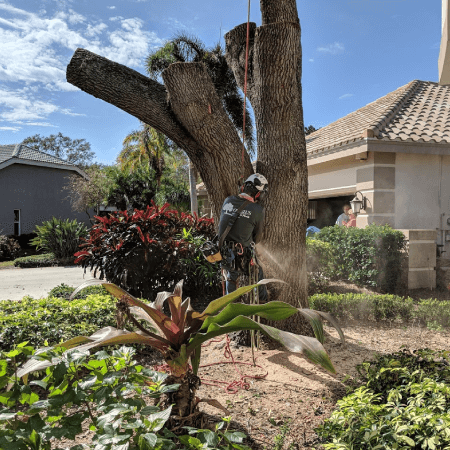
Tree Service in Safety Harbor, FL
O’Neil’s Tree Service provides certified arborist tree care throughout Safety Harbor, FL, including structural pruning, tree removal, plant health care, cabling, and risk assessment. Our team includes a former Safety Harbor city arborist with direct experience preserving the city’s most significant trees. ISA Certified and BCMA qualified. Serving residential and commercial properties from Bayshore Boulevard to Philippe Park.
Why Safety Harbor Trees Need Specialized Care
Safety Harbor sits on the eastern shore of Old Tampa Bay, where mineral springs, shallow coastal soils, and salt exposure create conditions most tree service companies don’t account for. The city’s tree canopy includes mature Southern live oaks, pignut hickories, laurel oaks, sabal palms, and slash pines, many of them decades old and growing in restricted root zones along downtown streets and waterfront parks.
The downtown corridor between Main Street and the waterfront presents a specific challenge: large trees planted in small curb extensions at intersections. Some have outgrown their planting space, causing infrastructure damage. Others show upper canopy dieback from root restriction. These trees need targeted management, not generic trimming.
Hurricane exposure is a recurring factor. Irma in 2017 demonstrated what happens when trees with decay, structural defects, or inadequate rooting space meet sustained winds. Trees between sidewalks and roads with minimal soil volume were among the first to fail. Proper structural pruning and health care before storm season is the most effective protection.
Neighborhoods We Serve in Safety Harbor
We work throughout Safety Harbor and the surrounding area, including properties along Bayshore Boulevard, the downtown historic district, neighborhoods near Philippe Park, Waterfront Park, and the residential streets between Main Street and McMullen Booth Road. We also serve Oldsmar, Clearwater, and Palm Harbor from our Palm Harbor office.
Heritage Trees and Urban Tree Preservation
Safety Harbor is home to some of the most significant live oaks in Pinellas County. The Baranoff Oak, the Pipkin Oak (81” DBH, the largest in the city), the Tree of Knowledge, the Elf Oak, and the Cross Legged Oak are all part of the city’s Trail of Trees, a mapped walking route highlighting 40 notable specimens.
Our PHC manager, Art Finn, served as Safety Harbor’s first city arborist. He was hired after public outcry over the removal of large live oaks for a parking lot expansion at the Safety Harbor Spa in 2015. Before that, the city had no arborist reviewing development sites and relied on Pinellas County for construction plan review.
Art was directly involved in the preservation of the Baranoff Oak, working alongside arborists Joe Saminick and Loren Westenberger when the tree began declining from root compaction and construction damage. That project included fungicide applications, crown misting systems, stainless steel branch supports, soil nutrition programs using composted oak leaves and targeted fertilizer, air spading on a five-year cycle, and lightning protection. O’Neil’s installed the stainless steel props on the Baranoff Oak and continues to maintain the Baranoff Oak, Pipkin Oak, Elf Oak, and several other named trees to this day. The same disciplined, long-term approach applies to every property we manage.
Tree Services Available in Safety Harbor
Structural and reduction pruning per ANSI A300 standards, performed by ISA Certified Arborists. Crown cleaning, deadwood removal, crown raising for clearance, and canopy reduction for wind resistance. Learn more about tree pruning.
Tree removal for dead, declining, or structurally compromised trees, including crane-assisted removals in tight-access properties. Stump grinding available. Learn more about tree removal.
Plant health care programs including organic soil therapy, trunk injection, fungicide treatment, growth regulator application, and soil testing. We use a diagnostic approach: soil samples, leaf tissue analysis, and pathology assessment before recommending treatment. Learn more about plant health care.
Tree risk assessment using ISA TRAQ methodology for homeowners, property managers, HOAs, and developers. Construction tree preservation plans for sites with protected trees. Learn more about tree risk assessment.
Cabling and bracing for structurally vulnerable trees, including co-dominant stems and heavy lateral limbs. Lightning protection installation and inspection.
Palm Health in Safety Harbor
Palms are a significant part of Safety Harbor’s landscape, and they face specific threats. Ganoderma butt rot is the number one killer of palms in Safety Harbor. Poor drainage, nutrient deficiencies, and improper pruning are also common contributors to palm decline. Some Bismarck and date palms in the area have been lost to palm weevil damage.
Lethal bronzing disease and Fusarium wilt have not been widespread in Safety Harbor to date, but both are present in the Tampa Bay region and worth monitoring. If you have palms showing frond discoloration, premature fruit drop, or basal conks, an assessment can determine what’s happening before the problem advances.
Recent Projects in Safety Harbor
Downtown Main Street Oak Management
Safety Harbor planted oak trees in small curb extensions at downtown intersections in 2001. Some trees outgrew their planting space, causing sidewalk and curb damage. Others showed upper canopy dieback from root restriction. The city’s approach included Shortstop growth regulator applied as a basal drench to slow top growth and redirect energy to root development, removal of concrete sidewalk sections to expand rooting area, and installation of Flexipaver permeable surfacing to improve water and air infiltration to root zones.
Second Street Sylva Cell Installation
When a retail and apartment development on Second Street North required the removal of mature street oaks, the city secured $23,000 in tree mitigation funds. Rather than replanting into the same undersized tree wells, the mitigation money funded Sylva Cell installation under sidewalks and parking areas, with porous concrete in the rear walkways. The replacement oaks are thriving because they have adequate below-grade rooting volume.
Baranoff Oak Preservation Program
The Baranoff Oak (78” DBH live oak) had been declining from decades of soil compaction caused by yoga classes, events, and surrounding construction that reduced its root system. The long-term preservation program includes stainless steel branch supports, weed management with selective herbicide and hand pulling, nutrition using composted coffee grounds, 0-0-22 potassium fertilizer (two applications per year), and six inches of oak leaf mulch applied each February. The soil under the tree has become spongy and forest-like. Air spading is performed every five years, and the lightning protection system is inspected every two years.
Waterfront Park Restoration
When the City of Safety Harbor purchased 20 acres from the Safety Harbor Spa for $1 million, two acres were a solid mass of Brazilian pepper. The invasive species were removed, the area graded to create a saltwater marsh, and over 12,000 wetland plants were installed with help from Tampa Bay Estuary Program and local school volunteers. Upland plantings included live oaks, slash pines, wax myrtle, Simpson stoppers, beautyberry, and sabal palms. The boardwalks are built from ipé (Brazilian walnut), one of the hardest and most rot-resistant woods available.
Why Safety Harbor Residents Choose O’Neil’s
Our PHC manager helped build Safety Harbor’s urban forestry program from scratch. He knows the trees, the soil, the storm history, and the development pressures that shape this city’s canopy. That institutional knowledge, combined with BCMA-level diagnostic capability and ISA Certified climbing crews, means your trees get care based on what they actually need.
We are not a trim-and-go operation. Every assessment starts with a conversation about what your trees need now, what they’ll need in five years, and what you can skip entirely. We follow ANSI A300 pruning standards, use TRAQ methodology for risk evaluation, and run plant health care programs built on soil science, not guesswork.
Request An Assessment

Safety Harbor Tree Service FAQ
Yes. Safety Harbor adopted a tree ordinance in 2015 (Article X of the Land Development Code) and added a Grand Tree Ordinance in 2021. Any protected tree, defined as a living shade tree 4 inches DBH or greater, a sabal palm with five feet of clear trunk, mangroves, or any species on the city’s Protected Tree and Replacement List, requires a permit before removal.
The one exception is Florida Statute 163.045, which says a local government cannot require a permit if the property owner has documentation from an ISA Certified Arborist or licensed landscape architect showing the tree poses an unacceptable risk. Under the statute, a tree qualifies if removal is the only way to practically mitigate its risk below moderate, based on ISA Best Management Practices for Tree Risk Assessment. In practice, fewer than 2% of trees fall into this category. The word “practically” in the statute introduces some subjectivity, but the standard is clear: most trees can be managed below moderate risk through pruning, cabling, or other treatments without removal.
If you need a tree removed, start with a certified arborist assessment. We can determine whether the tree qualifies under the dangerous tree exemption or whether a permit application is the right path.
Ganoderma butt rot is the most common cause of palm death in Safety Harbor, especially in queen palms. It produces shelf-like conks (fungal fruiting bodies) at the base of the trunk. There is no proven cure for Ganoderma once it is established, though some fungicide applications have shown limited success extending the life of infected palms. Early identification matters because infected palms can become structural hazards. Ganoderma can also persist in the soil, making it difficult to replant any palm species in the same location. Learn more about Ganoderma.
Often, yes. Growth regulator applications (basal drench) can slow canopy expansion while redirecting energy to root development. Expanding the rooting area by removing concrete and replacing it with permeable surfacing like Flexipave improves water and air access. In some cases, Sylva Cells installed under adjacent hardscape provide additional below-grade soil volume. The approach depends on how much root system remains and how much infrastructure conflict exists.
Irma caused significant tree failures throughout Safety Harbor. Trees with pre-existing decay, co-dominant stems, and restricted root zones were the most likely to fail. Heavy-fruited species like chinaberry and weak-wooded species like eucalyptus were disproportionately affected. One large pignut hickory intertwined with power lines kept the north side of town without power for a week. Structural pruning and health care before storm season reduces the likelihood of catastrophic failure.
The Trail of Trees is a mapped walking route through Safety Harbor highlighting 40 significant trees, including the Baranoff Oak, Pipkin Oak, Tree of Knowledge, Elf Oak, and Cross Legged Oak. The trail was created to bring public attention to notable trees and improve their protection. Named trees tend to receive better community stewardship. Our PHC manager developed the trail during his time as the city’s arborist.
Yes. We work with commercial property managers, HOAs, and developers throughout Safety Harbor. Services include routine pruning programs, tree risk assessments for liability management, construction tree preservation plans, and ongoing plant health care. We can provide CAM continuing education documentation where applicable.