Tree Touching Power Lines: Will Duke Energy or TECO Trim It, or Do I?
It depends on which line. Duke Energy manages trees along its main lines on the poles and takes trimming requests. The line from the pole to your house, the service drop, is the property owner's to keep clear, and when the tree work needs it, Duke will drop the service line at no cost. Tampa Electric (TECO) rules are similar.
If a Tree Is Touching a Line Right Now
- Stay back, and keep kids and pets back. Duke Energy says to consider all power lines, and trees, limbs and anything else in contact with them, energized and dangerous. Duke Energy power line safety.
- Do not touch the tree, prune it, or pull on it. Not with a pole saw, not with a rope, not with a ladder against it.
- Report it. Duke asks people to report all power line hazards to Duke Energy at 800.228.8485. If a line is down, sparking or burning, call 911.
- Then call an arborist about the tree itself, once the line is safe.
Which Line Is Which?
- Primary lines, the main high voltage lines, usually the highest wires on the pole. These are Duke’s to keep clear.
- The service drop, the low voltage line that runs from the pole to the meter on your house. Duke calls this the service line. This is the one the owner keeps clear.
- Cable, phone and internet lines, which a utility explainer from Entergy says are typically the lowest wires on the pole. Entergy, what’s on that pole. Those belong to the cable or phone company, not Duke.
Something I look for on a site visit is the tip of a tree touching the top wire. The leaves at that spot are often dried and brown while the rest of the tree is green. People tend to notice the cable lines lower down and miss the primary above them.

What Duke Energy Trims, and When It Removes a Tree
Duke says it evaluates every tree trimming request it gets from customers. A vegetation specialist looks at the site, urgent threats to the lines go first, and some requests are found unnecessary. Trees that are not affecting reliability are looked at during the next regular trimming cycle. Duke Energy tree trimming practices.
Duke does remove trees in some cases. Its FAQ says that if a tree poses a significant reliability risk, or cannot be trimmed in a way that gives enough clearance until the next cycle while keeping it healthy, the tree may be taken down. Duke says it generally asks permission before removing trees in maintained or landscaped areas, except in emergencies. Duke Energy trees and rights of way FAQ.
In my experience, Duke almost never removes a tree unless it has no choice: the tree is an imminent threat to the line, or, during routine maintenance, the species will keep growing into the line and stay a problem. That is most often a palm growing right under the line. Once a palm reaches the wires there is no way to prune it to grow away from them, because a palm grows from a single bud at the top.
On planned work, Duke says larger wood is cut into 18 to 24 inch lengths and left on site.
The Line From the Pole to Your House
A lot of the calls we get are about this line. Duke’s FAQ says that when a tree is interfering with the line between the pole and the meter at your home, the property owner has primary responsibility to keep that line clear of trees and vegetation.
The same FAQ says that if you, or a private contractor, are doing any work around your service line, Duke asks you to contact them, and Duke will drop the service line at no cost before the tree work. If a tree or limb is severely affecting the service line, you can still submit a trimming request and a Duke representative will evaluate it.
If you hire us for that work, the service line often does not have to come down at all. Many times we can trim the tree so it has clearance without touching the line. When it does need to come down, we call Duke, and Duke will drop the service line before we start, at no cost to you. Our crews keep 10 feet away from power lines, and anyone on the crew can stop a job if something near a line does not look right. Our tree trimming page covers the rest of how we trim.
The primary lines are a different story. On the 7,200 volt lines and higher, if we cannot trim or remove the tree from 10 feet away, the line has to be de-energized first. That is quite a process. The utility has to plan it ahead and notify everyone in the neighborhood of what is happening and about how long the power will be off, and utilities are reluctant to do it, so setting it up can take a long time, sometimes months.
We had one tree on the same line as a bank, and getting it out was a nightmare. We had to show that the tree could not be removed safely without de-energizing the line, and the power could not go off until the bank was secure. It took a while to set up. It was too much risk to human life to do it any other way.
How to Ask Duke to Trim a Tree
- Go to Duke’s tree trimming request page. Duke asks you to first make sure a primary power line is the one affected.
- If the tree poses a risk to the reliability of the primary lines, Duke says a vegetation management professional will follow up with you within 10 business days.
- For the line to your house, call Duke customer service, and Duke will drop the service line before anyone works near it.
Anyone can report an unsafe condition through Duke’s Contact Us page.

If Your Power Comes From Tampa Electric (TECO)
Tampa Electric serves Tampa and some nearby areas, and its rules on the line to your house are close to Duke’s. Its tree trimming page says customers must keep their service wires clear of vegetation, and that Tampa Electric will, on request, de-energize or “drop” the service wire so the work can be done safely. It also says only qualified line clearance trimmers may work within 10 feet of an electrical line.
To report limbs on Tampa Electric’s lines, use the tree limbs form on Tampa Electric’s website or call Customer Care at (888) 223-0800. If you hire us for a tree near a Tampa Electric line, we make that call for you, the same as we do with Duke.
Can a Regular Tree Company Work Near Power Lines?
Only with the right training, and only so close. OSHA, the federal workplace safety agency, says workers who are not qualified must keep at least 10 feet from overhead power lines of 50,000 volts or less, plus 4 inches for every 10,000 volts above that. Line-clearance tree trimmers are workers with specialized training to work within that 10 feet. OSHA line-clearance tree trimming. Duke’s FAQ repeats the 10 foot rule and cites OSHA and ANSI Z133, the tree care industry’s safety standard.
Z133 sorts tree workers into electrical levels. In the 2026 edition, Level 1 is not qualified for any voltage, Level 2 covers 750 volts or less, the range of most service drops, Level 3 covers up to 35,000 volts, and Level 4 is line clearance for all voltages. Line-clearance work is defined as work done for the utility, not for the homeowner. TCIA on ANSI Z133-2026. A tree company working for a homeowner is expected to notify the utility before working inside the distance its crew is allowed. TCIA, work near utility conductors.
So before you hire anyone for a tree near a line, ask how close their crew is trained to work, and whether they will have Duke de-energize the line first. Our page on whether your tree is dangerous covers what else to look at from the ground.
Why Utility Trimming Can Look Lopsided
Duke says its pruning is lateral and directional: each limb is removed where it joins another limb or the trunk, and it does not round trees over because that contributes to poor tree health. It also says it does not prune for light levels or for looks.
That kind of pruning trains the tree. Directional pruning sends growth away from the line, and on a hardwood like an oak, cutting back the branches that grow up into the line, cycle after cycle, starts to form the V shaped tree you often see under power lines. Pruning shapes how a tree grows as it develops.
That can leave a tree with a V or an L cut through it. In my opinion that usually looks worse than it is for the tree, and it is often better for the tree than a flat top cut, which tends to bring back weak sprouts. We usually do not recommend balancing it out right away. The tree has already lost a lot of leaves, and taking more adds stress. In my opinion, it is better to let it grow back and recover for a while before doing anything else.
What does help after heavy utility pruning is working on the tree’s health and its growing space: building and amending the soil, mulching the root zone, and keeping the roots from being disturbed. Our plant health care work covers that kind of soil care.
If you think something was done wrong, contact Duke first. If that does not resolve it, the Florida Public Service Commission takes complaints about investor-owned electric utilities at 1-800-342-3552 or online. Florida PSC consumer brochure.
When a Tree Falls on a Line
Treat the tree and the line as live. The National Weather Service says to stay far away from damaged power lines, on the ground or dangling overhead, and to leave power tools to people trained to use them. NWS after the storm. Report it to Duke, and call 911 if the line is down or arcing.
Duke restores the line, but it says it does not clean up tree debris from severe weather; that is the property owner’s responsibility. If the tree hit your house, insurance may help; see our page on insurance and tree removal. As our storm page says, call your utility provider first if lines are involved, then call us.
A limb Duke left behind
Here is one from a job of ours. A storm broke a limb about 4 to 5 inches across out of a neighbor’s oak. On the way down it hit the primary line, and you can see the damage it did to the line. It came to rest on the cable and internet lines and on the corner of our client’s house.
The power went out, and Duke came in with large trucks to restore it. The line was fixed, but the trucks damaged our client’s driveway and yard pretty badly, and the limb was left where it fell. It was the neighbor’s tree, and our client did not notice until later that it was still hanging on the cable lines.
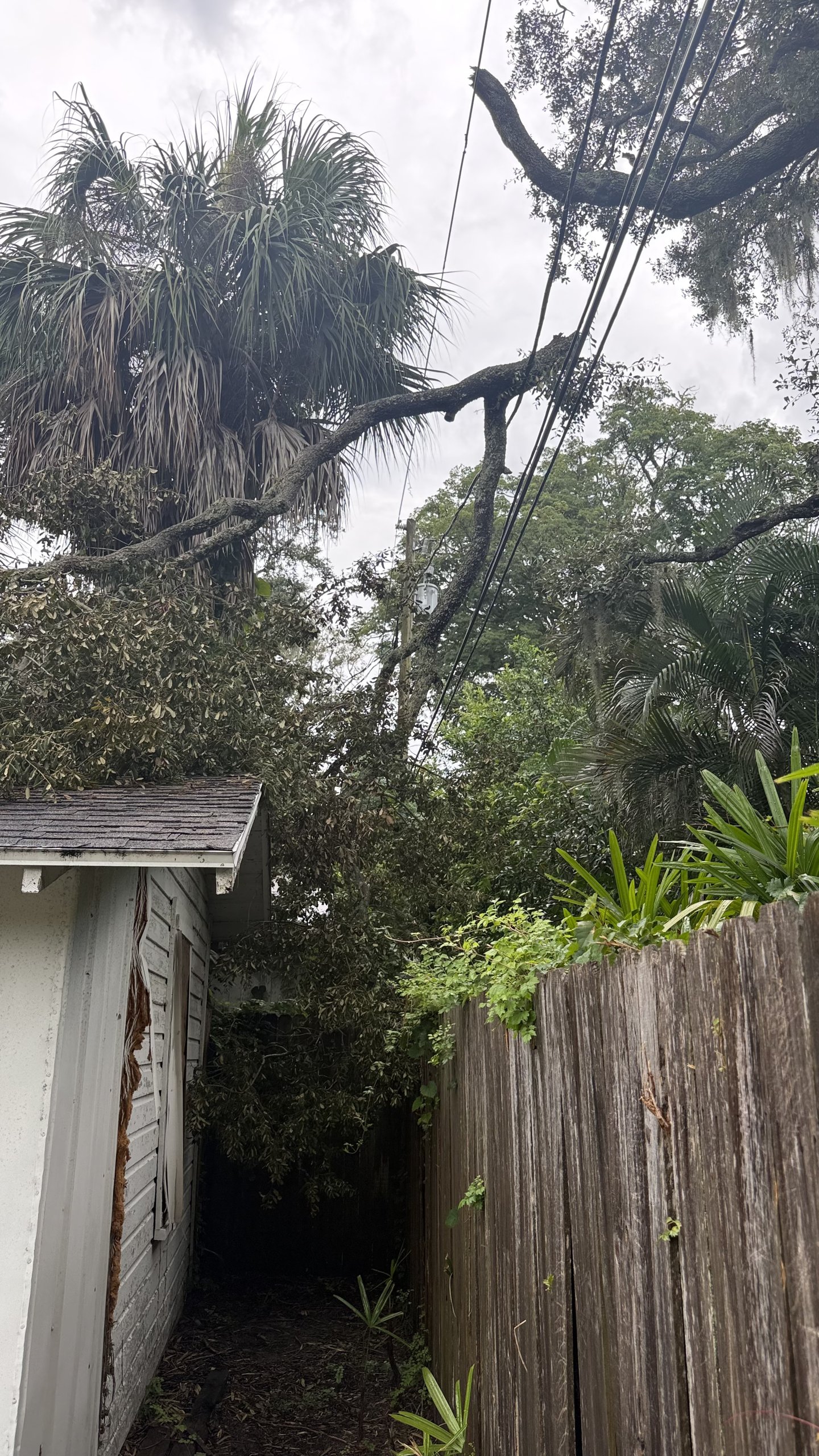
Our client was able to get Duke to come back and take it down, and I am glad they did. We could not have reached that limb with a lift or a bucket truck. It was about 100 feet from where a crane could set up, which would have meant a 60 ton crane or larger to lift a climber in, rig the piece and fly it out, all while keeping clear of the primary. A crane that size carries a minimum charge, and we would have had to lay down mats and cribbing to back it in close enough, then pick it all back up and break the crane down afterward. For one limb, that would likely have come to nearly $5,000. The climber cutting and rigging the piece would have been the quickest part of the whole job.
If something like this is left behind after a storm, it is worth calling the utility first and asking. It may save you a crane bill.
Planting So You Do Not Have This Problem Later
Duke Energy Florida’s Right Tree, Right Place guidance asks you to consider a tree’s size, shape and depth at maturity and how it will affect lines as it grows, never to trim trees around power lines yourself, and to call 811 before you dig, which it notes Florida law requires. It also asks for 10 feet of clear space in front of ground transformers, the green boxes, and 3 feet on the other sides. Duke Energy Florida tree guidance.
Under a line, that usually means a small tree. A decision you and your arborist can make before the hole is dug.

Trees and Power Lines FAQ
If the tree is affecting Duke’s main lines, Duke evaluates the request and trims or removes what it decides is needed. For the line from the pole to your house, the owner pays for the tree work, but when the work needs it, Duke will drop the service line at no cost so it can be done safely.
Tampa Electric says customers must keep their service wires clear of vegetation, and it will drop the service wire on request so the work can be done safely. Report limbs on its lines through its tree limbs form or Customer Care at (888) 223-0800.
Duke’s FAQ says the property owner has primary responsibility to keep the service line, from the pole to the meter, clear of trees. When the work needs it, Duke will drop the service line at no cost; call Duke before you or a contractor work near it.
In some cases. Duke says a tree may be taken down if it is a significant reliability risk or cannot be trimmed to give enough clearance while staying healthy. It says it generally asks permission first in maintained or landscaped areas, except in emergencies.
OSHA says workers who are not qualified must stay at least 10 feet from lines of 50,000 volts or less. Ask any company how close its crew is trained to work and whether it will have Duke de-energize the line first.
Stay far away, keep others away, and report it to Duke Energy at 800.228.8485; call 911 if the line is down or sparking. Do not try to cut the tree off the line yourself.
Start with Duke. If that does not resolve it, the Florida Public Service Commission takes complaints about investor-owned electric utilities at 1-800-342-3552 or through its website.