Tree Removal Cost Estimator: What Your Tree Might Cost to Remove
Answer six questions about your tree: its trunk size, yard, what it is near, its condition and how far a crane would reach. You get a price range built from what we charged on our own 2026 removals in north and mid Pinellas. It is a range, not a quote. The written estimate from the site visit is the price.
Your Tree, Your Range
The estimator is loading. If it does not appear, your browser may be blocking scripts; you can request a free written estimate instead.
What the Range Covers
The range adds up the lines you would see on our proposal for the tree you described:
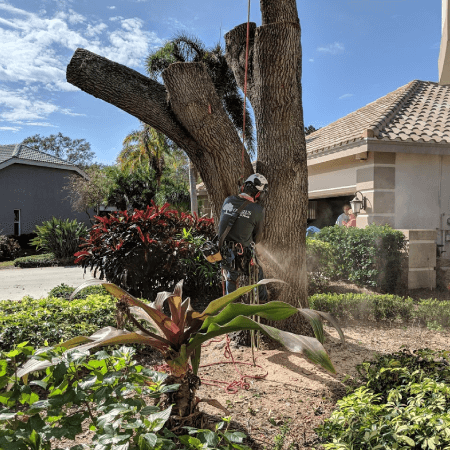
- The removal. Taking the tree down in pieces to a low stump, under ANSI Z133 safety rules, with an ISA Certified Arborist directing the work. Our tree removal service page covers how we do it.
- Debris hauling. Our grapple truck picks up the brush and wood and hauls it away. It is always its own line, priced by how much of a load your tree makes. If you want to keep the wood, the line comes down, but the brush still has to go.
- Stump grinding, if you add it. By default we cut the stump low and leave it. Grinding is its own line, and hauling the grindings away is another. Our stump grinding cost guide has this year’s numbers.
- A crane, when the tree is likely to need one. Big trees, and trees that cannot be climbed safely, get lifted out instead of lowered. The crane is its own line; our crane cost guide explains how it is sized.
Not in the range: a permit where your city requires one (the fee passes through and varies by city; see tree removal permits), a tree risk assessment letter where one is used instead of a permit, and any replanting your city’s mitigation rules call for.
Already have a bid? Our guide to reading a tree quote shows what each line should say and how to compare two bids.
Where the Numbers Come From
Every line comes from what we charged on our own 2026 removals, taken as a group by trunk size and yard: the removal itself, the debris hauling, the stump and the crane. No single job and no client appears anywhere in the tool. Our tree removal cost guide and the cost by height guide carry the same 2026 numbers in table form.
Two trees of the same size can still be very different jobs. A 28 inch oak with a clear drop zone in a front yard and a 28 inch oak over a screened pool cage in a tight back yard are not the same work, which is why the tool asks about the yard and what is under the tree, and why it gives a range rather than one number.
We test the tool against our own sold jobs, and we would rather the range run a little high than surprise you later. Nothing replaces the site visit, where one of our arborists measures the trunk, walks the drop zone and puts the price on paper.
How to Measure Your Trunk
Wrap a tape measure around the trunk at chest height, about 4.5 feet off the ground, and divide that number by 3.14. A trunk that measures 47 inches around is about 15 inches across; one that measures 75 inches around is about 24 inches across.
If the trunk splits into two or more stems below chest height, measure each stem and add the diameters together. That is how we size a multi-stem tree for pricing.
If you cannot get to the trunk, pick the closest size in the tool, or use the height choice as a rough guide. Height is the weaker ruler: a 60 foot slash pine with a narrow crown can be less work than a 35 foot live oak spread over a roof.
What Moves a Removal Price
- Trunk size. The biggest single factor. The trunk tells us how much wood has to come down.
- Front yard or back yard. Back yard removals typically run 40 to 50 percent more than the same tree out front. Every piece is lowered with care and carried or routed out through a gate, and turf needs protecting.
- What is underneath. A roof, a pool cage, a fence or a neighbor’s shed means smaller pieces and more rigging.
- Condition. A dead or decayed tree is often not safe to climb, so it is taken down from a lift or a crane.
- Power lines. Lines close to the tree change the plan. Lines touching the tree mean the utility trims or disconnects first.
- How many trees. The crew, the trucks and the setup come once, so several trees on one visit usually lower the price per tree.
How We Size a Crane
A crane gets used when the tree cannot be climbed safely, when big limbs hang over something that cannot be moved, or when there is no room to lower pieces by hand. Which crane depends on two things: how heavy the biggest piece will be, which follows the trunk size, and how far the crane has to reach from where it can park to the trunk.
Our rule of thumb is to keep about 3,000 pounds of working capacity at the reach for a tree up to 30 inches across, about 4,000 pounds up to 55 inches, and 5,000 pounds past that. Our own 55 ton knuckleboom handles most trees out to about 60 feet. Past that, or for heavier pieces, we rent a 40 to 45 ton boom truck or a 75, 120 or 240 ton crane, and each step up costs more because the machine, the transport and the setup all get bigger. On their load charts, the 45 ton boom truck holds 3,000 pounds out to about 80 feet; the 120 ton reaches 160 feet with its jib but holds only 3,000 to 5,000 pounds out there, depending on the jib it brings; the 240 ton, which we have rented for a big tree at a long reach, holds 5,000 pounds past 200 feet and runs around $18,000 for the day. The tool uses the reach you give it to pick the class and show its line, and past 160 feet it shows the price as a floor with “and up”; our crane cost guide explains the sizes in more depth.
When the Tool Sends You to a Person Instead
Some situations the tool will not put a number on, because we would not either without seeing it. A tree touching a power line waits on the utility. A trunk over 84 inches is a crane job planned on site. A tree that is already down gets a storm range, not a removal range: see the next section.
And not every tree that looks like it needs to come down does. A leaning tree is not automatically a hazard, and decay does not always mean removal. Our page on when tree removal is necessary walks through that decision, and a tree risk assessment can settle it.
After a Storm: What Emergency Removal Costs
Tick “Already down, or storm damaged” and the tool switches to what we charged on our own storm jobs, mostly the Hurricane Milton work in the fall of 2024, with Ian and Helene pointing the same way. Those prices are higher than a planned removal of the same tree, and they should be: crews are pulled off booked work, every crane in the region is spoken for, and a tree on a roof or a pool cage comes off in small pieces so nothing under it is crushed further. On our Milton jobs a tree on a structure ran about 1.4 times one lying in the yard.
Emergency work takes the large wood first. The thorough cleanup, the brush and the stump are priced once the emergency is handled, and in a declared storm the county often picks up curbside debris, which changes that line. Insurance usually covers removal when the tree has fallen on an insured structure or when getting it off prevents more damage; photograph everything before anything moves, and read our insurance and tree removal guide and our storm page. Then call us; storm work is priced on site.

Tree Removal Cost Estimator FAQ
It gives a range, not a quote. We check it against our own sold jobs and adjust it when they drift, and we would rather it run a little high than low. Unusual access, a tree that cannot be climbed, a palm, or a very large tree can land outside it. The written estimate from the free site visit is the price.
Debris hauling is always in the range as its own line. Stump grinding is included only when you tick it, since by default we cut the stump low and leave it. Hauling the grindings away is a further line.
Backyards typically run 40 to 50 percent more. Rigging takes longer, the wood has to be carried out or routed through a gate, turf needs mats, and equipment placement is harder. The tree is the same; the work around it adds up.
Not an honest one. The price depends on things we have to see: the drop zone, what is under the canopy, the gate width, the condition of the wood. One of our arborists comes out, measures, and writes it up. The estimate is free.
Often, yes. Clearwater, Pinellas County, Safety Harbor, Belleair, Largo and most Tampa Bay municipalities require a permit above their own size thresholds. We handle the permit process when it is required; the fee is its own line and is not in the tool’s range. Our tree removal permits page has the rules by city.
Tell the tool and it will stop there. The utility company trims or disconnects first; if we are hired, we call them and get the line made safe before our crew works. We can price the removal once we have seen it.
On our Hurricane Milton jobs, the emergency line for a tree with a 25 to 36 inch trunk mostly ran $4,000 to $10,750, with a crane on most of them as its own line, and a tree on a house or pool cage ran about 1.4 times one in the yard. The tool gives the range for your trunk size when you tick that the tree is already down. Insurance is usually involved; photograph everything first.
By how heavy the biggest piece will be, which follows the trunk size, and by how far the crane has to reach from where it can park. We keep about 3,000 pounds of working capacity at the reach for a tree up to 30 inches across, 4,000 to 55 inches and 5,000 past that. Our own 55 ton knuckleboom covers most trees to about 60 feet; past that we rent a 40 to 45 ton boom truck or a 75, 120 or 240 ton crane, and each step costs more.