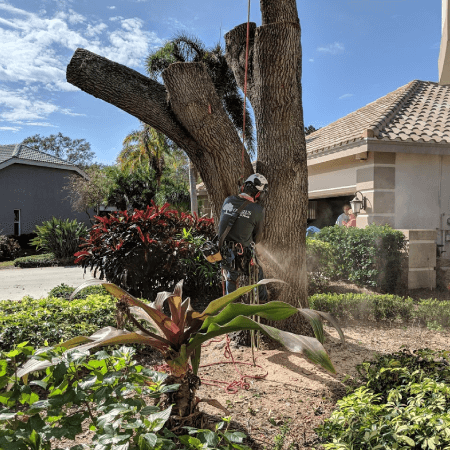
Can I Cut My Neighbor's Tree That Hangs Over My Property in Florida, and Who Pays If It Falls?
In Florida, you can generally trim a neighbor's branches and roots back to your property line at your cost, taking care not to badly harm the tree. If a healthy tree falls in a storm, your own insurance usually pays for your property. The neighbor may be responsible if the tree was dead or dangerous and they knew it.
The Branch Is Over My House Right Now. What Do I Do Today?
- Stay off the roof and out from under the limb. Do not cut a branch resting on the roof, a pool cage, or a wire yourself; a cut limb can shift or spring back.
- If the branch is touching or near a power line, keep everyone away and call your electric utility first. Our page on trees touching power lines covers who to call for which line.
- Take photos from your side: the branch, where it crosses the line, and anything it is touching. Note the date.
- Talk to your neighbor, then follow up in writing so there is a record of what you both saw.
- Have an arborist look at it. Our page on branches over the roof covers which limbs usually need to come off and which can be shortened.
If the tree already came down on the house, photograph everything before cleanup and call your insurance company.
Can I Cut My Neighbor's Tree That Hangs Over My Roof or Pool?
Generally yes, back to the property line. Florida courts follow the rule from Gallo v. Heller (1987): a neighbor is privileged to trim back encroaching branches and roots at their own expense. A later appeals court case, Scott v. McCarty (2010), followed the same rule.
That right has limits:
- To the line, not past it. You can cut what is over your property. You do not get to go onto the neighbor’s land, or cut the part of the tree on their side, without their permission.
- A tree on the line belongs to both of you. When the trunk straddles the line, UF/IFAS Extension notes that neither owner can remove it without the other’s consent.
- Badly harming the tree is a gray area. A Florida appeals court said in 2018 that it found no Florida case deciding what happens when trimming under this rule damages the tree, and other states disagree. Some attorneys advise not to damage or kill the tree. I would treat that as the safe line.
This is general information, not legal advice. I am an arborist, not an attorney. If you are already in a dispute, talk with a Florida attorney before anyone cuts.
Why a Cut at the Property Line Can Still Hurt the Tree
The property line rarely lines up with a good place to cut a branch. A cut straight down the fence line often leaves a stub, a cut piece of branch with no living side branch to take over.
The ISA, the arborist trade group, calls topping, cutting branches to stubs, perhaps the most harmful pruning practice known. Stubs tend to decay and push out weak sprouts, often right back toward your roof.
Pruning under the ANSI A300 standard means cutting back to a living side branch or to where the limb attaches, and taking only what has a reason to come off. On an older tree, that can mean much less than the whole overhang. In my opinion, the best result usually comes when both neighbors agree on a plan and one crew does the cuts on both sides at once.
Our tree trimming follows ANSI A300. On a neighbor’s tree, we stay on your side of the line unless the owner gives us permission, and we do not do anything on your side that would go against industry standards or the city’s rules. That protects you, too. I have been hired to assess trees a neighbor cut badly from their side, so the owner could take them to court for ruining the tree.
When the tree comes from the neighbor’s property, we still like to talk with the neighbor before we start. It is the right thing to do. Some neighbors have even offered to pay to have their own tree trimmed, so it gets done right and the person next door does not hire a company that ruins it.
Will Trimming It Back Keep Leaves Out of My Pool?
No, most of the time it does not. Trimming the tree back from the pool means fewer leaves in the pool, not none. I tell people this before we start so nobody is disappointed.
Leaves do not fall straight down. The wind carries them, and you can end up with leaves in your pool from a tree two houses down the road. I have had sycamore leaves in my own pool, and I do not have a sycamore. Neither of my next door neighbors has one, but there is one two houses away.
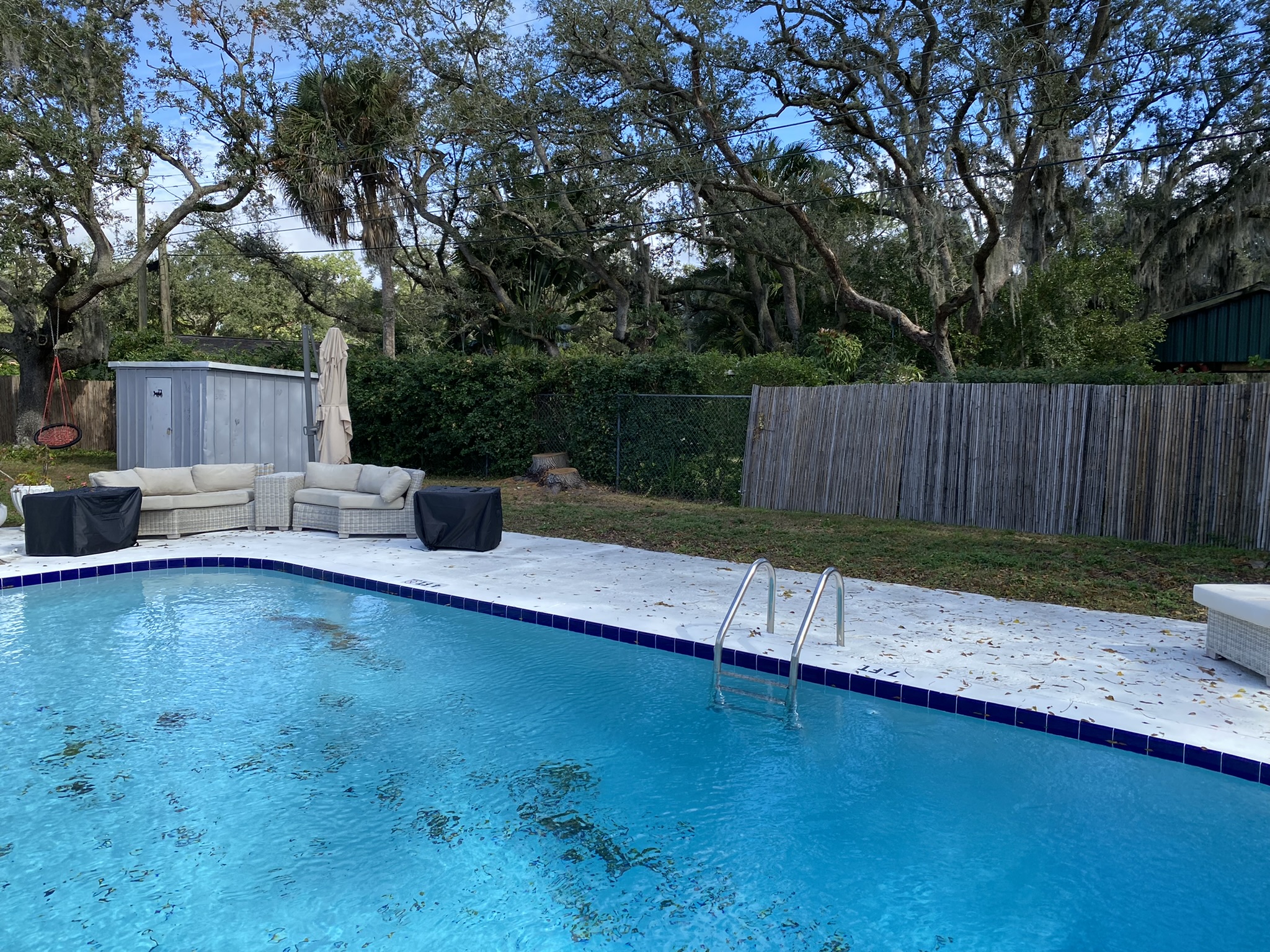
Many pool owners around here have a pool service anyway. I do not have a pool screen, and mine cleans the pool once a week, so it always looks nice. In my opinion, a good pool service and a well pruned tree together do more than cutting the tree back hard ever will.
Do I Need My Neighbor's Permission, or a Permit?
You generally do not need the neighbor’s permission to trim back to the line from your side. You do need it for anything past the line. Talking first usually goes better for everyone.
City rules still apply to the trimming, and they differ across Pinellas. A few examples from official sources:
- Unincorporated Pinellas, including Palm Harbor and East Lake. Pinellas County says routine trimming needs no permit, and that pruning should follow ANSI A300 to avoid compliance problems from excessive pruning.
- Safety Harbor. The city’s FAQ says you may prune a neighbor’s overhanging tree with proper technique, recommends telling the owner in writing first, and says pruning is generally limited to 25 percent of the canopy, and notes that older trees may tolerate only about 5 percent.
- Dunedin. The city’s tree brochure says topping or removing more than 25 percent of a tree’s leaf canopy is prohibited without a permit, and Grand Trees cannot be pruned without one.
Clearwater, Largo, Tarpon Springs and Oldsmar each have their own rules. Our tree removal permits page walks through them. If you live in an HOA, its rules apply on top of the city’s, not instead of them.
Who Pays If It Falls on My House?
When a healthy tree falls in a storm, the damage to your house is usually a claim on your own homeowner’s policy, even if the tree grew next door. Your insurer may then try to recover from the neighbor’s insurer, which Consumer Reports notes may get your deductible back if it succeeds.
The neighbor may be responsible when the tree was dead, diseased, or plainly dangerous and they knew or should have known it. That is why written notice matters. The UF/IFAS property law handbook also says Florida case law on hazardous trees that are not yet dead is not fully settled.
A 2025 bill in Tallahassee, called the Fallen Tree Act, would have made owners liable for any of their trees that fall on a neighbor’s property. It died in committee, so the older rules still apply.
Check your declarations page for the deductible and tree removal limits. Our page on insurance and tree removal covers what to photograph and what policies usually cap.
I have also been hired to assess trees that fell from a neighbor’s property onto a client’s and caused damage, so the client had a written record of what happened and why.
What If That Branch Falls on Somebody Over There?
The same logic runs the other way. Florida landowners are expected to use reasonable care about conditions on their land that could hurt people outside it. A 2022 Florida Bar Journal article put it this way: an owner who knows or should know that a tree is a danger should be liable if it hurts someone or damages property, on or off their land.
If you are worried about your own tree over a neighbor’s yard, a pool, or a sidewalk, have it looked at; our page on whether a tree is dangerous covers what to look for from the ground. If it is on a single-family home lot and an ISA Certified Arborist documents that it poses an unacceptable risk as the law defines it, Florida Statute 163.045 lets you prune or remove it without a local permit. That law helps the tree’s owner. It does not let a neighbor remove someone else’s tree. Our page on the Florida tree risk letter explains who qualifies.
The Neighbor Won't Do Anything About a Dead Tree
You cannot make them remove it, and you cannot remove it for them. What you can do is build a clear, calm record.
- Ask in person first. Some neighbors do not know the tree is dead, or are worried about the cost.
- Get a written assessment from an arborist, done from your side of the line.
- Send the neighbor a letter describing the problem with a copy of the findings, and keep proof that it was delivered. I have written letters like this to tree owners for clients, asking them to take action.
- Ask your city’s code enforcement office whether it handles dangerous trees on private property. Practice varies by city.
- If it still goes nowhere, a Florida attorney can tell you what options you have.
We do tree risk assessments with a written report, and many homeowners share that report with the neighbor. It gives them something specific to look at instead of a complaint. It does not guarantee they will act.
What We Can and Cannot Help With
We are arborists. We can look at the tree, tell you what we see, write it down, and trim from your side to ANSI A300 standards. If you are comparing bids for the work, our guide to reading a tree quote shows what each line should say. We do not handle legal disputes or tell you who owes what; an attorney and your insurance company do that. In my opinion, these situations go best when both neighbors look at the same assessment.

Neighbor's Tree FAQ
Generally yes, back to the property line and at your own cost, under Florida case law going back to Gallo v. Heller. You should not go onto their land or cut their side without permission. City and HOA rules still apply.
Usually your own homeowner’s insurance, after your deductible, when a healthy tree falls in a storm. The neighbor may be responsible if the tree was dead or dangerous and they knew or should have known.
It means fewer leaves, not none. Leaves blow in from trees several houses away, so a regular pool service usually does more to keep the pool clean than cutting the tree back hard.
Not to trim back to the line from your side, in general. You do need it to enter their property, to cut their side, or to remove a tree that sits on the line. Some cities, like Safety Harbor, recommend telling the owner in writing first.
You usually cannot force it yourself. You can tell them in writing with an arborist’s assessment attached, ask your city whether code enforcement handles it, and talk with an attorney if it goes nowhere.
No. That law lets the owner of a single-family home prune or remove their own tree without a local permit when an ISA Certified Arborist or Florida licensed landscape architect documents an unacceptable risk. It does not apply to a tree you do not own.