How Do I Protect My Trees Before a Hurricane in Florida?
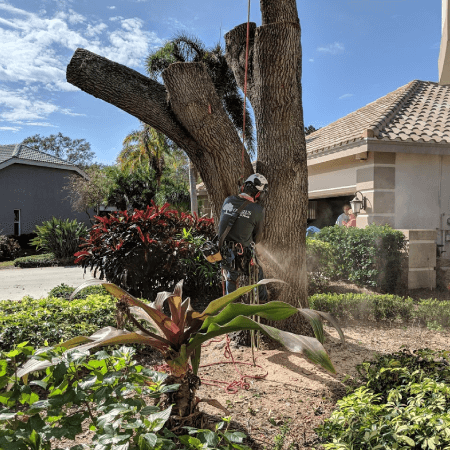
Have a trained arborist do structural pruning well before the season, ideally before June 1, and remove dead or decayed wood. Do not top trees, strip out the inside branches, or cut green fronds off palms. Once a storm is named, leave the trees alone. After it passes, stay clear of downed lines and broken limbs.
What Florida Hurricanes Taught the Researchers
A University of Florida team has studied what happens to city and neighborhood trees in hurricanes since Andrew in 1992, across storms like Charley, Jeanne, and Ivan. Their findings are some of the best guidance we have for yards like ours in Pinellas.
- Pruning helped. In the Hurricane Andrew study, 73 percent of pruned broadleaf trees survived, compared with 47 percent of trees that had not been pruned.
- Bad pruning hurt. The researchers write that topping or removing large branches makes trees more likely to fail in wind.
- Groups beat loners. Trees growing in groups survived better than single trees. In Ivan it was 80 percent against 70 percent.
- Roots need room. Trees with more rooting space stood up better.
- Age matters. Larger, older trees lost more branches. UF/IFAS notes that laurel oaks tend to hollow from decay as they approach 50 years old.
The same researchers are careful to say that no species and no tree is completely wind proof. The goal is to lower the odds, not to promise anything. Their full summary is Wind and Trees: Lessons Learned from Hurricanes. For how wind speed, wet soil and species fit together, see what wind speed knocks trees down.
Which Trees Hold Up Best in Wind
UF/IFAS ranks trees by wind resistance using storm surveys and expert ratings. Pinellas sits where the north and central Florida list and the south Florida list both partly apply, so I look at both.
- Among the best: live oak, sand live oak, southern magnolia, bald cypress, pond cypress, crape myrtle, dahoon holly, and the sabal palm, also called the cabbage palm.
- Among the weakest: laurel oak, water oak, sand pine, Chinese tallow, and, on the north and central list, the Washington fan palm. Experts rated the queen palm lowest of the palms in the south Florida survey.
In Hurricane Ivan, 91 percent of live oaks were still standing against 77 percent of laurel oaks. A laurel oak is not doomed, and a live oak is not safe by default. Condition and structure still decide a lot. If you are planting, our page on the best shade trees for Clearwater covers what does well here.
Prune Early, and Prune for Structure
Structural pruning means shaping a tree so it has one main trunk and limbs that stay smaller than that trunk. On a mature tree it mostly means shortening long or weakly attached limbs with reduction cuts. A reduction cut takes a limb back to a living side branch, and UF guidance is that the side branch should be at least one third the diameter of the limb being cut.
In a UF wind test, trees were run up to 120 mph. Trunks on unpruned trees bent more than trunks on trees that had been reduced, thinned, or raised. The authors wrote that the results support structural pruning as a way to prevent damage.
Thinning, done properly, takes out a small share of branches spread evenly through the crown, the leafy top of the tree. ISA guidance for homeowners is generally no more than 25 percent of the crown at one time, and less for mature trees. In my opinion, on a mature tree that number is a ceiling, not a target. We follow the ANSI A300 pruning standard, and you can read how we approach it on our tree pruning page.
Timing matters. Lake Wales and other Florida communities ask that major trimming be finished before hurricane season starts on June 1.
What Not to Do
- Do not top the tree. Topping cuts off whole sections of the upper crown. A UF/IFAS extension article warns it can strip half or more of the leaves, and it creates decay and weakly attached sprouts that break more easily later.
- Do not lion-tail it. Lion-tailing strips out the inside branches and leaves foliage only at the ends of the limbs. The same article says removing interior branches makes wind damage more likely, because the weight and wind load end up at the tips.
- Do not start pruning once a storm is coming. Miami-Dade says not to begin pruning during a hurricane watch or warning. Lake Wales asks people not to cut back trees once a storm is named, because debris at the curb may not be picked up before landfall and can become flying debris.
- Do not cut roots close to the trunk. UF researchers advise never cutting roots closer than five times the trunk diameter. Roots are the anchor.
Palms: Leave the Green Fronds
Many people still ask for a hurricane cut, where most of the fronds come off and only a small tuft of young ones is left at the top. UF/IFAS palm research found the opposite of what people expect. After the 2004 and 2005 hurricanes, hurricane-cut palms were more likely to have their crowns snapped off than palms with full crowns.
UF/IFAS palm guidance, citing the ANSI pruning standard, says not to remove fronds whose tips are above horizontal. UF/IFAS also notes that nearly all Florida palms are short on potassium, and the older fronds feed potassium to the new ones, so cutting them off can speed decline. Brown, dead fronds can come off. Green ones should stay.
When Cabling Helps
Cabling and bracing put steel or synthetic supports into a tree to hold weak parts together. UF/IFAS says they can help keep trunks with a weak union and included bark, bark pinched between two stems, from separating. Cables are usually set about two thirds of the way up from the weak union.
Cabling works best with pruning. UF guidance is that reducing the size of the crown should be considered when a support system goes in, and that the system should be inspected at regular intervals. There is an ANSI A300 standard for this work.
Cabling does not make a tree storm proof, and it is not a fix for a trunk with serious decay. If you are not sure whether a tree is a candidate, our cabling and bracing page explains what we look for, and is my tree dangerous covers the warning signs. UF researchers put it plainly in their summary: remove high-risk trees before the wind does.
After the Storm
- Stay away from downed power lines, including lines tangled in a tree. The National Weather Service says to keep far away from lines on the ground or hanging.
- Be careful with chainsaws. The Weather Service says to leave power tools to people trained to use them. Dunedin’s city arborist puts it this way: if it is not an emergency, do not pay emergency prices.
- Do not give up on a bare tree too soon. UF researchers found that leaf loss does not mean a tree is dead, and most trees leaf out again within a few months or by the next spring. Pines are the exception to watch, since some decline over six months to two years.
- Give palms time. UF/IFAS says to allow at least six months for a palm to put out new fronds. Broken fronds that are still green should stay on. A single-trunk palm with a broken trunk will not recover and should be cut at the base.
Our storm page covers what we do after a storm.

Hurricane Tree Prep FAQ
Yes, but well before the season, ideally before June 1, and by someone who prunes for structure. Once a storm is named, it is better to leave the trees alone, because cut debris at the curb may not be collected and can become flying debris.
UF/IFAS research rates live oak, sand live oak, southern magnolia, bald cypress, and the sabal palm among the most wind resistant. Laurel oak, water oak, sand pine, and the Washington fan palm are rated among the weakest.
Only the dead, brown ones. UF/IFAS found that hurricane-cut palms were more likely to have their crowns snap off in the 2004 and 2005 storms than palms with full crowns.
Proper thinning that removes a small share of branches spread through the crown can help, and UF wind testing found pruned trees bent less. Stripping out the inside branches, called lion-tailing, does the opposite and makes damage more likely.
It can help hold together a tree with a weak union, especially when paired with reduction pruning. It does not make a tree storm proof, and it is not the answer for a tree with serious decay.