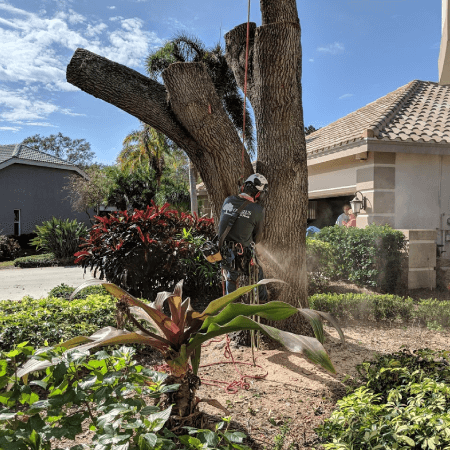
What Happens During a Tree Removal? Steps, Risks, and Safety
A safe tree removal follows the same steps every time: an assessment, a permit if the city requires one, a plan for how each piece comes down, a crew briefing, the cutting, and cleanup. The main risks are to people, the house, and buried utilities. Most of the safety work happens before the first cut.
The Steps in a Tree Removal
Here is how a removal goes from the first visit to the last rake.
1. Assessment
An arborist looks at the trunk, the branch unions, decay, what sits underneath, overhead lines, and access. The first question is whether the tree needs to come down at all. See when removal is necessary.
2. Permit
Many Pinellas cities require a permit for protected trees. We can help prepare and file the permit application if needed. See our tree removal permits page.
3. The Plan
We decide how each piece will come down: climbed and lowered on ropes, cut from a lift, or picked by a crane. We also decide where each piece lands and where nobody stands. Our crane-assisted removal page covers when a crane makes sense.
4. Utilities
If stump grinding is planned, Sunshine 811 gets two full business days of notice to mark buried lines. The utilities only mark the lines they own, so tell us about private lines like irrigation, landscape lighting or an invisible dog fence. Trees near power lines may need the utility or a line-clearance crew first.
5. Crew Briefing
Before the first cut, the crew foreman walks the site with the crew, assigns jobs, sets the drop zone, and checks the gear. Everyone knows the plan and the signals.
6. Cutting
The tree comes down in controlled pieces. Brush and wood are cut to sizes our grapple truck can load and that can be moved without damaging the yard.
7. Cleanup
The stump is cut low and the work area is cleaned up. When hauling is part of the proposal, the debris leaves with the crew. Stump grinding is a separate step when you want it.
What Are the Risks of Tree Removal?
- To the people doing the work. Tree work is one of the most dangerous jobs in the country. TCI Magazine reported in 2023 that the Bureau of Labor Statistics put the fatality rate at 110 per 100,000 tree trimmers and pruners, about 30 times the average for all industries, and that logging is one of the few occupations with a higher rate. TCI Magazine. Falls, struck-by injuries, saw cuts, and electrical contact are the big ones.
- To the house and yard. Roofs, screened pool cages, fences, gutters, irrigation, and turf are all in play when pieces come down.
- To buried utilities. Gas, water, cable, and electric lines can sit right under a stump.
- To overhead lines. Contact with an energized line can be fatal, and it is not always obvious which lines are energized.
- To the trees that stay. Heavy equipment over roots can compact soil and damage nearby trees you want to keep.
- To wildlife. Active bird nests and nearby eagle nests are protected, which can change when work happens.
Safety Precautions a Professional Crew Takes
- Work follows ANSI Z133, the national safety standard for tree care.
- Every climber and ground worker wears a hard hat and eye and hearing protection, and saw operators on the ground wear leg protection.
- A job briefing happens before the first cut, and again if the plan changes.
- A drop zone is set and kept clear, with clear signals between the climber and the ground.
- Anyone who is not a qualified line-clearance arborist stays at least 10 feet from energized lines, farther for higher voltage.
- Mats may go down where equipment would rut the lawn or crush roots.
- The company carries general liability insurance and workers’ compensation, and can prove both.
Our safety culture page covers how we train for this.
What You Can Do on the Day
- Move cars out of the driveway and away from the tree.
- Keep kids and pets inside while the crew is working.
- Unlock gates and let the crew know about any dog fence wires, septic lids, or sprinkler heads near the work.
- Stay out of the work area. If you need to talk to the crew, wave down the crew foreman from a safe distance and let them come to you.
Should You Remove a Tree Yourself?
A small tree you can cut from the ground, with nothing it can hit, is a reasonable homeowner job. Anything you would need to climb, anything near a power line, and anything that can reach the house is a different job. The equipment, the training, and the insurance are what you are paying a professional for.
If removal is the plan, our tree removal service page covers how we work, and the tree removal cost guide covers price.

Tree Removal Process FAQ
Assessment, a permit if the city requires one, a plan for how the tree comes down, a utility check, a crew briefing, the cutting itself, and cleanup. Stump grinding is a separate step.
Injury to the people doing the work, damage to roofs, fences, pool cages, and lawns, contact with buried or overhead utilities, and harm to nearby trees from equipment. Planning and trained crews are how those risks are managed.
A professional crew follows the ANSI Z133 safety standard, wears protective gear, holds a job briefing, keeps a clear drop zone, stays away from energized lines, and carries liability and workers’ compensation insurance.
Sunshine 811 asks for two full business days of notice before digging, and that includes stump grinding. Cutting the tree itself does not involve digging, but the stump work does. The utilities only mark the lines they own; private lines like irrigation, landscape lighting or an invisible dog fence are the homeowner’s responsibility, so tell us where yours run.
For anything you would need to climb, anything near a power line, or anything that can hit a structure, a trained and insured crew has the equipment, the experience, and the coverage if something goes wrong. Small trees cut from the ground are usually fine to do yourself.