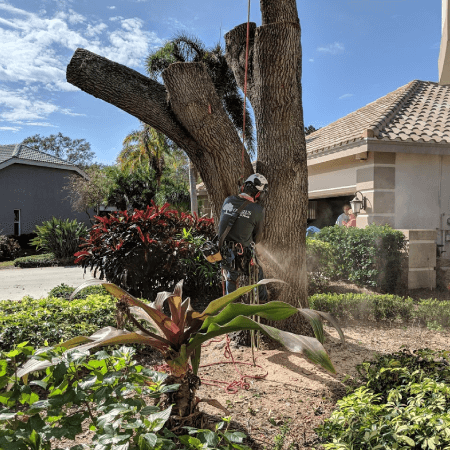
Someone Cut Down My Tree Without Permission. What Can I Do?
Start by documenting everything before it gets cleaned up: photos, the stump, the debris, measurements, and names. Then get a written tree appraisal from a qualified arborist, which puts a supportable dollar value on what was lost. For the legal side, including whether to file a claim, talk with a Florida attorney.
What to Document Right Away
The first days matter most, because the evidence gets hauled off, ground out, or rained on. Before anyone cleans up, try to collect the following.
- Photos of the site. Take wide shots that show where the tree stood in relation to the house, the fence, and the property line, then close shots of the cut. Put a tape measure or a common object in some photos for scale.
- The stump. Do not grind it or let anyone else grind it yet. Measure across the top in two directions and photograph the tape on it.
- The debris. If logs, limbs, or wood chips are still on site, leave them where they are if you can and photograph them. Cut sections of trunk can show whether the wood was sound or decayed.
- Older photos of the tree. Check your phone, family photos, listing photos, and online street-level map images. They show the tree standing, which the stump cannot.
- Records of care. Receipts for pruning, fertilizing, or treatment show the tree was cared for and valued.
- Who and when. Write down the date and time, the company name on trucks, license plates, and the names and phone numbers of any witnesses. Save any texts, emails, or work orders about the job.
- Your property line. Find your survey. If it is unclear whose land the tree stood on, a licensed surveyor can settle it.
In my opinion, it pays to stay calm with the neighbor or the crew; a heated conversation rarely helps anyone later.
Whose Tree Was It?
This is the first question an attorney or an insurer will ask. A UF/IFAS handbook on Florida fence and property law explains that a neighbor may trim encroaching branches or roots back to the property line, at their own expense. That is different from cutting down the tree.
The same handbook says that removing a tree on a boundary line without the consent of the adjoining owner may result in liability.
What a Tree Appraisal Is
A tree appraisal is a written estimate of a tree’s dollar value, done by a trained professional following a recognized method. Arborists in the United States use the Guide for Plant Appraisal, written by the Council of Tree and Landscape Appraisers (CTLA) and published by the International Society of Arboriculture (ISA).
The current edition is the 10th, first printed in 2018 and since revised, with updated worksheets dated October 2020. An 11th edition is in the works.
The Guide describes three approaches to value:
- The cost approach. What it would cost to replace or reproduce the tree, then adjusted for the tree’s actual condition and site. This is the approach most often used for yard and landscape trees.
- The income approach. Value based on what the tree would have produced for sale. This fits timber, orchards, and nurseries more than a home landscape.
- The sales comparison approach. Value based on market evidence, such as comparable sales.
Within the cost approach, a small tree is often valued at what a comparable tree costs to buy and plant. A large tree usually cannot be replaced with one the same size, so the Guide uses the trunk formula technique. The appraiser starts with the cost of the largest tree commonly available from nurseries, scales that cost up by the cross-section of the lost tree’s trunk, and then reduces it for the tree’s condition and for limits like a cramped root area or a poor location.
Two appraisers can arrive at different numbers, and the other side may hire their own. A clear method and good field data are what make a number hold up.
People are often told a cut tree is worth what the firewood would bring, or what removal would have cost. In my opinion, that misses the point for a yard tree. What was lost is the shade, the screening, the fruit or flowers, and the years it takes to grow a tree that size. Keep in mind that an appraised value is an estimate, not a price tag; it may not match what a court, an insurer, or the other side agrees to pay.
Who Should Do the Appraisal
Look for an arborist with appraisal training, not only tree care experience. The American Society of Consulting Arborists (ASCA) issues the Tree and Plant Appraisal Qualification, called TPAQ. Candidates need at least five years of professional experience plus a degree or a credential such as ISA Board Certified Master Arborist, take the course, and pass a 60 question exam with a score of 80 percent or better. The certificate must be renewed every five years, or sooner when the Guide is updated.
ISA certification shows tree knowledge, but it is not an appraisal credential. ASCA itself notes the TPAQ certificate alone does not prove how well someone appraises, so ask to see a sample report.
If the appraisal may be used in a legal claim, it should be:
- Written. A report, not a number given over the phone.
- Methodical. It names the method, shows the measurements and the math, and includes photos.
- Independent. The conclusions should follow the evidence, no matter who is paying for the report.
I hold the ASCA TPAQ along with my ISA Board Certified Master Arborist certification, and our arboricultural consulting page describes the appraisal and report work we do.
Florida Law and Whether You Need a Lawyer
This section is general information from what I could verify, not legal advice. Talk to a Florida attorney about your situation.
The UF/IFAS handbook describes a 1965 Florida appeals case about a boundary tree removed without the neighbor’s consent. The handbook describes the damages in that case as including the reduction in the value of the land and the loss of the ornamental value and creature comforts the tree provided.
Many states have timber trespass laws that double or triple damages for cutting someone else’s trees. Some people ask whether Florida’s civil theft statute, section 772.11, applies. That statute allows triple damages for theft proven by clear and convincing evidence, requires a written demand first, and lets the other side recover attorney’s fees if the claim lacks substantial support. Whether either idea fits a cut tree is a question for an attorney, not an arborist.
If you are not sure where to start, the Florida Bar Lawyer Referral Service can match you with an attorney, and its first 30 minute consultation costs no more than $25. It is also worth calling your insurance agent to ask whether your policy covers trees damaged by someone else; our page on insurance and tree removal covers how tree claims generally work.
The Permit Question
Tree permits control what an owner may remove from their own land. In unincorporated Pinellas County, most trees 4 inches or more in trunk diameter need a permit to come down, and since January 23, 2026, homesteaded single family lots only need one for trees over 24 inches. Cities like Clearwater and Dunedin have their own rules.
Some local codes treat fruit trees and non-native trees differently. The county’s undesirable plant species list, written under the code in place before the 2026 changes, places citrus in a recommended removal tier that can be taken out with a no fee permit; check with the county for the current rule. Other communities may exempt certain species entirely.
None of that gives anyone else the right to cut your tree. A permit or an exemption is about what the owner may do, not about consent. Our tree removal permits page explains the local rules in more detail.
How We Can Help
We provide arboricultural consulting and written tree appraisal reports. That usually starts with a site visit to measure and photograph the stump, the debris, and the site, and to review your older photos and records. Our arborist site consultation is $75 to $150, and written reports start at $600.
We do not give legal advice. Questions about whether to sue, what to claim, and deadlines belong with your attorney. When a case calls for it, we can refer you to one.

Tree Cut Down Without Permission FAQ
A UF/IFAS property law handbook describes a Florida case where a jury awarded damages after a boundary tree was removed without the neighbor’s consent. Whether you have a claim, and what it is worth, depends on the facts, so talk with a Florida attorney before you act.
There is no single number. An appraiser following the Guide for Plant Appraisal looks at the tree’s size, species, condition, and location, and large trees are often valued with the trunk formula technique. The result is usually far more than the value of the wood.
It is the Guide for Plant Appraisal’s method for trees too large to replace. It scales the cost of the largest common nursery tree up by trunk size, then adjusts for condition and site.
Look for an arborist with appraisal training, such as the ASCA Tree and Plant Appraisal Qualification (TPAQ), and ask for a sample report.
Generally, a Florida neighbor may trim encroaching branches back to the property line at their own expense, per the UF/IFAS handbook. That is not the same as cutting down the tree or cutting past the line.
Not yet. The stump is some of the best evidence of how big and how healthy the tree was. Have it measured, photographed, and looked at by an arborist first.