Is My Palm Dying From Lethal Bronzing?
Lethal bronzing is a bacterial disease that kills palms, including cabbage palms, queen palms, and date palms. Leaves turn bronze from the oldest up, then the spear leaf dies. A lab test confirms it. There is no cure. Infected palms should come out promptly, and nearby palms that test negative can get preventive antibiotic injections.
What Lethal Bronzing Is
Lethal bronzing is caused by a phytoplasma, a tiny bacterium with no cell wall that lives in a palm’s sap. It is related to lethal yellowing, but it is a different disease. It used to be called Texas Phoenix palm decline.
In Florida it was first found in Hillsborough County in 2006. UF/IFAS says it has since spread to more than 30 of Florida’s 67 counties.
The pathogen cannot live outside a palm or an insect. That means pruning tools and root contact do not spread it.
It moves from palm to palm by sap feeding insects. UF/IFAS researchers point to a small planthopper, the American palm cixiid (Haplaxius crudus), as the likely carrier. Its young feed on a wide range of grasses, and the adults feed on palms.
Is It in Pinellas County?
Yes. The UF/IFAS fact sheet on lethal bronzing lists Pinellas among the counties with confirmed cases, along with Hillsborough and Pasco next door.
That tells you it has been found here. It does not tell you how common it is on your street, and the county list changes as new cases come in. Your county Extension office can tell you more about recent cases near you.
Which Palms Get It
UF/IFAS lists more than 20 palm species that have tested positive in Florida. The ones you are likely to see in a Palm Harbor or Clearwater yard include:
- Cabbage palm, also called sabal palm, Florida’s state tree
- Queen palm
- Date palms: Canary Island date palm, edible date palm, wild date palm, and pygmy date palm
- Christmas palm, Bismarck palm, and pindo palm
- Chinese fan palm and Chinese windmill palm
- Coconut palm and Mexican palmetto
A palm missing from the list is not proven safe. The list may grow as more palms get tested.
The Symptoms, in Order
- Fruit and flowers first. If the palm is fruiting, the fruit may drop early. If it is flowering, the flower stalks can turn black. On a young palm, or one where the flower stalks get trimmed off, you may never see this step.
- Bronzing from the bottom up. The oldest, lowest leaves turn a bronze brown and dry out, and the color moves up into the younger leaves.
- The spear leaf dies. The spear is the newest leaf, standing straight up from the center. When it turns brown and collapses, the bud has died, and the palm cannot recover.
UF/IFAS says the first symptoms usually show up about four to five months after infection. From first symptoms to a dead spear usually takes about two to three months, though it varies. Some palms skip the bronzing, and the spear collapses first.
Not every brown palm has lethal bronzing. Old fronds die naturally, and nutrient problems, cold damage, and other diseases can all brown a palm. Potassium deficiency in particular also starts on the oldest leaves, which is one reason a test matters.
How It Is Confirmed
You cannot confirm lethal bronzing by looking at it. It takes a lab test that detects the phytoplasma in a sample from the palm. Your county Extension office can point you to how to get a sample tested.
UF/IFAS also recommends testing the healthy looking palms around a sick one, because a palm can test positive before it shows any symptoms.
In my opinion, a test is worth it before you treat a group of palms or take out a valuable one. It turns a guess into a decision.
Our field note on why palms die includes what our own lab samples have shown, including a palm that tested negative the first time.
Treatment: What Injections Can and Cannot Do
There is no cure. Once a palm is infected, UF/IFAS says it is usually too late for the antibiotic to save it, and the label rate is not enough to reverse symptoms.
What the antibiotic can do is protect. Oxytetracycline HCl, often called OTC, is injected into the trunk of nearby palms that test negative. UF/IFAS recommends repeating it every three to four months for at least two years.
That is a commitment, and it makes the most sense for palms that matter to you, like a specimen date palm by the pool or a row of cabbage palms that frames the house. We do these preventive injections. For a single palm on a site they start at $95, and that visit usually includes fertilization. Our plant health care page explains how we approach monitoring and trunk injections.
Why Infected Palms Should Come Out Quickly
UF/IFAS guidance is direct on this one. A palm that shows symptoms and tests positive should be removed right away. A palm that tests positive but still looks healthy should come out too, because the antibiotic cannot act fast enough to stop it.
The reason is the neighbors. UF/IFAS says waiting raises the chance the disease spreads, because insects can keep feeding on the infected palm and carry the pathogen to the next one. Taking it down removes that source.
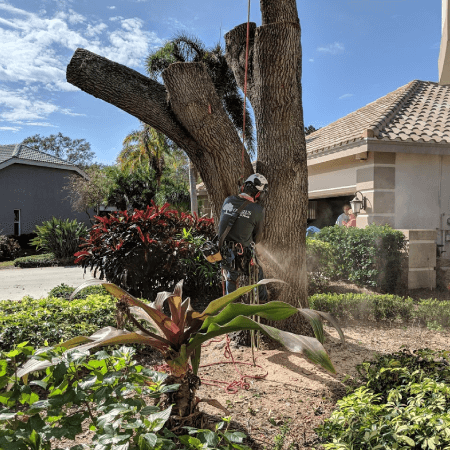
Removing a palm is usually simpler than removing an oak of the same height, but palms near roofs, pool cages, and power lines still take planning. Our tree removal page covers how we plan the work, and when is tree removal necessary covers how we think about removal in general.

Lethal Bronzing FAQ
No. There is no cure, and UF/IFAS says the antibiotic at the label rate is not enough to reverse symptoms. Infected palms should be removed.
Early fruit drop or blackened flower stalks, then the oldest leaves turning bronze brown from the bottom up. When the spear leaf in the center dies, the palm is gone.
Yes. UF/IFAS lists Pinellas among the Florida counties with confirmed cases. Your county Extension office can tell you more about recent cases near you.
They can help protect healthy palms. UF/IFAS recommends oxytetracycline injections every three to four months for at least two years in nearby palms that test negative. They do not cure a palm that is already infected. We offer them, starting at $95 for a single palm on a site.
No. The pathogen cannot live outside a palm or an insect, so tools and roots do not spread it. It spreads through sap feeding insects.
UF/IFAS lists more than 20 species in Florida, including cabbage, queen, Canary Island date, pygmy date, Christmas, Bismarck, and coconut palms. A palm missing from the list is not proven safe.