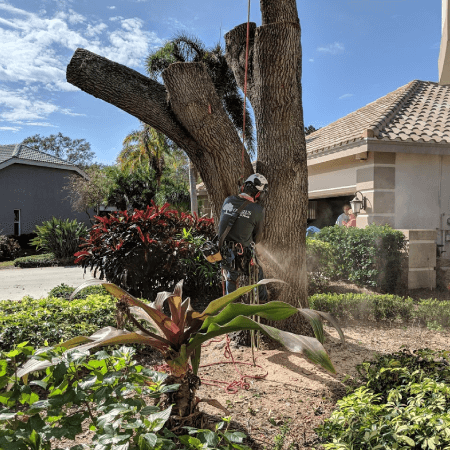
Pruning a Spreading Live Oak Before a Hurricane: Notes From a Site Visit
In early September, with a hurricane warning out, I walked a property with several large, spreading live oaks. The owner loved the spread and wanted the trees safer in a storm. The answer was not cutting them back hard. It was shortening a few long limbs, lifting clearance, and leaving the shape she loves.
What She Asked
She told me she was tired of making decisions about the yard, and then she asked, “If this was your tree, what would you do?”
That is a fair question, and it deserves a straight answer instead of a menu. So we walked every tree and I told her what I would do and why.
What I Saw
- Wide, low live oaks over the driveway, the road, and the roof.
- One limb headed for the road, low enough to catch a truck.
- Two of the lowest limbs growing north over the house, getting large compared to the trunk they come off of.
- A camphor tree that had been cut back at the roofline with heading cuts, the kind that leave a stub with nothing to take over.
- Brazilian pepper growing up into one of the oaks and into the hedge.
What We Recommended
- Shorten the two lowest limbs over the house with reduction cuts so they stay small compared to the trunk.
- Trim the limb headed for the road and lift the canopy to 14 feet over the road and driveway, enough room for a fire truck or an ambulance.
- Remove dead wood an inch and larger up top, and clean out the dead twigs underneath.
- Lift the camphor about two feet off the gutters and soffits, cutting back to side branches instead of making more heading cuts.
- Cut the Brazilian pepper at the ground and treat the stumps so it does not come back.
- Hand-prune the east hedge with reduction cuts so it looks natural instead of flat-topped, and pull the vines out of it.
Her lawn and sprinklers were part of the conversation too. We pointed her to a landscape architect and an irrigation contractor we trust.
The Tradeoff We Talked Through
She loves the spread. A more upright tree would carry less leverage in a storm. We did not try to turn her oaks into something they are not.
The plan takes weight off the limbs most likely to cause trouble and leaves the rest of the shape alone. That is usually the right middle ground with a mature live oak.
What You Can Take From It
- Have long limbs over the roof looked at well before hurricane season, not the week a storm is coming.
- Shortening the ends of a few limbs does more for storm risk than thinning out the inside of the tree.
- Ask what kind of cut will be made. A cut back to a side branch closes better than a heading cut that leaves a stub.
Our tree pruning service is built around this kind of work, and when to trim trees in Florida covers hurricane season timing.

Live Oak Hurricane Pruning FAQ
If long limbs reach over the house or the road, it is worth doing well ahead of the season. Shortening the ends of a few limbs lowers the leverage on the union. Heavy cutting the week before a storm is a different thing and can leave a tree weaker.
On this visit we aimed for 14 feet over the road and driveway, which leaves room for a fire truck or an ambulance. Some cities set their own rules over streets and sidewalks, so it is worth checking yours.
A cut through the middle of a branch that leaves a stub with no side branch to take over. The tree pushes out a cluster of weak sprouts below it, and the stub often decays. Cutting back to a side branch avoids both.