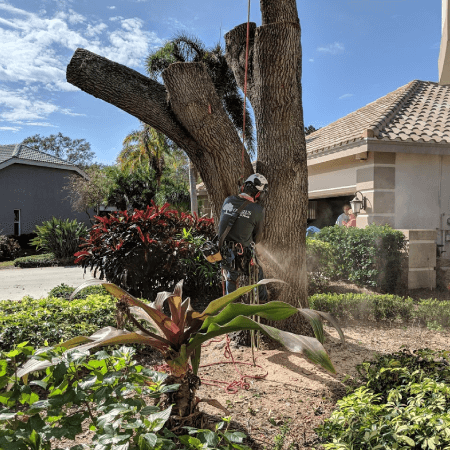
How Much Does Stump Grinding Cost in Clearwater and Palm Harbor?
Our minimum for stump grinding on its own is $195, and that minimum can cover more than one stump. We price mainly by the grind area, the stump plus its surface roots, at roughly $125 per square foot on a grinding-only job. On 2026 jobs, a standard grind ran about $275 per stump at the median.
What We Charged for Stump Grinding in 2026
These numbers come from the stump grinding we sold between January and mid October 2026, pulled from our own job records. They are what customers paid, so use them as a guide to what a quote may look like, not as a quote.
Our minimum for grinding alone is $195. That minimum can cover more than one stump, so if you have two or three, ask about doing them together.
A rough rule of thumb for a grinding-only job is about $125 per square foot of grind area, meaning the stump plus the surface roots around it. When we grind the stump as part of a tree removal, it often comes in a bit less.
Each stump gets its own line on our estimate. The size of the grind area sets most of the price, and the depth we grind adjusts it from there. Here is where those lines landed by depth. The median is the middle price when you line them all up from lowest to highest.
- Shallow grind: about $165 per stump at the median.
- Standard grind: about $275 per stump at the median, and half of them landed between $150 and $350.
- Deep grind: about $450 per stump at the median, and half landed between $300 and $700.
Some single stump lines come in under $195. The $195 minimum is for a visit where grinding is the only work, so a small stump ground on the same visit as other work can price lower.
Stump-Only Jobs vs. Grinding Added to a Removal
When stump grinding was the only work on the visit, the grinding typically came to $300 to $515, and the whole visit was about $360 at the median. That is a small sample, 14 jobs this year, so treat it as rough.
When we ground the stump on the same visit as a tree removal, the stump line typically ran $200 to $550, with a median around $300. Most of those jobs had one stump on them.
Grinding is not part of a removal price unless you ask for it. By default we cut the stump low to the ground and list grinding as its own line, so you can decide whether you want it. Our tree removal cost guide explains what else is priced separately, and our tree removal service page covers how we do the work.
What Drives the Price of Stump Grinding
- Diameter. We measure the stump at its outermost surface roots, not just across the cut top. A wide root flare, the flared base where the trunk meets the roots, adds wood to grind.
- Surface roots. Roots that have grown up through the lawn are a separate item. Grinding them is not included unless we talk about it and put it on the estimate, and it can tear up the grass around them.
- Access. A stump in an open front yard is simpler than one behind a narrow gate, a fence or a pool cage. We carry smaller machines for tight spots, and tight access can add to the price.
- Rocks and buried debris. Old concrete, bricks, wire or fence posts around a stump can dull or break the grinder teeth and slow the work. If you know something is buried there, tell us up front.
- Underground lines. We call 811 before we grind. Lines you put in yourself, like irrigation or landscape lighting, are not marked by 811, so it helps to show us where they run.
- The grindings. What you do with them changes the price. Leaving them on site is the least work; hauling them away and bringing in soil adds to it.
- How many stumps. Grinding several stumps on one visit is more efficient than separate trips, so it can lower the price per stump.
How Deep Do We Grind a Stump?
We price three kinds of grinding. A standard grind goes about three to six inches below the existing soil. For most lawns and planting beds, that is enough to lay sod or plant shrubs over the spot.
A shallow grind stays closer to the surface. We use it when the roots of a nearby tree you are keeping need protecting, or when irrigation lines run close to the stump. Many Florida irrigation lines sit around four to six inches deep, so we keep that in mind.
A deep grind goes further down, and in some cases we dig the stump out instead. It makes sense when you are building, pouring a slab or planting a new tree in the same spot. Tell us when you schedule, because it changes the equipment and the price.
Grinding removes the stump and the main root flare just below the soil. The roots running out sideways stay in the ground and break down over several years. Grinding surface roots that run across the lawn, or leveling a root mound that has lifted the ground around an old stump, are priced as their own lines, and so is hauling away the grindings. Every grind includes an 811 locate call. Irrigation is the most common complication on these jobs, and damage to it generally is not covered unless we talk about it ahead of time, so we like to have that conversation before we start. Our stump grinding service page covers the work itself.
Calling 811 Before We Grind
Florida’s underground damage prevention law, Chapter 556 of the Florida Statutes, requires anyone excavating to notify Sunshine 811 at least two full business days before digging. The service is free, and a locate ticket is good for 30 calendar days.
Grinding below grade cuts into the soil, so we call 811 before we grind. Utilities then mark their lines with paint or flags. The law has a narrow exception for a homeowner digging on their own land no deeper than 10 inches, but that exception is written for the owner, not for a company hired to do the work.
811 marks utility lines only. Sunshine 811 says private lines on your property, like irrigation, outdoor lighting and gas lines to a grill, are the owner’s responsibility and are not marked.
Stump grinding by itself does not need a permit in Pinellas County. Removing the tree can, and our page on tree removal permits explains when.
What Happens to the Grindings?
Grinding turns the stump into a pile of wood chips mixed with soil. You have three choices.
- Rake them back into the hole as fill and haul the extra away. This is what most of our customers choose.
- Leave all of them on site to use as mulch.
- Haul everything away and backfill the hole with fresh soil. This gives the cleanest result and is the most work.
The spot will settle a little over the following months as the grindings break down. A little topsoil on top usually fixes it, and sod laid over the spot generally does well.
If you plan to plant a new tree in the same spot, I would consider a deeper grind and fresh topsoil. Wood chips mixed into soil can tie up nitrogen while they break down, and that may slow a young tree.
Ways to Bring the Cost Down
- Have several stumps ground on the same visit.
- Choose a standard grind unless you are building or replanting in that spot.
- Keep the grindings as mulch instead of paying to haul them.
- Open the gate, move the cars and clear a path to the stump before we arrive.
- If the budget is tight, we can cut the stump low now and grind it later. Keep in mind the $195 minimum applies when grinding is the only work on a visit.

Stump Grinding Cost FAQ
Most of the price comes from the size of the grind area, the stump plus its surface roots. A rough rule of thumb for a grinding-only job is about $125 per square foot of grind area, with a $195 minimum. For us in 2026, a standard grind ran about $275 per stump at the median, with half between $150 and $350.
No. We cut the stump low by default and list grinding as its own line so you can choose. When customers added it to a removal this year, the stump line typically ran $200 to $550.
A standard grind goes about three to six inches below the soil. We go shallower near irrigation or the roots of a tree you are keeping, and deeper, or dig the stump out, when you are building or replanting in that spot.
You choose. We can rake them back in as fill and haul the extra, leave them all as mulch, or haul everything and backfill with fresh soil. Hauling everything is the cleanest and the most work.
We make the call. Florida law requires anyone excavating to notify Sunshine 811 at least two full business days before digging, and the service is free. Private lines like irrigation are not marked, so show us where they run.
It removes the stump and the main root flare just below the soil. The side roots stay in the ground and break down over several years.
In my experience termites do not really infest live trees. A rotting stump can attract them sometimes, and most of the research on that is on pine stumps. With the pest control most yards around here already get, I would not worry too much about it, but grinding the stump does take away the wood they would feed on.
After a standard grind, most people can lay sod or plant shrubs over the spot once the grindings are raked out and topsoil goes back in. Planting a new tree in the same spot usually calls for a deep grind, because the old root flare and grindings are in the way.