Should I Cut the Branches Hanging Over My Roof?
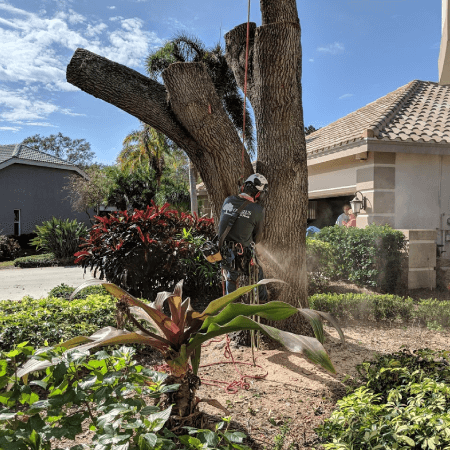
Usually you do not need to remove every branch over the roof. Cut back limbs that touch or rub it, dead limbs, and heavy or weakly attached limbs. Shortening a limb with a reduction cut often keeps the shade. In Florida you may generally trim a neighbor's branches back to the property line at your own expense.
What Branches Over a Roof Can Do
Branches near a roof are not a problem just because they are there. The trouble comes from a few specific things, and knowing which one you have tells you what to cut.
- Rubbing. LSU AgCenter notes that branches flail in high winds and can damage a roof. A limb that already touches the shingles on a calm day will hit harder in a storm.
- Leaves and moisture. Leaves that stay on a roof hold moisture, and roofs are built to shed water, not hold it.
- Dead wood. A dead limb over the house is the one I would deal with first. It is also the one that can change who is responsible if it falls, which I cover below.
- Weak attachments. A long limb that grows out from a weak union, or that is far heavier at the end than near the trunk, is more likely to fail than a short, well-attached one.
How Far Should Branches Be From the Roof?
As far as I know, no published standard sets a distance for branches over a house roof. LSU AgCenter’s advice is simply that branches can shade the roof but should not touch it. Most numbers you will see online appear to be company practice, not a rule.
In my opinion, the right gap depends on the tree. A long limb moves a lot more in wind than a short one, so it needs more room. A fast-growing tree like a laurel oak will close a gap sooner than a slow one. The clearance should allow for that movement and for a season or two of growth.
That is a decision you and your arborist should make standing under the tree. If cost is a concern, you can reduce scope to just clearance over the roof and leave the rest of the tree for later. Our tree trimming page covers limbs rubbing the roof and how our trimming is priced.
Shorten the Limb Before You Remove It
A reduction cut shortens a limb back to a living side branch instead of taking the whole limb off at the trunk. UF guidance is that the side branch you cut back to should be at least one third the diameter of the limb being removed. The tree keeps a leafy limb, and the wound is smaller.
Removing a whole large limb is sometimes the right call, for example when it is dead, cracked, or badly attached. It is still a bigger wound on the trunk. UF researchers who studied Florida hurricanes found that removing large branches, like topping, makes trees more likely to fail in wind.
Topping, cutting limbs back to stubs with no side branch left, is not the same thing as a reduction cut. It creates decay and a flush of weakly attached sprouts, often right back over the roof. If you are not sure what you are being offered, our page on trimming versus pruning explains the difference.
The Shade Tradeoff
A common worry with limbs over the roof goes like this: the homeowner wants the branches gone before hurricane season but does not want to lose the shade on the house.
The shade is worth something. A UF/IFAS case study from Gainesville estimated that tree shade there avoids about 9,243 megawatt hours of air conditioning use a year. A study in Auburn, Alabama, found that shade from a typical tree reduced a home’s electricity use by about 4 percent, and dense shade by about 9 percent in a month.
Placement matters too. UF/IFAS notes that trees on the west side of a house block the afternoon summer heat. If the limbs over your roof are on the west side, I would look hard at shortening them rather than taking them off. You often can get the roof clear and keep most of the shade.
Your Neighbor's Branches Over Your House
This is not legal advice, and I am not an attorney. Here is what the UF/IFAS handbook on Florida fence and property law says.
- You may trim to the line. The adjoining owner may, at his or her own expense, trim back branches or roots up to the property line.
- Healthy branches. The tree owner is generally not liable for damage caused by healthy branches or roots that cross the line.
- Dead branches. If the branches are dead, the tree owner may be responsible for the damage.
The rule covers your side of the line. Going onto your neighbor’s property, or cutting so much that the tree is badly harmed or killed, raises different questions for an attorney. A conversation with your neighbor first usually goes better for everyone, and UF/IFAS extension suggests the same.
Tree rules also apply. Unincorporated Pinellas, Belleair Bluffs, and Belleair Shore follow the county tree ordinance, and each city has its own rules. Our page on tree removal permits covers what applies where.
Read the UF/IFAS property law handbook on trees if you want the source. Our page on a neighbor’s tree over your house or pool covers permission, permits, and who pays if it falls.
Before Anyone Climbs Over Your Roof
- Look for wires. If the limb is near the line from the pole to your house, ask about the line before any cutting starts.
- Ask how the pieces come down. Over a roof, branches are usually cut in small pieces and lowered on ropes, not dropped.
- Ask for the cuts in writing. A good estimate says which limbs come off, which get shortened, and roughly how much clearance you will have.
- Ask about standards. We follow ANSI A300 for pruning and ANSI Z133 for safety. Most of our estimates are done by ISA Certified Arborists, and you can ask for one.

Branches Over the Roof FAQ
Cut the ones that touch or rub the roof, the dead ones, and the heavy or weakly attached ones. Many of the others can be shortened instead of removed, which keeps shade on the house.
As far as I know, no published standard sets a distance. Branches should not touch the roof, and long limbs and fast-growing trees need more room because they move and grow more.
Generally yes, back to the property line and at your own expense, according to the UF/IFAS property law handbook. This is not legal advice, and it is worth talking to your neighbor first.
Under the rule UF/IFAS describes, the tree owner is generally not liable for damage from healthy branches, but may be if the branches were dead. Your insurance company or an attorney can tell you how it applies to your case.
It can if you remove a lot of shade, especially on the west side of the house. Shortening limbs to get the roof clear often keeps most of the shade.