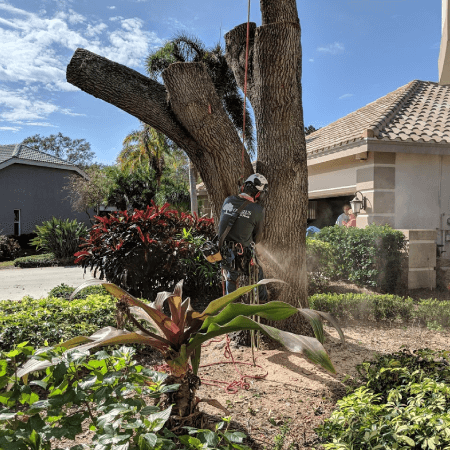
What Does a Certified Arborist Do?
A certified arborist is a tree care professional who has passed an International Society of Arboriculture exam and keeps up with continuing education. Arborists diagnose tree problems, recommend pruning, removal, or treatment, assess risk, and write reports. In Florida, certification is voluntary, so it is worth checking a credential before you hire.
What an Arborist Does
An arborist is a person trained in the care of individual trees. The job is less about cutting and more about deciding what a tree needs and why.
- Diagnose. Figure out why a tree is declining: soil, roots, insects, disease, construction damage, or something else.
- Recommend. Decide whether a tree should be pruned, supported, treated, monitored, or removed.
- Assess risk. Look at defects, the tree’s load, and what it could hit, and rate the risk.
- Document. Write reports for permits, insurance, construction projects, or disputes.
- Supervise the work. Make sure pruning and removal follow industry standards, such as the ANSI A300 pruning standard.
Our arboricultural consulting page shows the kinds of reports this work can produce.
Arborist vs Tree Service: What Is the Difference?
A tree service is a business. An arborist is a person with training in tree biology and care. Some tree services employ certified arborists, some have one person who holds the credential, and some have none.
That difference shows up in the decisions. A crew can cut a limb well and still cut the wrong limb. In my opinion, the most useful question to ask a company is not “Do you have an arborist?” but “Will a certified arborist look at my tree and decide what gets done?”
At O’Neil’s, most of our estimates are done by ISA Certified Arborists, and you can ask for one. We follow ANSI A300 for pruning and ANSI Z133 for safety.
The Three ISA Credentials Homeowners See Most
The International Society of Arboriculture, or ISA, is the best-known organization that certifies arborists. These are the three credentials you are most likely to see on a business card.
- ISA Certified Arborist. Requires at least three years of full-time experience in arboriculture, or a two or four year degree with tree courses plus one to two years of experience, then passing an exam that covers a wide range of tree care topics. It lasts three years. To keep it, the arborist earns at least 30 continuing education units in that period or retakes the exam, and agrees to a code of ethics.
- ISA Board Certified Master Arborist. The highest level ISA offers. The candidate must already be a Certified Arborist in good standing and earn eight points from years of certification, formal education, other credentials, and work experience, then pass a scenario-based exam. Keeping it takes at least 60 continuing education units every three years, split across science, practice, and management.
- ISA Tree Risk Assessment Qualification, or TRAQ. A qualification in assessing tree risk, not a general certification. To sit for it, a person needs a prerequisite such as an ISA certification or a degree in a related field. It takes a two-day course and a half day of written and field tests, and it has to be retaken every seven years.
I hold the Board Certified Master Arborist credential. I have held TRAQ and need to renew it, and Roy Carter, Carson Smith and Matt Samnik on our team hold it now. TRAQ matters in Florida for a practical reason covered below.
How to Verify an ISA Credential
Anyone can print “certified arborist” on a truck. Checking takes a few minutes.
- Ask for the arborist’s full name and ISA certification number.
- Look them up in ISA’s credential directory. The verify link on ISA’s consumer site, treesaregood.org, leads to the same place. ISA describes it as its most accurate and current source for credential verification.
- Confirm the credential is current and that it is the type the person claims. A Certified Arborist and a Board Certified Master Arborist are different credentials.
- Ask whether that person will be the one looking at your tree, or only the person whose name is on the website.
Certification does not guarantee good work, and a UF/IFAS extension article says the same. It does tell you the person passed an exam and keeps up with training. Our page on how to choose a tree service covers the other checks, like insurance.
What Florida Licenses, and What It Does Not
- Tree trimming and removal. Florida does not have a state license for tree services. Since July 1, 2025, local governments cannot require a tree trimmer license either. In practice, a local business tax receipt is often all a company needs to operate, and that does not test training.
- Pesticide and fertilizer applications. These are licensed. Someone who applies pesticides to lawns and landscape plants for hire needs a license or certification from the Florida Department of Agriculture and Consumer Services, or FDACS, or must work under a licensed operator. For-hire fertilizer applicators need their own FDACS certificate. You can look up a license on the FDACS licensing site.
- Hazard documentation. Under Florida Statute 163.045, an owner of a single-family home can prune or remove a tree without a local permit when the owner has documentation from an ISA Certified Arborist or a Florida licensed landscape architect that the tree poses an unacceptable risk. That documentation has to follow ISA’s tree risk assessment best management practices, which is where TRAQ training comes in.
So the ISA credential is not a state license, but Florida law does lean on it in this one place.
When to Call an Arborist Instead of Just a Crew
- A tree is leaning, cracked, hollow, or has fungus growing on it.
- You want a large tree to stay and need it pruned without hurting it.
- You are building, adding a pool, or regrading near trees.
- Your city wants documentation before a removal.
- A tree is declining and you do not know why.
- You are in a dispute with a neighbor, an insurer, or a contractor about a tree.

Certified Arborist FAQ
A certified arborist diagnoses tree problems, recommends pruning, treatment, or removal, assesses risk, and writes reports. The certification shows the person passed an ISA exam and keeps up with continuing education.
A tree service is a business that does tree work. An arborist is a person trained in tree care. Some tree services have certified arborists making the decisions, and some do not, so it is worth asking.
Get the person’s full name and certification number, then search ISA’s online credential directory, which the verify link on treesaregood.org also leads to. Check that the credential is current and is the type they claim.
Not a state license. Since July 1, 2025, local governments also cannot require a tree trimmer license. Applying pesticides or fertilizer for hire does require FDACS licensing.
It is a higher credential that requires more experience, education, and a harder scenario-based exam. For a routine pruning job, a good Certified Arborist is often all you need. For complex reports or disputes, the extra experience can help.