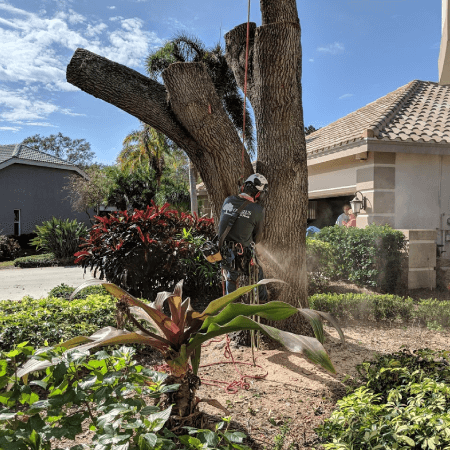
What Is the Cheapest Time of Year for Tree Removal in Florida?
In Pinellas County, late fall through winter is usually the slowest stretch for tree companies, so it is often the easiest time to schedule and sometimes the best price. No rule we work under here bans tree removal by month. Nesting birds, eagle nests, permits, and hurricane season matter more than the calendar.
Why Late Fall and Winter Often Cost Less
Tree work in the Tampa Bay area runs in waves. Spring and early summer fill up with people getting ready for hurricane season. Summer and fall bring storm work. Late fall into winter is usually quieter.
When schedules are lighter, companies have more flexibility on dates, and some will price more sharply to keep crews busy. That is something I have observed over the years but it isn’t always the case. The tree, the yard, and the trunk size still set most of the price, and our tree removal cost guide shows how.
One more reason to plan ahead: a tree removed on a calm day in January is a simpler job than the same tree after it breaks onto a roof in September. If a tree has to go, the cheapest time is usually before it becomes an emergency.
Our tree removal service page covers how we plan a removal.
Are There Months You Cannot Cut Down Trees in Florida?
Not by the calendar. A lot of the advice online about months to avoid comes from up north, where oak wilt spreads through fresh cuts in spring. UF/IFAS has described oak wilt as a potential future threat to Florida, not one established here, so that rule is not the one that governs work in Pinellas.
What can stop or delay a removal here:
- An active bird nest. Most native birds are protected under the Migratory Bird Treaty Act, and so are their active nests. Most of our songbirds nest in spring and summer. If we find an active nest in a tree that is not a hazard, that tree may need to wait until the young have left.
- A bald eagle nest nearby. Florida’s eagle nesting season runs October 1 through May 15. Guidance sets a 660 foot buffer around an active nest, and work inside it can need a permit and monitoring. Bald eagles nest in Pinellas County, sometimes in residential neighborhoods.
- A permit. Many Pinellas cities require one for protected trees, and the review takes time. Starting early matters more than the month. See our tree removal permits page.
- Hurricane season. It runs June 1 through November 30. It does not stop removals, but after a named storm, crews go to emergency work first and planned jobs wait.
When Should You Not Prune?
Removal and pruning follow different timing. For pruning, a few windows are probably best avoided:
- Heavy pruning in the heat of summer on a tree that is already stressed.
- Stripping green fronds off palms before or during hurricane season. Green fronds help the palm, so remove only fronds that are fully dead.
- Pruning pines during the spring flush and the warm months when bark beetles are most active.
- Topping or heavy thinning the week before a storm, which tends to make a tree more likely to break, not less.
Light work to remove dead or broken branches is fine any time. Our page on when to trim trees in Florida covers timing species by species, including live oaks, laurel oaks, crape myrtles, and palms, and our tree pruning service follows the same timing.
Timing Choices That Save Money
- Book non-urgent removals for late fall or winter.
- Start the permit early if the tree is protected, so the permit is not the thing holding up the date.
- Group several trees into one visit, since setup and drive cost about the same either way.
- Have a tree you are worried about looked at before hurricane season, not during it.
- Ask whether the tree needs to come down at all. Our trim or remove page walks through that.

Tree Removal Timing FAQ
In Pinellas County, late fall through winter is usually the slowest season for tree companies, which often means easier scheduling and sometimes a better price. The tree’s size, the yard, and access still drive most of the cost.
No month is off limits by the calendar. What can delay a removal is an active bird nest in the tree, an active bald eagle nest nearby during the October 1 to May 15 season, a permit that has not been issued, or storm work after a hurricane.
Active nests of most native birds are protected by federal law. If the tree is not a hazard, the usual answer is to wait until the young have left the nest. If the tree is a hazard, talk to an arborist about the options.
Removal can happen any time of year. For pruning, light work is fine in summer, but heavy pruning on a stressed tree is better scheduled for late winter or spring.
If it needs to come down, yes, plan it for the off season rather than waiting. Many trees do not need removal at all. Correct pruning done well ahead of the season can lower storm risk while keeping the tree. See our storm page for what we do after a storm.