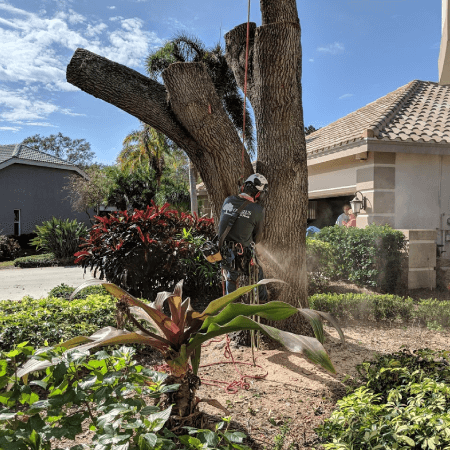
How Much Does It Cost to Cut Down a 30, 40, or 60 Foot Tree?
In Clearwater and Palm Harbor, removing a 30 foot tree often runs $400 to $1,200 from front yard to back yard, a 40 foot tree $1,150 to $2,850, and a 60 foot tree $2,200 to $4,900, before debris and stump work. Height is a rough guide; proximity to structures, canopy spread, and the size of limbs over obstacles set the price.
Why Height Is the Wrong Ruler
Most people describe a tree by how tall it is. Our price chart starts from trunk size, because the trunk tells us how much wood has to come down. What moves the price most is what the tree is over: how close it is to the house, the pool cage, and other obstacles, how far the canopy spreads, and how big the pieces are that have to come down over them.
Two trees of the same height can be very different jobs. A 60 foot slash pine with a narrow crown in an open front yard generally takes less work than a 35 foot live oak with limbs spread over a roof and a screened pool cage. The pine is taller. The oak has more wood over more things that can break.
Height still matters for a few things: whether a climber or a lift can reach the top, whether a crane makes more sense, and how much open ground we need to lower or drop pieces safely.
Rough Prices by Height
These numbers come from the same price chart as our tree removal cost guide, which is built on trunk diameter. The trunk sizes next to each height are what we commonly see on laurel oaks, pines, and similar trees in north Pinellas. Live oaks often run thicker for their height, so treat this as a starting point.
| Tree height | Typical trunk size (DBH) | Front yard | Back yard |
|---|---|---|---|
| Under 20 feet | Under 10 inches | $100 to $300 | $148 to $450 |
| Around 30 feet | 10 to 15 inches | $400 to $800 | $592 to $1,184 |
| Around 40 feet | 16 to 24 inches | $1,150 to $1,920 | $1,702 to $2,841 |
| 50 to 60 feet | 25 to 36 inches | $2,200 to $3,300 | $3,256 to $4,884 |
| Over 60 feet, or over 36 inches | 37 inches and up | Can require a crane; see the crane guide | |
DBH means diameter at breast height, the trunk measured 4.5 feet off the ground. Debris hauling, stump grinding, permits, and crane time are separate line items. For the bigger trees, our crane-assisted removal cost guide covers how the crane is priced, and our crane-assisted tree removal service page covers how we plan the lift.
How to Measure Your Tree's Trunk
You can get close with a tape measure. Wrap it around the trunk at about chest height, 4.5 feet off the ground, and divide that number by 3.14.
A trunk that measures 47 inches around is about 15 inches across. One that measures 75 inches around is about 24 inches across. If the trunk splits into two or more stems below chest height, measure each stem and add the diameters together. That is how we size a multi-stem tree for pricing.
Knowing the trunk size gets you much closer to a useful number from the chart above than guessing the height, which is hard to judge from the ground.
What Moves the Price Up or Down
- Front yard or back yard. Backyard removals usually run 40 to 50 percent more, because every piece has to be lowered carefully and carried or routed out through a gate.
- What is underneath. A roof, a pool cage, a fence, or a neighbor’s shed means more rigging and slower, smaller pieces.
- Power lines. A tree near energized lines may need the utility or a line-clearance crew involved before we can work it.
- Condition. A tree with heavy decay may not be safe to climb, which can mean a lift or a crane instead.
- Species. A palm of the same height is often less work than an oak, because there is no wide canopy to take apart. Over a house, that can change.
- How many trees. Setup and drive cost about the same for one tree or four, so several trees on one visit usually lower the price per tree.
Before You Pay to Remove It
A tall tree is not automatically a dangerous one. A lot of trees that look like they need to come down do not. Some can stay with the right pruning or some support, and a removal you did not need is an expensive mistake on a mature oak.
If you are not sure, read when tree removal is actually necessary or whether trimming or removal costs less over time. When removal is the right call, our tree removal service page covers how we do it.

Tree Removal Cost by Height FAQ
In Clearwater and Palm Harbor, a 30 foot shade tree often has a trunk around 10 to 15 inches across. From our price chart that is about $400 to $800 in a front yard and $592 to $1,184 in a back yard, before debris and stump work.
A 40 foot tree commonly has a trunk around 16 to 24 inches across. That runs about $1,150 to $1,920 in a front yard and $1,702 to $2,841 in a back yard on our chart. Limbs over a roof or pool cage push it toward the top of the range.
A 50 to 60 foot tree with a 25 to 36 inch trunk runs about $2,200 to $3,300 out front and $3,256 to $4,884 in back. Trees larger than that can require a crane, which is priced as its own line item.
Usually, yes. A palm has one trunk and a small crown, so there is less to take apart. A tall palm leaning over a roof or pool cage can still take careful rigging, and that adds cost.
No. The base price covers cutting the tree down to a low stump. Hauling the wood and brush, grinding the stump, and any permit are priced as separate lines so you can see what each costs.
Across six years of our removals, from small ornamentals to very large oaks, the average has been about $993. For one tree, the trunk size and the yard matter more than any average. Our page on what a fair price looks like explains what should be in the number.