Crane-Assisted Tree Removal in Clearwater and Palm Harbor, FL
O'Neil's Tree Service performs crane-assisted tree removal across Clearwater, Palm Harbor, and Pinellas County. We operate our own crane, and every lift is planned by an ISA Certified Arborist before the first cut. Cranes let us take large trees down in controlled sections, over houses and pools, without dragging equipment through your yard.
Why a Crane, and Why It Matters to Your Yard
Most homeowners who need a crane never ask for one. They call and say some version of “there is a big oak leaning over my house.” The crane is our answer to that problem, not something you need to figure out yourself.
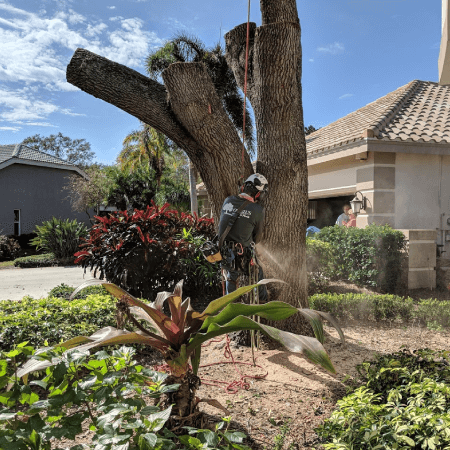
Here is the difference it makes. Traditional removal means a climber rigs each section and lowers it through the canopy on ropes, and the pieces come down through your landscape. Crane removal lifts each section up and over, straight to the landing zone. Less time in the tree, less weight swinging near your roof, and far less impact on the lawn, irrigation, and plantings underneath.
We run our own crane, and we still rent bigger ones regularly; the real answer to “do you own a crane” is both. Ours is a 55 ton knuckle boom, and it handles most trees out to about 60 feet of reach. Really large trees, over 30 inches in diameter, get heavy fast. At 60 feet an average pick might run around 3,000 pounds, and a 30 inch plus tree will push past that easily. When the numbers get close, we step up to a larger stick crane, 60, 75, 90, or 120 ton, depending on the size of the tree and the distance to it. We keep stepping up until the lift is safe with room to spare.
Crane work on trees is different from almost anything else you would lift. Once a section is cut from the tree, you cannot set it back down. You own it, and the crane has to carry it. If the piece is heavier than the chart allows, the crane tips over or drops it on something. That is why the weight math matters so much, and why crane load charts, which are not easy reading, have to be understood by the people planning the lift. Not respecting the chart is how a company ends up on the news.
We may be the only tree company in Pinellas County with three certified crane operators on staff. Carson and I are certified on articulated cranes, fixed boom, and all terrain cranes; Rich is certified on articulated and fixed boom. When we spec a crane for your tree, we look at the size of the tree, the distance from the setup to it, and the average pick weight, then put a machine on the job that builds in a safety factor.
When Crane Removal Is the Right Call
A crane is the right piece of equipment when one or more of these is true. The tree is over or close to the house, pool, or screen enclosure. The backyard has no equipment access, which is common in Clearwater and Palm Harbor lots with fenced yards and tight side setbacks. The tree is dead or structurally compromised, so putting a climber’s full weight in it is not a responsible plan. Or the tree is simply large, and sectioning it conventionally would take days of impact on your property instead of hours.
Storm-damaged trees are a frequent crane job here. After a storm passes, a tree resting on a roof needs to be lifted off, not cut off, because cutting releases the weight unpredictably. That lift is exactly what a crane is for. It is also where a crane earns its keep on collateral damage: lifting a fallen tree off a home nearly eliminates the chance of doing more harm on the way out, where cutting it off in place or dragging it with ropes tends to add roof punctures, ripped gutters, and torn soffits to the claim. Our storm response process is on the storm page.
When a Crane Is NOT the Right Call
Plenty of removals do not need one, and a majority of the time we will not bring a crane to a job that does not need one. A tree with open drop space, decent access, and sound structure usually comes down faster and cheaper with a lift, bucket truck and or climber. The average tree removal we performed last year ran $993.22; crane jobs sit well above that, so we only recommend the machine when it genuinely reduces risk or protects your property.
There are tradeoffs in the other direction too. A crane sitting on a driveway or crossing a sidewalk carries its own risk. We use mats and cribbing to spread the load and protect the concrete, and most of the time that works. The driveways that crack are usually the old ones, or ones where a root has pushed the slab up and left a void underneath, so the concrete is no longer sitting on the ground. Edges are often thinner in the pour and more delicate, so we take extra precaution there. If your driveway looks like one of those, we will talk about it before the crane arrives, not after.
If you are not sure which situation you have, that is normal. Request an assessment and an arborist will tell you plainly, including when the cheaper method is the better method.
How We Plan a Crane Lift
Every crane removal starts with a assessing the site, not just having guys show up with chainsaws. An ISA Certified Arborist walks the property and works through the same questions each time: where the crane sets up, what the ground can bear, what each section weighs, and where each pick lands.
The crane’s position is calculated before it arrives. Outriggers spread the machine’s weight, and we protect driveways and soft ground with mats and cribbing. Weight estimates for each section are worked out from trunk diameter and wood species; a water-heavy laurel oak section weighs a lot more than the same size pine, and the rigging plan reflects that.
On lift day, a climber or bucket operator sets the rigging on each section, the crane takes the load before the cut is finished, and the section flies up and over to the landing zone where the ground crew processes it. A removal that would take two days of conventional rigging often finishes in a morning. ANSI Z133 safety standards govern the whole operation, the same way ANSI A300 governs our pruning work.
Recent Crane Work
State Road 580, Safety Harbor
In July 2026 we removed three laurel oaks, 39, 27, and 22 inches DBH, at a senior living property. All three had fungal fruiting bodies at the base, bark inclusions, and canopies in decline; trees in that condition are not safe to put a climber in, so the crane did the holding. We filed the City of Safety Harbor removal permit, set a 75 ton load line crane on cribbing, and took all three down in controlled sections. The full scope ran $15,420, each service priced as its own line so the client could see exactly where the money went.
Dartford Drive, Tarpon Springs
A 35 inch live oak was lifting the driveway and the AC slab, close to underground utilities, with a multi-dominant trunk. The county permit came through, a 45 ton crane lifted the sections up and over, and the removal ran $3,500 with debris included. A second declining oak on the same property qualified under Florida’s hazard tree statute, so a $150 ISA Certified Arborist letter took the place of a permit for that one; knowing which path each tree qualifies for is part of what you are paying an arborist-led company to know.
What Crane Tree Removal Costs
Crane-assisted removals in Pinellas County generally run from around $1,000 for a straightforward assist up to $14,000 for the largest and most technical lifts. Where your tree lands in that range depends mostly on size, wood weight, what the tree is over, and how far the crane has to reach.
Insurance claims involving crane removals are their own category, and they can exceed $20,000, because storm work is triage. Think of it like the emergency room. My primary doctor has much of the same equipment, but the ER visit costs many times more, because everything about it is unscheduled. It feels like ten times; we are not ten times more, but a tree that has to be lifted off a house does cost more than the same tree standing in the yard. It pulls crews off booked work, changes the schedule for everyone, and often runs into overtime.
We published a full breakdown with pricing by trunk diameter in our crane tree removal cost guide. If your removal is connected to an insurance claim, our insurance tree removal guide explains how documentation works; we photograph and document crane jobs thoroughly because carriers ask.
What Most People Get Wrong About Crane Removal
The most common worry we hear is that a crane near the house is riskier than ropes. In practice it is usually the opposite. The crane holds each section under control before it is ever cut free, which removes the swing that rope rigging has to manage.
The second misconception is that the crane will destroy the lawn. The machine typically sets up on the driveway or street, on mats, and reaches over the house. On most jobs the yard sees less traffic than a conventional removal, not more.
The third is assuming a “free wood” crew with a rented crane is the same service. Crane work is a coordination discipline between the operator, the climber, and the ground crew. Ask any company two questions: who is running the crane, and who is doing the weight calculations. You want one team accountable for both.
The framing that helps most people is this: on a tree job, the only thing that is not rated is the tree. The ropes are rated, the rigging hardware is rated, and the crane is rated with a load chart down to the pound. The tree is the unknown. It may have taken a lightning strike ten years ago and grown over the scar, or be carrying decay you cannot see from the ground. Conventional rigging assumes the tree can withstand the forces of pulleys, ropes, and swinging, falling loads that shock potentially weakened wood; when that assumption is wrong, climbers get hurt and property gets damaged. A properly specced crane takes those dynamics out of the tree entirely. Used correctly, the crane is always safer than the tree. Overloaded or set up over a void it becomes dangerous like any machine, which is why the planning is the job.
Request An Assessment

Crane Tree Removal FAQ
Straight answers to the questions we hear most about crane work.
Most crane-assisted removals run between $1,000 and $14,000 depending on tree size, wood weight, and what the tree is over. Our cost guide breaks pricing down by trunk diameter so you can estimate before we visit.
We set outriggers on protective mats and position the crane on pavement whenever possible. Most crane jobs put less traffic on your yard than a conventional removal, because sections fly over the landscape instead of coming down through it.
Yes; that is the situation a crane handles best. Each section is held by the crane before it is cut free, then lifted up and over the structure to the landing zone.
Both. We own a 55 ton knuckle boom that covers roughly half to 60 percent of our crane jobs, and we rent larger stick cranes, 60 to 120 ton, when the tree or the reach calls for more machine, or when our crane is booked. We are a tree company, not a crane company; owning every size of crane would be silly. What we keep in-house is the knowledge: three certified crane operators on staff, and crews, foremen, and climbers trained and educated in crane-assisted removal.
For large, dead, or storm-damaged trees, it generally is. The crane supports each section under load control, and it keeps climbers out of trees that should not carry a person’s weight. Every lift follows ANSI Z133 safety standards.
In most Pinellas County cities, removing a protected tree requires a permit, and the rules vary by city. Florida law adds one path that matters here: on single-family residential property, if an ISA Certified Arborist documents that the tree poses an unacceptable risk, meaning removal is the only practical way to reduce its risk below moderate, the city cannot require a permit, fee, or replanting for that removal. Dead and storm-broken trees often qualify. We assess honestly, prepare that documentation when the tree meets the standard, and file the standard permit when it does not. Our permits guide explains how it works where you live.