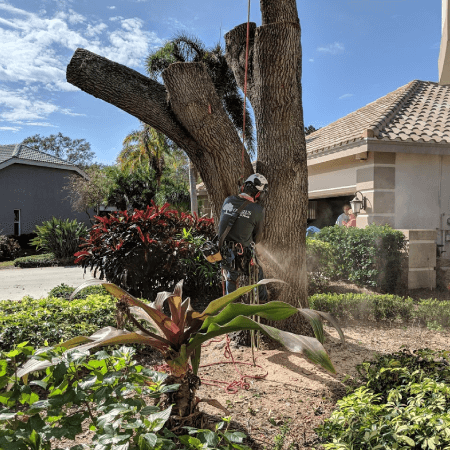
Is It Cheaper to Trim a Tree or Cut It Down?
Trimming is cheaper, often less than half the cost of removing the same tree. Over ten or twenty years it can go either way. A sound tree that needs pruning every three to five years usually costs less to keep. A tree with a serious defect may cost less to remove once.
On the Day, Trimming Costs Less
Take a 40 foot shade tree. Our trimming cost guide puts pruning a tree that size at about $400 to $800. Removing a 40 foot tree with a typical trunk in a front yard runs about $1,150 to $1,920 on our removal price chart, before debris hauling and stump grinding.
So if the question is only about this year’s bill, trimming wins almost every time.
Over Time, the Math Changes
A healthy live oak pruned correctly might need attention every four years or so. At around $600 a visit, that is about $3,000 over twenty years. Removal might be $1,500 plus debris and a stump, and then you have lost the shade, and some cities will require a replacement tree. A replacement that meets a city’s requirements typically runs around $950 installed.
Now picture a laurel oak with decay at the base and limbs that keep growing back over the roof. Laurel oaks are shorter-lived than live oaks, often 50 to 70 years. If that tree needs work every two years just to stay off the house, and it is near the end of its life anyway, removing it once may be the better use of your money.
Neither answer is right for every tree. The math depends on the tree’s health, its structure, how long it is likely to live, and what it gives you in shade and value.
When Trimming Is the Better Buy
- The trunk and main branch unions are sound.
- The crown is full and healthy, with live branches over at least half the tree’s height.
- The problem is a few limbs over the roof, the driveway, or the neighbor’s yard.
- The species is long-lived, like a live oak, and the tree has decades ahead of it.
- The tree shades the house or adds value you would pay to replace.
That kind of targeted work is what our tree trimming and pruning services are built around.
When Removal Is the Better Buy
- Decay has hollowed out a large part of the trunk or root flare.
- A palm has Ganoderma conks at the base. See what Ganoderma conks mean.
- Two stems are splitting at a weak union and support would not hold.
- A short-lived species is near the end of its life.
- You are paying every year or two just to keep the tree off the house.
Our page on when tree removal is actually necessary goes deeper on that decision, and our tree removal service page covers how we do the work.
The Third Option: Support
Some trees fall in between. A co-dominant oak with a weak union may be a good candidate for cabling or bracing along with pruning. A declining tree may respond to plant health care.
Both cost less than a removal and keep the tree, but only when the tree is worth keeping. That is a decision you and your arborist should make standing under the tree.
What "Trimmed Back" Should Mean
Trimming back should mean shortening specific limbs to a side branch big enough to take over. It should not mean cutting the top off. Topping looks cheaper because it is fast, but it triggers dense regrowth that is weakly attached, creates decay and needs cutting again sooner, so it usually costs more over the life of the tree.
Our page on trimming versus pruning shows what correct work looks like and what to watch for.

Trim or Remove FAQ
Yes, often less than half the cost. Over many years it depends on the tree. A healthy, well-built tree pruned every three to five years usually costs less to keep. A decaying or poorly structured tree that needs constant work may cost less to remove once.
Most mature shade trees in the Tampa Bay area do well with pruning every three to five years when it is done correctly. Young trees benefit from lighter structural pruning more often while they are forming.
Sometimes. Several Pinellas County cities require replacement trees or a fee in lieu for protected trees. A replacement that meets city requirements typically runs around $950 installed. Our tree removal permits page covers the local rules.
Often it can, with a few rounds of careful pruning over several years to choose new leaders and thin out weak sprouts. It depends on how much decay set in at the old cuts, so it is worth having it looked at.