Tree Removal in Clearwater and Palm Harbor, FL
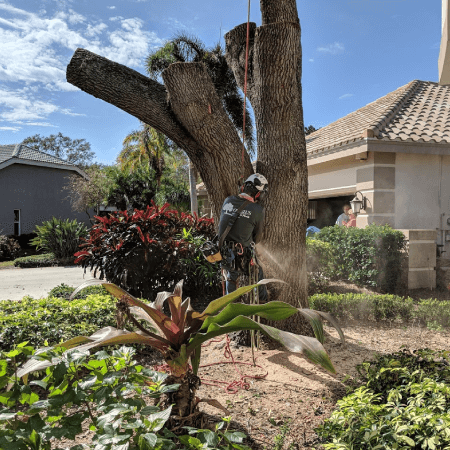
O’Neil’s Tree Service provides safe, professional tree removal in Pinellas County and the Tampa Bay area. Our ISA Certified Arborists use cranes, advanced rigging, and turf-friendly equipment to remove hazardous, declining, or storm-damaged trees with as little impact to your property as possible. We have served more than 20,000 homeowners since 2008.
Why Homeowners Call Us for Tree Removal
Apollo O’Neil, Board Certified Master Arborist and founder of O’Neil’s Tree Service, removed his first tree with his dad when he was just 5 years old, and then at the beginning of his arboricultural career right here in Clearwater. Since then, we have been safely removing declining, hazardous, and problem trees across Pinellas County and the Tampa Bay area.
At O’Neil’s we always try to preserve trees. When it is possible to save a tree, we use the most effective and current, science-based methods of tree care to keep trees safe and preserve them as long as possible. When a tree is dead, failing, creating a hazard, or needs to be removed for construction, we make sure the job is done safely, cleanly, and with as little impact on your property as possible.
Tree removal is likely the highest-risk task in arboriculture, which is why our arborists and crews are so highly trained. Our tree removal crews adhere to and practice the most current climbing, rigging, and safety standards in the industry. Whether a tree is near a home, over a pool, above a roof, or too dangerous to climb, we use cranes, grapple trucks, and turf-friendly equipment to perform tree removals safely and efficiently.
-
ISA Certified Arborists on staff
-
Specialists in hazardous and hard-to-reach tree removals
-
Crane-assisted removals for maximum safety
-
Clean, careful work that protects lawns, roofs, pools, and structures
-
Serving Pinellas and Tampa Bay since 2008
How We Remove Trees Safely
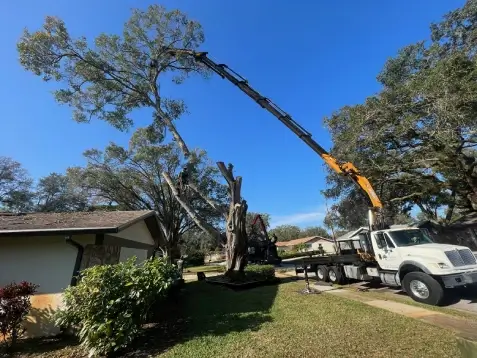
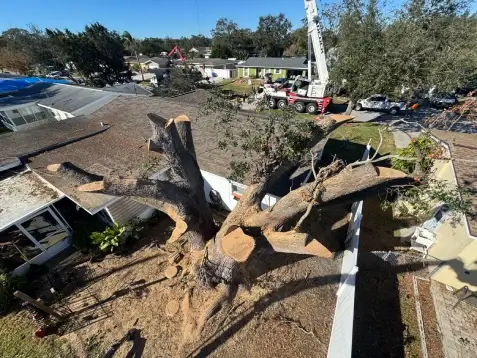
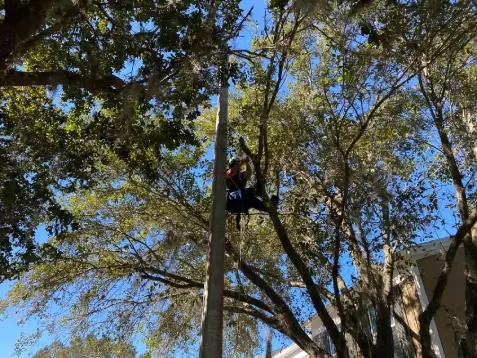
O’Neil’s uses the most advanced equipment and the most current tree removal techniques available in the industry. This includes ISA Certified Arborists, ISA Certified Tree Climbers, highly credentialed and trained crews, cranes, tight-access and backyard self-propelled aerial lifts, bucket trucks, grapple trucks, turf-friendly wheel loaders, and large diesel stump grinders.
Our foremen, tree climbers, bucket truck operators, and crane operators are constantly working to improve their skills and education through weekly safety and educational meetings at our shop in Palm Harbor every Friday. We have the most highly educated, credentialed staff in the Tampa Bay area. No private, tree-care-only company in the state of Florida has as many ISA Certified Arborists on staff as we do.
What Makes Our Tree Removals Different
-
We specialize in high-risk tree removals near homes and structures
-
We use cranes whenever doing so increases safety and efficiency, saving labor hours and reducing risk
-
We protect lawns, shrubs, irrigation, other trees, sidewalks, and driveways during every removal
-
We handle tree removals in tight spaces and limited-access situations
-
We plan every job ahead of time so our crews work as safely and quickly as possible; rushing tree removals is dangerous
-
Before we start, our team meets to go over hazards, the safest approach, and how to minimize impact to your property; this is one of the biggest reasons people trust us with their removals
What to Expect When You Hire Us
When one of our estimators visits your property, we will ask a lot of questions and look for factors that determine the amount of effort your tree removal will require. Our estimators, most of whom are ISA Certified Arborists, strategize the plan for how to complete the job. Often the details of these plans are included in the proposal. Annotated photos may be included to give a clear visual of where equipment will be placed and how the job will be carried out.
Here are a few of the factors we consider and that you should expect to discuss:
- The safest way for personnel to perform their work; this is the first and most important factor
- The most efficient removal method for the site, which may include cranes, tree climbers, lifts, bucket trucks, or turf-friendly wheel loaders; the most efficient method is always considered because it can save labor hours and reduce cost significantly
- Permit requirements; almost every municipality in Pinellas and Hillsborough counties requires a permit or a letter meeting Florida statute requirements before a tree can be removed; we often help homeowners through this process or handle it entirely to save time and reduce stress
Once the municipal requirements are satisfied, we schedule your job. Most tree removals are completed in one day. When we are done, we clean the property thoroughly. Our goal is to make it look like we were never there.
Before you decide, our tree removal cost guide shows typical prices, and when tree removal is necessary walks through whether the tree needs to come down at all. If you only know how tall the tree is, our cost by height page gives a starting range.
Tree Removal Permits in Pinellas County and Nearby Cities
Almost every municipality in Pinellas and Hillsborough counties requires a permit or an ISA Certified Arborist report that adheres to the best management practices for tree risk, in which a tree's risk cannot be mitigated below a moderate risk practically, before a tree can be removed. The requirements vary by city, and it is always best to verify the specific municipality you are in before proceeding. O'Neil's can handle permits for you when required so everything is done legally and with minimal stress.
- Clearwater
- St. Petersburg
- Palm Harbor (unincorporated Pinellas County)
- Safety Harbor
- East Lake
- Oldsmar
- Belleair (permit required)
- Belleair Beach (no permit required at this time)
- Largo
- Seminole
- Ozona
- South Pasadena
- Gulfport
- Feather Sound
- Indian Rocks Beach
- Redington Beach
- Madeira Beach
- South Tampa
- City of Tampa
- Hillsborough County (unincorporated)
If you are unsure of your permit requirements, call us or request an assessment and we will confirm what applies to your specific tree and location.
Areas We Serve for Tree Removal
We provide safe, professional tree removal across Pinellas, Hillsborough, and Pasco counties and have helped more than 20,000 homeowners since 2008. Cities we serve regularly include Clearwater, Palm Harbor, Dunedin, Safety Harbor, Tarpon Springs, Largo, Belleair, Oldsmar, St. Petersburg, Pinellas Park, Tampa, Westchase, Carrollwood, and Odessa.
Related Services
Tree removal is sometimes the right answer, but not always the first one. Before recommending removal, we evaluate whether the tree can be preserved through:
- Structural pruning and crown cleaning
- Plant Health Care programs
- Cabling and bracing
- Tree Risk Assessment and consulting
If removal is the right call, stump grinding is the logical next step. We can quote it separately or include it as part of the removal scope.
Request An Assessment

Tree Removal FAQ
When you are considering removing a tree in Pinellas County, most people have a lot of questions. It is hard these days to know who to trust. Below are real answers to the questions I have been asked by homeowners across Pinellas and Hillsborough over the years. As a Board Certified Master Arborist, my goal is to give you honest information, even if the truth does not benefit O’Neil’s bottom line. I would rather see you make the decision that is best for you, your tree, and your property.
Most people do not. A tree owner would need to invest some time getting educated about trees and how they function to correctly answer this question. Fortunately, you do not need to know the answer because we do. We have ISA Certified Arborists and Tree Risk Assessment Qualified (TRAQ) arborists on staff to help with exactly this question. We look for things such as:
- Branch attachments and aspect ratio (the size of the branch relative to the trunk or stem it is attached to)
- Branch spacing and structural defects
- Cavities, decay, and wound closure
- Growth rate by year
- Cracks and seams
- Dead branches and branch tip dieback
- Leaf size, leaf color, and overall canopy health
- Root disease and root rot
If a tree can be saved with plant health care, proper pruning, or supplemental support such as cabling or bracing, we will recommend that instead. Our goal is always to preserve trees when possible. When a tree is unsafe or past the point of recovery, removal is the most responsible and reasonable choice. If you are still unsure after meeting with an arborist, seek out another arborist who is well versed in the ISA Best Management Practices for Tree Risk Assessment. A thorough assessment can be provided in writing by a qualified TRAQ arborist.
A dead tree usually has no green leaves or needles left in the canopy. Many self-proclaimed arborists tell homeowners a tree is dead when it is only declining.
If a self-proclaimed doctor, or even an actual doctor, told you that you were dead or dying while you were still standing, most of us would get a second opinion.
If the canopy is not completely brown, it is likely not a dead tree. Most trees do not just suddenly die. Ninety-nine percent of the time they have been declining for years before they finally give up. Decline happens over many years, and eventually the tree runs out of resources.
$993.22. We took all of the tree removals we performed and the total price of them over the last six years, and $993.22 was the average cost. This obviously includes small trees that could have been 3 to 5 inches in diameter all the way up to trees measuring more than 84 inches in diameter. Factors that affect cost include:
- Size of the tree
- Access to the tree
- What is under and around it
- The skill level of arborists needed
- Whether we are already on site or nearby
- Drive time to the site
- Whether cranes, bucket trucks, lifts, skid steers, or rigging are needed
- How long the job will take
The biggest thing to consider is how much collateral damage you are willing to allow on your property. Many tree companies can come out and drop a tree, but we have all seen those videos online, and it rarely ends well.
The best thing to do is have a professional arborist come out so you can ask questions, understand the risks, and set clear expectations. A truthful person will tell you things you do not want to hear, even if it risks the sale. If you are not comfortable or you feel they were not fully honest, trust your gut.
Tree removal is one of the most dangerous jobs in the country, not landscaping, but actual arboriculture. When arboriculture is separated from landscaping and measured by deaths per 100,000 workers, we land somewhere around 110 to 150 deaths per 100,000. That number would put us at or near the top of the most dangerous jobs in the United States, just under logging at 78 per 100,000. You are paying for:
- Highly trained arborists
- Thousands of hours of training and education performed off job sites
- Very expensive equipment that wears out quickly due to the nature of the work
- Legitimate insurance and payroll taxes, which together cost O’Neil’s $700,000 to $800,000 per year before we make a dollar; our insurance alone exceeded $400,000 in 2025
- The risk of driving heavy equipment on public roads (one slow-speed accident cost us $150,000 in premium increases)
- Rigging, cranes, bucket trucks, and heavy mats
- Drive time, prep time, labor, and expertise
- Protecting homes while removing thousands of pounds of wood
Anyone can cut a notch and yell timber. Making sure a tree does not hit your house, fence, pool cage, shed, or your neighbor’s house takes real skill.
And maybe more importantly: when something does go wrong, does the company do what is right, or do they run and try to push the mess onto your insurance?
The cost is not about cutting a tree. It is about making sure the job is done safely, responsibly, and professionally.
Yes, with very limited exceptions. There is only one city in Pinellas County that does not require a permit, and none in Hillsborough County are exempt across the board. However, certain species may not require a permit in some municipalities. It is best to check with your city arborist or a reputable arborist who can correctly identify the species and confirm the requirements. O’Neil’s can handle this for you when required so everything is done legally and with minimal stress.
It can. The bigger the tree, the more likely there is some risk of property impact. We work extremely hard to protect lawns, driveways, and landscaping. We use protective mats, cranes, rigging systems, turf-friendly equipment, and controlled lowering techniques to keep things as clean and neat as possible. The larger the tree and the more precautions required, the more the removal costs. Most of the time, when we are done, homeowners tell us it looks like we were never there, minus the stump.
1.58 hours is the average time to remove a tree across all diameters we have removed over the last six years. Keep in mind we remove far more small ornamental trees than anything else, and this average includes small trees along with trees exceeding 84 inches in diameter. We also use some of the most sophisticated tree removal equipment available, which makes us very efficient. There are not many tree removals that take more than a day to get on the ground. We plan everything ahead so the job runs as smoothly, safely, and efficiently as possible.
Yes. This is something we specialize in. Many of our crew members love the challenge of removing a tree in a tight spot with limited or no access. These types of removals require much more skilled and trained arborists. We handle jobs like this almost daily. We use cranes, rigging, and controlled lowering to remove the tree safely without damaging the surrounding area.
Yes. In most municipalities in Pinellas County and Tampa, it is actually illegal to leave debris behind for the city to pick up. All logs, branches, and debris are hauled away and recycled unless you want to keep material for firewood or woodworking. Cleanup is one of the most important parts of the job, and we make sure your yard looks clean before we leave. Our goal is for your yard to look like we were never there.
In Florida, any time of year works. If you are trying to get the best price, tree companies are typically slower in the winter, so you are more likely to get a discount. Florida does not deal with frozen ground or snow like northern states, so turf and yard damage are more controllable. The main issue is the rainy season, which can make things sloppy and increase the chances of ruts and yard damage.
What matters more than the season:
- How hazardous the tree actually is; 98% of trees can safely wait until winter
- What fits your schedule and budget
- Current weather conditions
- If the tree is truly hazardous, the best time is as soon as possible, regardless of season
It depends. If you have a tree that is already declining, leaning from root zone damage, cracked, or showing root plate problems, hurricane season can increase the chances of it failing. We often see perfectly green trees with large canopies fall because they have structural defects. Think of a large sail on a boat with a damaged mast versus the same mast with a small sail that has holes in it. A full, dense canopy on a structurally compromised tree is the highest-risk combination.
If a tree is healthy, well-structured, and well-maintained, there is usually no reason to remove it just because hurricane season is approaching. We assess each tree by considering:
- Structure and overall health
- Wound closure and root stability
- Previous storm behavior based on client feedback
- Species characteristics
- Clearance around your home
We never recommend removal unless the tree is at least a high-risk tree and its removal actually reduces your risk, not just because a date on the calendar says June 1st.
No, not typically. Once a tree is removed, the roots stop growing. Without a canopy they cannot produce energy or sustain themselves, so they slowly die off. Sometimes young trees or certain species may sprout from the stump for a while. If not kept at bay, these sprouts can re-supply the roots and cause them to grow again. They can be cut periodically until the stump runs out of stored energy. Options to fully ensure the roots die include stump grinding, excavating the roots and hauling them away, or treating the stump and roots with an herbicide. Always consider the long-term impacts and side effects of any products before use.
No, not typically. Ninety-eight percent of the time it does not. However, if you have a tree that is truly high risk, removing it can absolutely increase value by eliminating that risk. Removing a healthy tree, on the other hand, can reduce property value by 15% or more. Research comparing properties with mature trees to similar properties without trees shows that trees can account for 15% or more of value at closing.
Removing a perfectly healthy, beautiful, well-structured tree is a bad move. People love trees. Trees make people feel comfortable, peaceful, and happy. They provide shade, lower power bills, reduce atmospheric cooling and make a property feel established. However, removing a dangerous, heavily declining, or structurally failing tree can increase value because you are removing risk.A reputable company will:
When trying to decide whether a tree adds value or creates risk, call a reputable company with Certified Arborists on staff. If you are trying to figure this out on your own, ask yourself: am I certain this tree is dangerous? If you are certain, the tree is likely a candidate for removal. Before making a final decision, consider how much value it also adds to your property.
- They talk about a tree being ‘dangerous’ but never use words like likelihood of failure or likelihood of impact; if you do not hear those terms, that is a red flag
- You cannot get them to discuss times they have made mistakes and how they made them right
- Their price is suspiciously low
- They do not perform a job site safety assessment (JSA)
- Workers are not wearing safety gear such as hard hats, ear protection, and chainsaw pants
- No cones are set out around equipment
- No ropes are set in the tree other than the climber’s line (a secondary rope is a rescue line; its absence is a red flag)
- They only use ladders and have no climbing gear
- No offer or ability to use ground protection mats or plywood
- They have no plan to perform the work
- They say ‘don’t worry about insurance’
- They cannot explain how they will protect your property during the removal
- Their equipment looks like it barely survived a disaster; though a brand-new company just starting out may still have good people who lack capital
A professional should walk you through every step and willingly answer any question. If they seem rattled by your questions, that is a bad sign. I had a client tell me he asked a tree service representative to ensure all crew members had government IDs so he could verify them against the workers’ comp policy. The representative responded: “Who are you, the Gestapo?” If a company makes you feel bad for asking questions, be on full alert.
- What mistakes have you made, and how did you fix them?
- Can I talk to those clients?
- Can you walk me through the risks of my job and tell me what your company will do to ensure my property is not damaged?
- Can all of your employees provide government ID on site that I can verify against your workers’ comp policy?
A reputable company will show you their process, explain the risks honestly, provide copies of their workers’ comp policy with every employee listed, carry proper equipment, own their mistakes, and give you a detailed plan of action. If a company says they have never made a mistake, they are either lying or inexperienced. If someone is only telling you what you want to hear instead of the truth, that is a red flag. Do not get salesman-shipped. Ask the hard questions.
And one more test: ask yourself whether you would trust this person in your home alone. If the answer is no, that is worth listening to. Your gut is usually right.
Only when the tree is genuinely high risk, and that is rarer than most people think. A formal risk assessment, done to the TRAQ Best Management Practices, usually finds that a tree the homeowner is worried about can be pruned, cabled, or monitored instead; roughly 98 percent of the trees we assess are low risk. When a tree really is failing, structurally compromised, or heavily declining, removing it does add value, because the buyer is buying the absence of that risk. Removing a healthy, well-structured tree does the opposite; the research on home sales puts mature trees at 15 percent or more of value at closing. The answer above covers the hurt-your-value side in more detail.
The signs show up on the job itself. No jobsite safety assessment before work starts that morning. Climbers without hard hats, eye protection, or chainsaw-rated protection. Limbs over your roof free-dropped instead of rigged or lifted. Big wood dragged across the lawn instead of moved on mats or with equipment that protects the turf. Nobody watching the drop zone. If you see any of these, call the company office and say so; a good company fixes it the same day. The question above covers the red flags to check before you ever hire.
If the company is legitimate, fully insured, and honest, they will handle it quickly, with integrity, and without dodging responsibility. The contractors O’Neil’s provides for repairs are professional companies with appropriate licensing and insurance. We also let the client choose their own repair company if they prefer.
If you choose the wrong company, you are about to enter a nightmare of finger-pointing. Tree companies hiding something almost always:
- Blame the wind
- Blame your tree
- Blame your property
- Try to file on your homeowner’s insurance
- Or disappear faster than a squirrel in July
This is why hiring based on price alone is dangerous. Cheap companies in this industry do not have the resources to fix problems when they occur. Hire people who take responsibility seriously and have proof of it.
You can leave the stump. It is your yard. There are not many negative consequences from leaving a stump besides it being an eyesore. Some possible issues you may not think of:
- Some species can sprout and try to grow back; you can cut these back periodically to keep them at bay
- Insects move in, which could include termites
- It becomes a tripping hazard
- Grass does not grow well around it
- You bang your mower into it
- Palms can attract Ganoderma fungus, which can get into the soil and make replanting new palms nearly impossible without risking them getting the disease
Stump grinding is usually worth it if any of these reasons apply. If the stump is far enough from your home or in a natural area or woods, leaving it is fine. Termites need a home too, and better a stump than your house.
If the crew knows what they are doing, the chances of significant damage drop considerably. That said, dragging large trees across turf to get debris to the road can cause damage. Your tree company should discuss this and offer ground mat protection or plywood to reduce the risk.
When removals are done correctly, with mats, rigging, cranes, turf-friendly loaders, and proper planning, the yard should look 90% or more normal afterward. Stump grinding will always leave behind an area that needs attention and potentially a large pile of mulch. Many companies do not haul mulch away as part of the job, so be sure to clarify if that is an extra cost.
If a crew will be driving skid steers or heavy trucks across your yard to remove and haul material from a large tree removal, you should expect ruts, torn grass, and possibly broken sprinklers. Most homeowners do not realize that cleanup is an important and time-consuming part of the job. If the company does not emphasize
cleanup, they probably do not do it well.
Yes, we use cranes, and yes, they affect cost. If the tree is large, dangerous, leaning, over a house, near a pool, or in a tight spot, cranes reduce the risk of damage, increase efficiency, and make the job site far more predictable. A new 40-ton crane can cost $800,000 or more to buy, and that cost is reflected in the removal price.
Manual removals in tight spaces create more labor hours on site, and often the crane ends up costing less than the labor would have. Another important factor is the reduction in landscaping damage. Landscaping is expensive to install and maintain, and a crane can nearly eliminate the possibility of damage to it. Cranes are heavy, however, and can crack sidewalks, driveways, and patio stones if pulled onto your property. Discuss this with your arborist ahead of time.
Cranes: reduce time, reduce risk, reduce property damage, and keep climbers safer. Not every removal needs one, but when it does, nothing else comes close.
One more reason we reach for the crane: on a tree job, the only thing that is not rated is the tree. Ropes, rigging, and cranes all carry ratings; a tree carrying hidden decay is the unknown. Our crane removal page explains how lifts are planned and priced.
No, but we do not mind if you are. There are some instances where we would actually prefer you not be in the house, such as when a crane is lifting tree parts over the roof. In the unlikely event something went wrong, we would rather you not be directly below it. If you will not be home, please make sure of the following:
- The crew can access the backyard
- You reviewed the work with the estimator
- You trust the company
- No gates, pets, or vehicles are blocking access; sort this out before you leave
Here is what helps the job go smoothly whether you are home or not:
- Move cars out of the driveway and down the street if possible
- Let your neighbors know, especially if any part of the tree is over their property or we will be blocking traffic
- Lock pets inside
- Clean up any dog waste where removal personnel may walk or work
- Clear kids’ toys, grills, garden tools, and anything fragile
- Unlock gates
- Move patio furniture and potted plants away from the work area
Yes. Let your arborist know you would like to keep some material and be specific about the size and how much you want. A large tree may produce far more wood than most homeowners expect, sometimes several truckloads.
Just keep in mind:
- Palm logs and some other species rot quickly
- Some species attract more pests than others
- Large logs are heavy to move later
If you do not want it, it will be hauled off. Make sure to discuss this with your arborist before the job begins.
Prices vary because companies vary:
- Some have credentials and are insured and some are not
- Some use cranes and proper rigging and some free-fall everything
- Some pay trained arborists and many hire anyone with a chainsaw
- A few carry $400,000 or more in insurance and many carry none
- A few pay payroll taxes on all their employees and most do not
- A few do things the safe way and others do things the fast way
- Some fix their mistakes and some disappear
- Very few train and educate their employees and most do not
- Some have staff that can assist with permits and some do not
- Very few provide employee benefits and real careers and most do not
Cheap work is not cheap if it results in devalued property, arguments, anxiety, property damage, lawsuits, or injuries. If you are still unsure whether your tree needs to be removed, schedule a consultation. We will evaluate the tree honestly and explain every option, including ways to save the tree if that is possible.