What Is the Difference Between Tree Trimming and Tree Pruning?
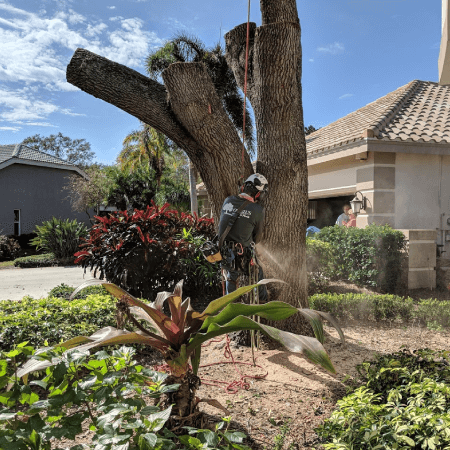
Trimming and pruning both involve cutting branches, but the goals are different. Trimming is usually about appearance; pruning is about the health and structure of the tree. Most residential tree work is pruning, even when homeowners call it trimming. The distinction matters because the technique is different and the results are different.
What Most People Get Wrong
Most homeowners assume the two words mean the same thing, just used in different contexts. They do not.
Trimming is a shape-based activity. It makes something look a certain way. It is the right word for hedges, shrubs, and ornamental plants being maintained at a defined size. For those, cutting to a uniform shape is the entire point.
Trees are different. A mature shade tree does not have a “correct shape” the way a boxwood hedge does. It has a structure, and that structure either supports long-term health or it does not. Cutting branches on a tree without considering where the cut lands, how much live canopy is removed, and what the tree’s response will be is not pruning. It is just cutting.
The other common mistake is assuming that any company offering “tree trimming” is performing the same work. They are not. ISA-certified arborists follow ANSI A300 pruning standards, which specify cut placement, canopy removal limits, and acceptable pruning objectives. Many crews operating as tree trimmers do not follow these standards and may not be aware of them.
How to Think About It
Think of it this way: trimming is maintenance, pruning is medicine.
Trimming keeps something at a size or shape. Pruning addresses what is actually happening inside the canopy: crossing branches competing for dominance, deadwood accumulating, a codominant stem developing that could fail under load, or a crown so dense that wind cannot move through it.
When you call about a tree that has not been touched in four years, branches growing toward the roof, or a canopy that looks heavy and overgrown, what you are describing is a pruning job. The right approach starts with understanding what the tree needs, not with picking up a saw.
Under ANSI A300 standards, pruning objectives are defined before work begins. Crown cleaning, crown thinning, crown raising, structural pruning, and deadwood removal are each distinct objectives with specific techniques. An arborist identifies which apply to your tree. A trimming crew typically does not make that distinction.
Warning Signs That Previous Work Was Done Incorrectly
If a tree on your property was worked on before and you are not sure whether it was done right, look for these:
- Stubs where branches used to be, with no lateral branch remaining at the cut point
- Large flat wounds in the middle of branches rather than clean cuts at the branch collar
- A tree that was significantly reduced in height by cutting the main stem or primary leaders; this is called topping and is not an accepted pruning practice under ANSI A300
- Dense regrowth of thin, fast-growing shoots from old cut points; these are called epicormic sprouts and often indicate a tree responding to stress from prior cuts
- Interior branches stripped away with foliage left only at the branch tips; this is called lion’s tailing and shifts weight to the ends of branches
None of these make a tree unsalvageable, but they do change how future pruning should be approached. An arborist can assess the current state and explain what is realistic going forward.
What to Do Next
If your trees have not been assessed in the last three to five years, a site visit is a reasonable next step. You do not need to know whether you need trimming or pruning before you call. That is what the assessment is for.
If you have a specific concern, such as a branch near the roof, a tree that looks different than it did last season, or work a previous company did that you are not sure about, bring that up during the visit. The more specific you can be about what you have noticed, the more useful the conversation will be.
Most of what homeowners call tree trimming is actually structural pruning when done correctly. Here is what that means and what to expect.
When to Call an Arborist
Call an ISA-certified arborist, not just a tree trimming crew, when:
-
The tree is a large established shade tree, live oak, laurel oak, or other canopy species
-
You are seeing deadwood, structural changes, or anything that was not there last season
-
A previous company did work you are uncertain about
-
You want to understand what your trees need before agreeing to any work
-
The tree is near a structure, power line, or high-use area
-
You are buying or selling a property and want a documented assessment
For hedges, palms, and ornamental shrubs, a certified arborist is not always necessary. For the trees that make up your property’s canopy, the training difference matters.
Request An Assessment
Tree Trimming vs Pruning FAQ
Topping is not recognized as an acceptable pruning practice under ANSI A300 standards and is condemned by ISA. It creates weakly attached regrowth, introduces decay through large wounds, and makes trees less stable over time. If a company’s recommended solution is to top the tree, ask for an alternative or get a second opinion.
No. When you call O’Neil’s Tree Service, we focus on understanding your trees, not the terminology. Tell us what you are seeing and we will take it from there.
ANSI A300 is the national standard for tree care operations, developed through the American National Standards Institute. It covers pruning objectives, cut placement, canopy removal limits, and other arboricultural practices. When an arborist follows ANSI A300, their work is guided by a peer-reviewed standard. It is the clearest benchmark a homeowner can use to evaluate whether a company’s approach is credible.
An overgrown appearance is often a reasonable indicator that structural work is overdue, but a visual check from the ground only tells part of the story. An arborist looks at branch attachment, canopy density, deadwood, and the tree’s overall response to its environment. A tree can look fine and have a developing structural problem, or look messy and be perfectly healthy. A site visit answers the question more reliably than appearance alone.
For small ornamental trees and shrubs, yes. For established canopy trees, the risk is higher, both for the tree and for personal safety. Improper cuts on large trees cause long-term structural damage. Work above ground level on mature trees involves equipment and hazard awareness that trained crews manage differently than a homeowner with a ladder. For anything significant, a certified arborist is the right call.
Most established shade trees benefit from a structural assessment every three to five years. Young trees benefit from more frequent formative pruning in their first ten years to develop strong architecture. Species, site conditions, and prior pruning history all affect the schedule. An arborist will give you a specific recommendation after seeing the tree.