Why We Wear Hard Hats in Tree Work (And Why It has Nothing to Do With OSHA)
At O’Neil’s Tree Service, wearing a hard hat is company policy. Not because of OSHA, rules, or regulations, but because of responsibility, respect, and professionalism.
I’ve seen a lot of controversy around hard hats over the years. I’ve also caught guys not wearing them. This page explains why I insist on it and why I always will.
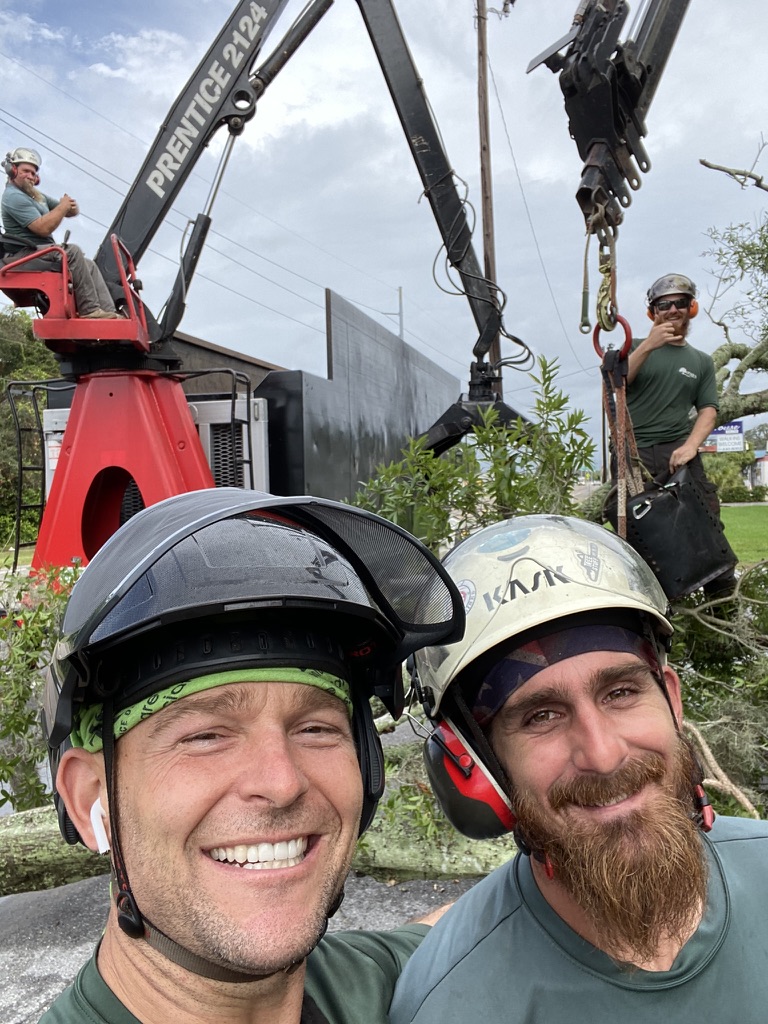
Table of Contents
If You Don’t Care About Yourself, That Matters
If you don’t wear a hard hat, it shows that you don’t care about yourself.
I’ve hit my head countless times over the years. During tree removal projects, due to dynamic forces, I’ve had hangers fall and hit me in the head while ascending trees. I’ve had branches fall out of a grapple while raking nearby. In one case, a branch swung as it fell, gained velocity, and struck me. I was probably standing closer than I should have been, but it still happened.
A couple of those hits rang my bell. If I hadn’t been wearing a hard hat, I would have at least ended up in the hospital. A couple branches that have hit me were under 2 inches in diameter, another was closer to 3–4 inches. That one shook loose and hit me while I was ascending.
Why do hockey players wear padding and helmets? Not because it’s a rule, but because of the risk.
Why do soccer players wear shin guards? Not because they love rules, but because getting kicked in the shins is common.
Why do police officers wear bullet proof vests? Because of rules or because there is a risk?
Tree work is no different. Arborists wear hard hats because they work.
If You Don’t Care About Yourself, Do You Care About Your Team?
If you don’t care about your own safety, it’s hard to believe you truly care about the people working around you.
I insist on hard hats because I care about the guys that I work with everyday. I know they work. I don’t want to be the one who has to call a wife, a parent, or a family member and explain that someone is paralyzed or seriously injured because I didn’t care enough to make safety non-negotiable.
If your friend, someone you genuinely care about, is smoking crack, is it wrong to ask them to stop? Is it wrong to beg them to stop? Of course not. You do it because you care.
This is no different.
Image Matters, Even When People Pretend It Doesn’t
People judge you by how you look. That’s reality.
If you look sloppy, dirty, and like you don’t take care of yourself, people assume you won’t take care of their property either. They wonder if you’ll do just enough to get by, sweep mistakes under the rug, or hide problems instead of taking responsibility.
You may think that’s not fair, but it’s how the world works.
There’s also something powerful about looking like a team. When everyone shows up wearing proper PPE, including hard hats, it sends a clear message that you are part of a coordinated, professional operation. Not a group of individuals just getting through the day, but a team that trains together, works together, and holds itself to a standard.
Professionalism Builds Trust
Professionalism matters.
When you look professional, people trust you more. They believe you know what you’re doing. They believe you work for a company that cares about its employees and prioritizes safety.
If you show up to court in flip-flops, tattered clothing, and smelling like you just climbed out of a dumpster, no one is going to take you seriously. They will think you don’t care about the outcome. If you show up in a suit, people know you are serious and intend to handle things properly.
Yes, it’s judgmental.
Yes, it’s reality.
Professionalism looks different depending on the profession. A surf instructor wearing a suit would look ridiculous. Flip-flops and shorts make sense there.
But if that same surf instructor is going to a bank to get a business loan, dressing professionally is the smart move. That’s dressing for the occasion.
Tree work is no different.
If you show up in shorts, flip-flops, a tank top, and no PPE, you look unpredictable and unprofessional. You look like someone who doesn’t know what they’re doing. When you show up in work boots appropriate for the trade your in, work pants, uniform shirts, hard hats, safety glasses ear protection to trim someones trees you look the part. The client views you as a professional.
What do you think people are willing to pay someone who looks like that?
Would you hire the lawyer in flip-flops and a Hawaiian shirt to represent you in court, or the one in a suit?
Why Safety Rules and Regulations Still Matter
Unfortunately, we have rules and laws because a small number of people took advantage of others or didn’t care about the consequences of their actions.
For example, why do we need laws that say it’s illegal to steal from someone, or illegal to break a contract? Not because everyone is a thief, and not because most people don’t keep their word. In fact, I believe most people, once they’re adults, don’t steal and genuinely want to honor their agreements.
Those laws exist because of a few people, a minority, who didn’t.
Rules are created to protect everyone else.
When judging rules or laws, I wish organizations and governments would ask a simple question first: is this rule meant to allow for expansion, success, and growth, or is it simply meant to stop people and charge them money?
Why are we doing it?
Is this rule going to allow a company or a country to grow, expand, and do better, creating more opportunity and success, or will it cause that company or country to shrink, contract, and become more restricted?
If rules were consistently judged this way, weighing whether they create more positive outcomes than negative ones, we would be in a much better place.
Some rules have far more downsides than benefits. Others clearly make sense.
In the case of hard hats and PPE in a business like ours, the positive consequences far outweigh the negative ones. They reduce serious injuries and fatalities, protect the people doing the work, protect the company, and ultimately protect everyone’s livelihood. The downside is minimal. The upside is enormous.
This is one of those rules that genuinely works.
There’s also another reality: I don’t just represent myself.
I have employees and team members. If something happens to them, I am held accountable. If I ignore safety rules like this, it doesn’t just risk my own health or my own bank account. It puts the entire company at risk.
The business could be shut down. Everyone could lose their job.
Allowing that to happen over a rule that doesn’t infringe on anyone’s rights and clearly improves safety would be irresponsible leadership. I won’t do that.
Our Standard
Wearing a hard hat isn’t about compliance. It’s about:
Caring about yourself
Caring about your team
Presenting yourself professionally
Earning trust before you ever say a word
Protecting the livelihoods of everyone who depends on this company
What This Means as an Employer
I’d rather reason with people than threaten them.
But if someone can’t get this through their head and keeps refusing to wear PPE, it tells me something about the person. It may show that they don’t care about themselves or others. They don’t care to be paid more, they don’t care to be treated like a professional, and they have no regard for other people’s families and lives, or the well-being and success of our company.
At that point it’s not about a hard hat anymore. It’s about character, responsibility, and whether someone belongs on a team like this.
Written by Apollo O’Neil, Board Certified Master Arborist and Founder & CEO of O’Neil’s Tree Service.
At our company they are. In many other industries and companies they are as well. More importantly, they reduce serious head injuries and fatalities, which is why we require them. Everyone is more likely to go home in the same condition they came to work in if they wear them.
No. This policy is about responsibility, team safety, trust, culture, professionalism, and leadership.
Yes. I have personally taken head impacts that would have resulted in serious injury without one. Additionally, there have been many studies done that unequivocally prove hard hats save lives and prevent work place down time.
Because people associate safety, professionalism, and trustworthiness with how a company presents itself on their property. They don’t want to feel nervous about hiring a tree company or any company for that matter.